
Dr Mannan Gupta
Medically Reviewed by Dr. Mannan Gupta On July 28, 2026

It’s tempting to think of a monitoring ultrasound or blood test as just another appointment on an already exhausting IVF calendar, one you could push back a day, or skip if work gets in the way.
I want to be honest with you about why that’s a riskier decision than it looks. As an IVF specialist providing IVF ultrasound monitoring in New Delhi, I’ve seen how a single missed or mistimed check can genuinely change the outcome of a cycle, and I want to walk you through exactly why.
Key takeaways:
- Monitoring during ovarian stimulation tracks two things: how your follicles are growing and how your hormone levels are responding
- Timing matters as much as frequency , a scan on the wrong day can miss what it was meant to catch
- Skipping monitoring near trigger time risks either missing the ideal retrieval window or missing early OHSS warning signs
- Monitoring schedules aren’t one-size-fits-all , your specific protocol and risk profile shape how often you need to be seen
- If you genuinely can’t make an appointment, talk to your clinic before skipping , some visits can be adjusted, others cannot
Why Does Skipping a Monitoring Appointment Actually Matter for IVF Success?
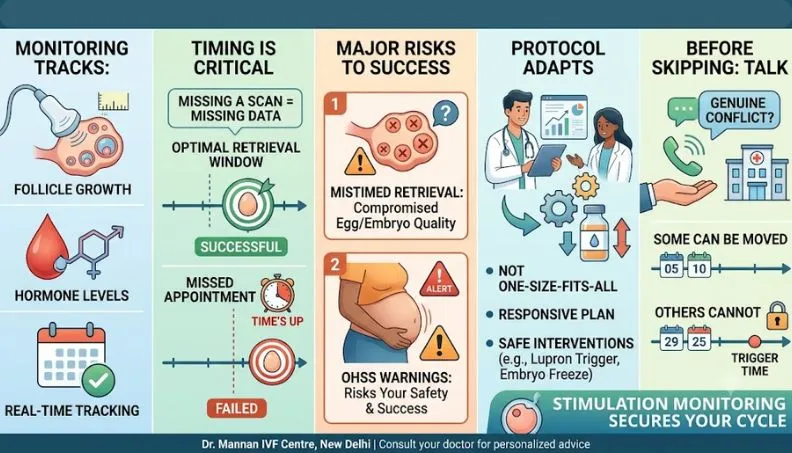
Monitoring during ovarian stimulation exists to track two fast-moving things at once, how your follicles are growing and how your hormone levels are responding and both change quickly enough that missing even one check can mean missing the right moment to act.
This isn’t a formality your clinic adds for its own convenience; it’s how your care team keeps the entire cycle on track in real time.
Ovarian stimulation is a pharmacological process, meaning your body’s response is actively being shaped by medication dosing that often needs adjustment based on how you’re responding, not a fixed plan set in advance.
Skipping a check doesn’t just mean missing information; it means your medication dose or timing decisions are being made blind, on old data, at a point in the cycle where things are changing daily.
What Exactly Happens During Ovarian Stimulation Monitoring?
Monitoring combines an ultrasound scan, which tracks the number and size of developing follicles, with a blood test, which measures hormone levels like estradiol, together these two pieces of information guide your medication dose and help determine the right day for your trigger shot.
Your fertility team is watching for follicles to reach a mature size, generally around 18–20 mm, while cross-checking that hormone levels are rising appropriately for the number of follicles present.
Most patients are triggered around day 9 of stimulation, though this varies by individual response, age, and protocol. If you want to understand what your body is actually experiencing during each phase of stimulation from the first injection to egg retrieval.
Our guide on what happens to your body during IVF week by week gives you a clear physical map of the whole process, which many patients find genuinely reassuring alongside the clinical monitoring schedule.
Your fertility team is watching for follicles to reach a mature size, generally around 18-20mm, while cross-checking that hormone levels are rising appropriately for the number of follicles present.
Guidance from reproductive medicine literature notes that most patients are triggered around day 9 of stimulation, though this varies by individual response, age, and protocol.
These two data points together are what determine your trigger shot timing, the single most time-sensitive decision in your entire stimulation phase.
Dr Mannan IVF Centre
Experience world-class fertility care with Dr. Mannan Gupta at the Best IVF Centre in Delhi
How Serious Are the Risks of Skipping a Scan or Blood Test?
Skipping monitoring near trigger time carries two real risks: missing the optimal window for egg retrieval, or missing early warning signs of ovarian hyperstimulation syndrome (OHSS) before it becomes more serious.
These aren’t hypothetical , they’re the specific, documented reasons this monitoring exists.
If your follicles are checked too late, they may become over-mature by the time your trigger shot is finally given, which can affect the number and quality of eggs retrieved.
On the other side, if hormone levels are rising faster than expected and this isn’t caught in time, your care team loses their window to adjust your dose, delay your trigger, or use OHSS-prevention strategies before symptoms escalate.
OHSS occurs in roughly 1–5% of IVF cycles and can become genuinely serious. Understanding its symptoms, risk factors, and what immediate action looks like is something every IVF patient going through stimulation should know before it becomes relevant.
Our dedicated guide on OHSS after IVF: symptoms, prevention and when to call your doctor covers all of this in detail, including the early warning signs that monitoring is specifically designed to catch before they escalate.
Is Monitoring Frequency the Same for Every Patient?
No , monitoring frequency is individualized based on your specific stimulation protocol, ovarian reserve, and personal risk factors, and isn’t the same fixed number of visits for every patient.
This is genuinely worth knowing, because it means your clinic’s schedule for you isn’t arbitrary, even if it looks different from what a friend going through IVF elsewhere was given.
Standard protocols typically involve appointments every 2-3 days over 3-4 visits during stimulation.
That said, reproductive medicine is actively re-examining these standards , recent clinical commentary has questioned whether every patient truly needs the traditional volume of scans, particularly with newer medication dosing algorithms and freeze-all embryo strategies reducing certain risks.
Some centers are researching reduced-monitoring or even non-ultrasound-based approaches for carefully selected, lower-risk patients.
This doesn’t mean monitoring is becoming optional , it means the field is working out who genuinely needs closer watching versus who can safely be monitored somewhat less intensively, and that determination should be made by your doctor, not by you deciding independently to skip a visit.
For women whose monitoring has flagged a poor ovarian response, fewer follicles than expected or hormone levels that aren’t rising appropriately.
Our Poor Ovarian Response Treatment in New Delhi page outlines the specialist evaluation and protocol adjustment options available for this specific pattern.
What Are the Treatment and Safety Measures Tied to Monitoring Results?
Monitoring results directly drive real-time safety decisions, adjusting your medication dose, changing your trigger shot type, or in some cases, pausing stimulation altogether to protect you from OHSS.
These aren’t abstract options; they’re actively used, evidence-based interventions.
If your estradiol levels are rising too quickly, your team may use a GnRH agonist (“Lupron”) trigger instead of the traditional hCG trigger, which meaningfully lowers OHSS risk. In higher-risk cases, a “coasting” strategy, briefly withholding stimulation medication while continuing to monitor, allows hormone levels to stabilize before proceeding.
In some higher-risk situations, your team may recommend freezing all embryos for a later frozen transfer, allowing your body to fully recover from stimulation before any pregnancy hormones could worsen OHSS symptoms.
None of these protective options are available to you if the monitoring data that triggers them was never collected.
What Should I Do If I Genuinely Can't Make a Scheduled Appointment?
If a scheduling conflict comes up, call your clinic before deciding to skip , some appointments have the flexibility of a day, while others, particularly those close to your expected trigger date, genuinely cannot be moved without real risk.
This single phone call is the difference between a manageable adjustment and a compromised cycle.
Early monitoring visits, further from trigger time, sometimes have a small window of flexibility since follicle growth is still gradual at that stage.
Visits scheduled in the final days before your likely trigger day are a different matter entirely , this is precisely when follicles and hormone levels are changing fastest, and this is not the window to reschedule around a work meeting or travel plan.
If cost, distance, or logistics are the real barrier, say so directly to your care team. Many clinics can problem-solve around genuine logistical constraints in ways that don’t compromise your safety, but only if they know about the conflict in advance.
How Does the Monitoring Schedule Affect Daily Life and Stress During Stimulation?
The monitoring schedule during stimulation is genuinely demanding, often multiple visits over roughly 8-10 days, and acknowledging that burden matters as much as explaining why it’s necessary. This isn’t a minor inconvenience you should feel guilty about finding difficult.
Balancing work commitments, travel, and the emotional weight of frequent clinic visits during an already stressful process is a real and valid source of stress.
Give yourself permission to find this hard, and talk openly with your employer or support system about needing this flexibility for a defined, short window of time, rather than trying to quietly absorb the disruption alone.
Many patients find that planning ahead, blocking out the expected monitoring window on their calendar before stimulation even begins, reduces some of the day-to-day scrambling that adds unnecessary stress on top of an already demanding process.
Can the Monitoring Process Be Made Less Burdensome Without Compromising Safety?
Yes, for the right patients, individualized protocols and newer, algorithm-based medication dosing can sometimes reduce the number of visits needed without compromising safety.
This is worth raising proactively with your fertility team before your cycle starts, rather than discovering it’s an option only after finding the schedule difficult.
Some newer stimulation medications use dosing algorithms based on your weight and AMH level to more precisely calibrate your starting dose, which has been shown in some protocols to reduce the need for monitoring before the later stages of stimulation. Whether this applies to you depends entirely on your specific risk profile and protocol.
For patients in New Delhi who want to understand what a monitoring-appropriate, individualised IVF stimulation plan looks like before committing to a cycle, our IVF Treatment in New Delhi page outlines how protocol design and monitoring frequency are tailored to each patient’s specific situation at Dr. Mannan IVF Centre.
Final Thoughts
Skipping a monitoring appointment during IVF stimulation isn’t a small convenience trade-off , it’s removing the exact information your care team needs to protect both your safety and your chances of success at a moment when things are changing quickly.
Timing matters as much as frequency, the risks of skipping are specific and real, and monitoring schedules are increasingly individualized rather than one-size-fits-all.
If a scheduled visit becomes genuinely difficult, the right move is a conversation with your clinic, not a decision made alone.
If you’re preparing for an IVF cycle and want a monitoring plan that fits your specific risk profile and schedule, I’d encourage you to book a consultation with me, Dr. Mannan Gupta, at Dr. Mannan IVF Centre, New Delhi. We can build a stimulation plan that keeps you safe without more visits than you actually need.
Frequently Asked Questions
Can I do my monitoring blood test and ultrasound at a different clinic if I'm traveling?
It’s possible in some cases, but results need to reach your treating doctor quickly enough to act on them, so this should only be arranged in advance with your clinic’s direct involvement, not independently.
Does more monitoring always mean a safer cycle?
Not necessarily , monitoring needs to be appropriately timed for your specific risk level, and research is actively exploring whether some lower-risk patients can be safely monitored less frequently rather than more being automatically better.
Will skipping one early monitoring visit definitely ruin my cycle?
Not necessarily, especially if it’s early in stimulation when follicle growth is more gradual, but this should always be confirmed with your doctor rather than assumed, since individual risk varies.
How much does each monitoring appointment typically cost?
Costs vary by clinic and location, and it’s worth asking your fertility center directly for a full breakdown of monitoring costs before starting your cycle so there are no surprises.
Can I request fewer monitoring visits if I'm not at high risk for OHSS?
You can raise this with your fertility team, and depending on your protocol and risk profile, some reduced-monitoring approaches may be appropriate, though this decision should be made by your doctor, not requested purely for convenience.
What are the actual physical signs that monitoring is trying to catch?
Monitoring is primarily tracking follicle size and hormone levels through scans and blood tests rather than visible physical symptoms, which is exactly why relying on how you feel alone isn’t a substitute for the actual tests.
Is it normal to feel anxious before every monitoring appointment?
Yes, it’s a common and valid response given how much these results can influence your treatment decisions, and it’s worth mentioning this anxiety to your care team if it’s affecting you significantly.
Can monitoring appointments be done over video call instead of in person?
No, ultrasound and blood testing require in-person visits since they involve physical examination and sample collection that can’t be done remotely.
If I've had OHSS before, will I need more monitoring this time?
Likely yes, a prior history of OHSS is a recognized risk factor, and your care team will likely increase monitoring frequency and consider preventive strategies for your current cycle.
Does skipping monitoring affect embryo quality even if eggs are retrieved successfully?
It’s possible? mistimed retrieval due to poor monitoring can affect egg maturity, which can influence embryo quality, even if the retrieval procedure itself technically goes ahead as planned.
