

Dr Mannan Gupta
Medically Reviewed by Dr. Mannan Gupta On Sept 28, 2026
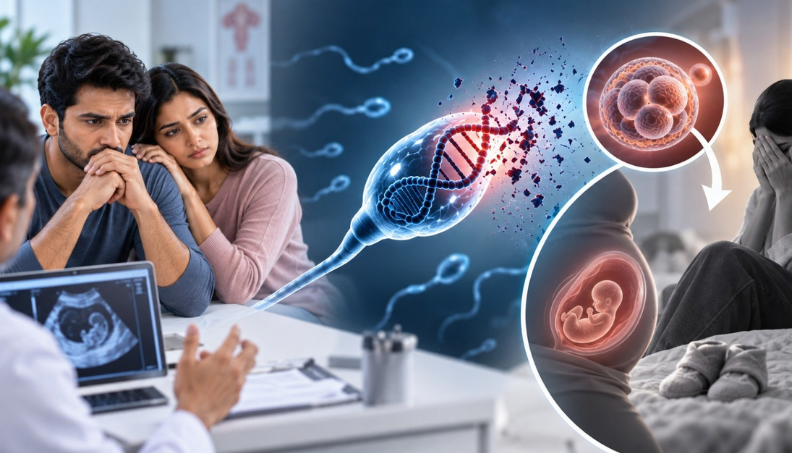
Repeated miscarriage can leave you wondering what went wrong, especially when routine fertility tests appear normal.
As Dr. Mannan Gupta, IVF Specialist at Dr. Mannan IVF Centre in Delhi, I often explain to couples that sperm DNA fragmentation and recurrent miscarriage can be connected in some cases.
However, sperm DNA damage is only one possible factor, and it should not be assumed to be the sole cause of recurrent miscarriage.
Key Takeaways
- Sperm DNA damage may be associated with recurrent pregnancy loss in some couples.
- A normal semen analysis does not assess the DNA integrity inside sperm.
- SDF testing may be considered when recurrent miscarriage remains unexplained, particularly when infertility is also present.
- Finding high DNA fragmentation does not automatically tell us why a miscarriage occurred or guarantee that treatment will prevent another one.
- A complete evaluation of both partners remains important before deciding on treatment.
Can sperm DNA damage contribute to recurrent miscarriage?
Yes, higher sperm DNA damage has been associated with a greater risk of pregnancy loss, but it isn’t the only possible explanation. Research has found higher sperm DNA fragmentation among some men whose partners experience recurrent pregnancy loss.
I want to make one point clear because patients can easily become worried after reading about this online. An abnormal sperm DNA test doesn’t prove that sperm DNA damage caused a particular miscarriage.
Miscarriage can have several causes. Chromosomal abnormalities in the embryo are among the most common reasons for early pregnancy loss, and factors involving the uterus, hormones, autoimmune conditions, genetics and other health issues can also contribute.
That is why I look at the complete fertility history rather than treating one test result in isolation.
Why can a normal semen analysis miss sperm DNA damage?
A routine semen analysis mainly looks at sperm count, movement and appearance, while it doesn’t directly measure the integrity of sperm DNA.
You may therefore have an apparently acceptable semen analysis and still have an issue with the genetic material carried by some sperm.
Sperm DNA can become damaged through processes such as oxidative stress. Factors that have been associated with higher DNA damage include smoking, certain environmental exposures, fever or illness, varicocele, increasing paternal age and other health or lifestyle factors.
This doesn’t mean that any one of these factors will cause miscarriage. They are possible contributors that need to be considered in the context of the individual couple.

Dr Mannan IVF Centre
Experience world-class fertility care with Dr. Mannan Gupta at the Best IVF Centre in Delhi
What does sperm DNA fragmentation actually mean?
Sperm DNA fragmentation means that some of the genetic material inside sperm has breaks or damage that can affect reproductive potential.
One commonly discussed measure is the DNA fragmentation index (DFI). Different laboratory methods can be used to assess sperm DNA integrity, including SCSA, TUNEL and sperm chromatin dispersion methods.
One important limitation is that there isn’t one universally applicable cutoff that can be interpreted in exactly the same way across every test and laboratory. Test methodology and clinical circumstances matter.
So, if your report shows an elevated value, I wouldn’t recommend making treatment decisions based on the number alone.
When should sperm DNA fragmentation be tested?
Testing may be considered when recurrent miscarriage remains unexplained, particularly when the couple also has infertility or other male-factor concerns.
The updated 2026 ASRM guidance specifically lists sperm DNA fragmentation testing as a consideration for recurrent unexplained miscarriage or recurrent miscarriage accompanied by infertility.
I would not suggest that every man needs this test after one miscarriage. The reason for testing should be based on the couple’s history and the findings from the broader evaluation.
For a couple seeking male fertility evaluation, I may consider factors such as:
- Previous pregnancy losses
- Difficulty conceiving
- Previous IVF or ICSI outcomes
- Varicocele or other male reproductive conditions
- Abnormal or borderline semen parameters
- Relevant lifestyle or environmental exposures
The test should complement, not replace, a proper fertility assessment.
Can high sperm DNA fragmentation cause miscarriage?
It may contribute to miscarriage risk, but it cannot be assumed to be the cause in every couple.
A 2012 meta-analysis of 16 cohort studies involving 2,969 couples found a higher miscarriage risk in couples where sperm DNA damage was high, although the researchers also noted differences between studies and testing methods.
This is the study hosted on PubMed by the NIH’s National Library of Medicine, published in Human Reproduction.
More recent evidence continues to support an association, but it also highlights uncertainty around how well SDF alone can predict individual reproductive outcomes.
This distinction matters. Association does not mean that every miscarriage is caused by sperm DNA damage.
If you have experienced repeated pregnancy loss, the goal should be to identify as many relevant factors as possible rather than focusing on one test.
What can increase sperm DNA damage?
Several factors may contribute to sperm DNA damage, and some are potentially modifiable.
These can include:
- Smoking and tobacco exposure
- Oxidative stress
- Varicocele
- Febrile illness or high fever
- Certain environmental or occupational exposures
- Increasing paternal age
- Some health and lifestyle factors
The updated ASRM guidance also notes environmental toxins, pollution, drugs, smoking, varicocele, and paternal age among factors associated with sperm DNA damage.
I usually advise patients to focus on factors that can realistically be improved rather than trying to achieve a “perfect” sperm report.
Can sperm DNA fragmentation be reduced?
Sometimes the factors contributing to sperm DNA damage can be addressed, but there is no single treatment that works for every man.
The first step is to look for an underlying issue. For example, a reproductive urology assessment may be appropriate when varicocele or another male reproductive problem is suspected.
Lifestyle optimization can also form part of the plan. Depending on the individual, this may include stopping smoking, reducing harmful exposures, maintaining a healthy weight and addressing relevant medical conditions.
You can read more about our approach to this on our DNA Fragmentation Treatment page.
However, you shouldn’t assume that antioxidants or supplements will automatically correct DNA fragmentation or prevent miscarriage.
Current ASRM guidance notes that although several interventions can reduce SDF, well-controlled evidence showing that treating elevated SDF reduces recurrent pregnancy loss is still limited.
Can sperm DNA damage affect IVF success?
It may be associated with some poorer assisted-reproduction outcomes, but the effect varies according to the treatment and clinical situation.
Research has linked elevated SDF with adverse outcomes in assisted reproduction, although the strength of the association isn’t identical across IVF, ICSI, and IUI.
A recent umbrella meta-analysis found associations between elevated SDF and several adverse ART outcomes, while also rating the certainty of evidence as low because of heterogeneity and methodological limitations.
We’ve written about a specific case where this connection changed a treatment plan in If We Missed This… IVF Would Have Failed.
This is why I don’t use an SDF result alone to decide whether a couple needs IVF, ICSI or another treatment.
The female partner’s age, ovarian reserve, embryo factors, previous treatment history, semen parameters and the cause of infertility all matter.
What happens if the SDF result is high?
A high result usually calls for further assessment rather than immediate treatment.
I would first look at the couple’s complete history and consider whether there is an identifiable male factor. Depending on the findings, this may involve reproductive urology evaluation, lifestyle optimisation or discussion of assisted reproductive options.
It is also important to evaluate the female partner and the pregnancy losses appropriately.
Current ASRM guidance recommends a structured recurrent pregnancy loss workup that can include evaluation of miscarriage chromosomes, uterine anatomy and selected testing based on the clinical situation.
The purpose is not to blame either partner. It is to understand where potentially useful information may be found.
Should recurrent miscarriage always be treated as a sperm problem?
No. Recurrent miscarriage is a multifactorial condition, and sperm DNA damage is only one possible contributor.
Current ASRM guidance defines recurrent pregnancy loss as two or more spontaneous pregnancy losses and recommends a structured evaluation rather than relying on a single suspected cause.
If you have experienced repeated losses, your evaluation may consider:
- Chromosomal factors
- Uterine or anatomical factors
- Antiphospholipid syndrome when clinically indicated
- Thyroid or metabolic factors when indicated
- Male reproductive factors
- Sperm DNA fragmentation in appropriate cases
We’ve covered this fuller recurrent pregnancy loss investigation in Repeated Miscarriage: The Hidden Cause Most Doctors Miss (And What to Do Next).
The exact tests should be selected according to your history.
When should you speak with a fertility specialist?
You should consider a fertility consultation after recurrent pregnancy loss, especially when no clear explanation has been found or conception has also been difficult.
As an IVF specialist, I often tell couples that the evaluation should involve both partners. A male fertility factor can sometimes be overlooked when the focus is entirely on the woman after a miscarriage.
If you’re seeking recurrent miscarriage treatment in Delhi, the important first step is not simply ordering more tests.
It is understanding what has already been investigated, what remains unexplained and which additional evaluation could genuinely change management.
Repeated loss with no clear answer is precisely when the male side of the equation gets missed. Get both partners looked at together. Consult Dr. Mannan Gupta at Dr. Mannan IVF Centre, Delhi. Book an Appointment or Call Now.
When should you consider IVF or ICSI?
IVF or ICSI may be considered when infertility or specific reproductive factors make assisted conception appropriate, but an elevated SDF result alone doesn’t automatically mean that IVF or ICSI is required.
The treatment decision should take into account the complete fertility picture, previous treatment outcomes and the needs of both partners.
I also explain to couples that ICSI can help with fertilisation in selected male-factor situations, but it doesn’t erase every potential effect of sperm DNA damage.
Frequently Asked Questions
1. Can high sperm DNA fragmentation be the only reason for repeated miscarriage?
No, it should not be assumed to be the only reason. Even when SDF is elevated, other causes of recurrent pregnancy loss may still need to be investigated. A high SDF result is a piece of the clinical picture, not a complete diagnosis.
2. Does normal semen analysis rule out sperm DNA damage?
No, a normal semen analysis does not directly rule out sperm DNA damage. Semen analysis assesses parameters such as count, movement and morphology, whereas SDF testing evaluates DNA integrity.
3. Can sperm DNA fragmentation be reduced?
It can sometimes improve when an underlying contributing factor is identified and addressed, but there is no guaranteed treatment. Lifestyle changes and treatment of conditions such as varicocele may reduce SDF in some men, although evidence that lowering SDF prevents recurrent miscarriage remains limited.
4. Is sperm DNA fragmentation the only cause of recurrent miscarriage?
No, recurrent miscarriage has many possible causes. Chromosomal abnormalities, uterine factors, antiphospholipid syndrome and selected endocrine or other medical factors may also need evaluation.
5. Does sperm DNA fragmentation affect IVF?
It may be associated with some IVF and ICSI outcomes, but the effect isn’t the same for every couple. Your treatment should be based on the complete fertility assessment rather than an SDF result alone.
6. When should sperm DNA fragmentation be tested?
It may be considered when recurrent miscarriage is unexplained, particularly when infertility is also present. The 2026 ASRM guidance specifically identifies these situations as circumstances where SDF testing may be considered.
7. Is a high DFI always a sign of infertility?
No, a high DFI does not automatically mean that natural or assisted conception is impossible. The result needs to be interpreted alongside semen parameters, reproductive history and the couple’s overall fertility assessment.
8. Can smoking affect sperm DNA?
Yes, smoking has been associated with sperm DNA damage. If you smoke, stopping is an important step for overall reproductive health, although it doesn’t guarantee that an SDF result will become normal.
9. Can varicocele affect sperm DNA?
Yes, varicocele has been associated with sperm DNA damage in some men. If a varicocele is suspected, a reproductive urology assessment can help determine whether it requires attention.
10. Should I take antioxidants for high sperm DNA fragmentation?
Don’t start supplements solely because an SDF result is high without discussing them with your doctor. Evidence for treatments intended to reduce SDF and improve pregnancy outcomes remains mixed, so the underlying cause and complete fertility picture should guide management.
11. Can sperm DNA damage improve naturally?
Sperm DNA integrity may improve when contributing factors are addressed, but improvement isn’t guaranteed. A fertility specialist can help identify modifiable factors and decide whether repeat testing or another treatment approach is appropriate.
12. Can recurrent miscarriage happen even when both partners' tests are normal?
Yes, some cases remain unexplained even after an appropriate evaluation. This can be emotionally difficult, but an unexplained result doesn’t mean that you caused the miscarriage or that a future pregnancy cannot succeed. Current ASRM guidance recommends supportive, evidence-based care rather than unnecessary testing or unproven treatments.
Final Thoughts
Sperm health can be an important part of the recurrent miscarriage evaluation, but it shouldn’t be viewed in isolation.
If you’ve experienced repeated pregnancy loss, a careful assessment of both partners can help identify factors that may influence future pregnancy planning.
The right approach depends on your reproductive history, test results, age, medical factors and previous pregnancy or fertility treatment outcomes.
Medical Disclaimer:
This article is intended for general educational purposes only. It does not replace an individual medical consultation, physical examination, diagnosis or personalised treatment plan. If you have experienced recurrent pregnancy loss or difficulty conceiving, speak with a qualified fertility specialist for an evaluation suited to your circumstances.
