

Dr Mannan Gupta
Medically Reviewed by Dr. Mannan Gupta On Oct 14, 2026
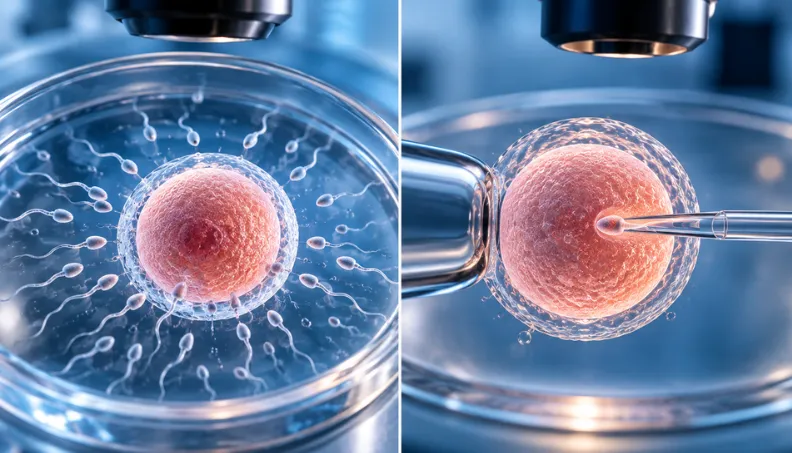
This image is AI-generated and intended for illustrative purposes only.
“I’m Dr. Mannan Gupta, IVF Specialist at Dr. Mannan IVF Centre.”I often explain to couples that ICSI is not a separate fertility treatment from IVF. It is a fertilisation technique used as part of an IVF cycle. The main difference is how the egg and sperm are brought together for fertilisation.
For some couples, conventional IVF is appropriate. For others, particularly when there are significant sperm-related problems or previous poor fertilisation, ICSI may be recommended.
Key Takeaways
- IVF allows sperm to fertilise the egg in the laboratory, while ICSI involves injecting one selected sperm directly into the egg.
- ICSI does not automatically have a higher pregnancy or live birth success rate than IVF.
- ICSI may be considered when there are significant sperm abnormalities, surgically retrieved sperm, or previous IVF with failed or poor fertilisation.
- A normal semen report does not automatically mean ICSI is necessary.
- The decision between IVF and ICSI should be based on your fertility history, sperm and egg factors, and previous treatment response.
What is the difference between IVF and ICSI?
The main difference is how fertilisation happens in the laboratory. In conventional IVF, eggs and sperm are placed together so that sperm can naturally enter an egg. With ICSI, an embryologist injects a single sperm directly into the egg.
The overall IVF process can include ovarian stimulation, egg retrieval, fertilisation, embryo development and embryo transfer. ICSI changes only the fertilisation step.
With conventional IVF:
- Eggs are collected after ovarian stimulation.
- Prepared sperm are placed with the eggs in the laboratory.
- A sperm fertilises the egg naturally.
- Fertilised eggs are monitored as embryos develop.
With ICSI:
- Eggs are collected in the same way.
- Sperm are prepared in the laboratory.
- An embryologist selects an individual sperm.
- The sperm is injected directly into the egg.
- The fertilised egg is monitored for embryo development.
So, IVF and ICSI are not two completely different fertility treatments. ICSI is a method of fertilisation that can be used during IVF.
Feature | Conventional IVF | ICSI |
Fertilisation method | Eggs and sperm are placed together in the laboratory. | A single sperm is injected directly into an egg. |
Sperm involvement | Sperm must enter the egg on its own. | An embryologist selects and injects the sperm. |
When it may be recommended | Often used when sperm parameters are suitable and no specific fertilisation issue is identified. | Often considered for severe male-factor infertility or previous fertilisation failure. |
Embryologist’s role | Monitors fertilisation after eggs and sperm are combined. | Selects an individual sperm and injects it into the egg. |
Egg retrieval | Required as part of the IVF cycle. | Required as part of the IVF cycle. |
Embryo development | Fertilised eggs are monitored as embryos develop. | Fertilised eggs are monitored as embryos develop. |
Pregnancy chances | Depend on factors such as age, egg and sperm quality, and embryo development. | Depend on similar factors; ICSI does not guarantee a higher pregnancy rate. |
Key difference: ICSI is a fertilisation technique used during IVF. The choice between conventional IVF and ICSI depends on the couple’s fertility assessment and medical history.
Does ICSI have a higher success rate than IVF?
Not necessarily. ICSI can improve the chance of fertilisation in selected cases, but it does not automatically result in a higher pregnancy or live birth rate than conventional IVF.
This distinction is important because fertilisation and pregnancy are different outcomes. Fertilisation means that sperm has successfully fertilised an egg, while pregnancy and live birth depend on several additional factors.
A 2024 randomised controlled trial published in The Lancet compared ICSI with conventional IVF in couples with non-severe male-factor infertility. The study reported the following live birth rates after the first embryo transfer:
Success measure | ICSI | Conventional IVF |
Live birth rate after the first embryo transfer | 33.8% | 36.6% |
The difference was not statistically significant, meaning the study did not demonstrate a clear live birth advantage for ICSI over conventional IVF in this patient group.
You can read the 2024 randomised controlled trial comparing ICSI with conventional IVF for the study methods, results and statistical analysis.
ICSI may still be recommended when sperm have difficulty fertilising an egg naturally, when semen parameters are abnormal, or after previous failed or very poor fertilisation.
According to the updated NICE guidelines on when ICSI is recommended, ICSI should be considered in cases of abnormal semen parameters or previous failed or very low fertilisation. The guidelines advise against using ICSI for non-male-factor fertility problems when semen parameters are normal.
The Human Fertilisation and Embryology Authority’s guide to ICSI treatment also provides information about the procedure, its use and treatment outcomes.
This is why I do not recommend choosing ICSI simply because it sounds like a more advanced form of IVF. The appropriate method depends on the couple’s fertility assessment, sperm quality, medical history and previous treatment outcomes.
Evidence note: These percentages are from one specific study population and represent live birth after the first embryo transfer. They should not be interpreted as universal success rates for every patient or fertility clinic.

Dr Mannan IVF Centre
Experience world-class fertility care with Dr. Mannan Gupta at the Best IVF Centre in Delhi
When might ICSI be recommended?
ICSI may be recommended when sperm-related factors make conventional fertilisation less likely or when previous IVF resulted in failed or very poor fertilisation.
Depending on the individual case, I may discuss ICSI when there is:
- Significantly reduced sperm count
If the number of sperm available is very low, there may be fewer sperm capable of reaching and fertilising an egg during conventional IVF.
ICSI allows the laboratory team to select an available sperm and inject it directly into the egg.
- Poor sperm movement
When sperm motility is significantly reduced, sperm may have difficulty reaching or entering the egg.
In such cases, ICSI can bypass some of the physical steps required for conventional fertilisation.
- Significant sperm abnormalities
Sperm morphology, motility and concentration are considered together rather than relying on one semen-report value.
If the semen parameters are substantially abnormal, your fertility specialist may discuss whether ICSI is appropriate.
- Sperm retrieved through a procedure
Some men have very few or no sperm available in the ejaculate but may have sperm that can be retrieved surgically.
We’ve covered the two different reasons this happens, and what it means for retrieval odds, in Obstructive vs Non-Obstructive Azoospermia: What Is the Difference?
Procedures such as TESA or Micro-TESE may be considered in selected cases. When usable sperm are retrieved, ICSI is often used because the number of available sperm may be limited.
- Previous IVF with failed or poor fertilisation
A previous IVF cycle with failed or very poor fertilisation is an important reason to consider ICSI in a future cycle.
This does not mean that every unsuccessful IVF cycle requires ICSI. I would first look at what happened during the previous cycle, including the number and maturity of eggs, sperm parameters, fertilisation results and embryo development.
Do you need ICSI if your sperm report is normal?
No. A normal semen analysis does not automatically mean that you need ICSI, and it does not automatically mean that conventional IVF will be used either.
A semen report provides important information, but it is only one part of the fertility assessment.
I would consider factors such as:
- Sperm concentration
- Sperm movement
- Sperm morphology
- Previous fertilisation results
- Egg number and maturity
- Female age and ovarian reserve
- Previous IVF or ICSI history
- Any sperm retrieval procedure
- The couple’s overall fertility diagnosis
If there is no male-factor indication and no previous fertilisation problem, routine ICSI may not provide an additional benefit over conventional IVF.
Can ICSI help with unexplained infertility?
ICSI is not automatically required for unexplained infertility.
When standard fertility investigations do not identify a clear cause, it can be tempting to choose ICSI because it is a more direct fertilisation technique.
However, unexplained infertility by itself does not establish that sperm are unable to fertilise an egg.
I would therefore look at the complete fertility history rather than recommending ICSI simply because the diagnosis is unexplained infertility.
If there are additional concerns about sperm quality or a previous cycle showed poor fertilisation, the decision may be different.
Does ICSI improve embryo quality?
ICSI does not inherently create better-quality embryos.
The purpose of ICSI is to assist fertilisation by injecting sperm directly into an egg. Embryo development happens after fertilisation and depends on several biological factors.
These can include:
- Egg quality
- Sperm quality
- Embryonic development
- Maternal age
- Chromosomal factors
- Laboratory conditions
- Individual reproductive factors
So, I explain to patients that ICSI should not be viewed as a method for making embryos stronger or guaranteeing a better-quality embryo.
What factors affect IVF or ICSI success?
Age, egg and sperm factors, embryo development and the individual fertility diagnosis can all influence the outcome of IVF or ICSI.
The fertilisation method is only one part of the treatment.
For example, even when ICSI results in successful fertilisation, pregnancy still depends on subsequent embryo development and implantation.
Other factors I consider include ovarian reserve, number and maturity of eggs retrieved, sperm quality, embryo development, uterine factors and previous fertility treatment.
This is why I prefer to discuss the likely benefit of ICSI in the context of an individual couple rather than quoting one universal success rate.
What tests help decide whether ICSI is needed?
A semen analysis is one of the main tests used to assess whether male-factor infertility may influence the choice of fertilisation method.
Depending on the history, evaluation may include:
- Semen analysis
- Repeat semen testing when appropriate
- Assessment of sperm concentration, motility and morphology
- Male reproductive evaluation when indicated
- Review of previous IVF fertilisation results
- Assessment of ovarian reserve and egg-related factors
- Review of previous fertility treatments
If a semen analysis is abnormal, the result may need to be interpreted in context rather than used alone to decide between IVF and ICSI.
NICE recommends appropriate assessment of semen parameters as part of fertility investigation and advises further assessment when abnormalities are identified.
Is ICSI used with sperm retrieved through TESA or Micro-TESE?
Yes, ICSI may be used when sperm are obtained through procedures such as TESA or Micro-TESE, because only a limited number of sperm may be available for fertilisation.
You can read more about how these retrieval procedures work on our MESA, TESA and Micro-TESE Procedures page.
This situation is different from conventional IVF, where a sufficient number of sperm are placed around the eggs in the laboratory.
When sperm are surgically retrieved, the laboratory team may need to work with a small number of sperm. ICSI allows an individual sperm to be injected directly into an egg.
The appropriate sperm-retrieval procedure depends on the underlying condition and should be decided after a proper male fertility assessment.
Is ICSI always better than conventional IVF?
No. ICSI is not automatically better than conventional IVF. It is more appropriate for certain clinical situations.
I often tell patients that the goal is not to choose the most technically advanced option. The goal is to choose the most appropriate fertilisation method for their particular fertility problem.
If sperm-related factors are present, or if previous IVF resulted in poor fertilisation, ICSI may have a clear role.
If there is no relevant indication, routine ICSI may not add a meaningful benefit.
What should you ask your fertility specialist before choosing IVF or ICSI?
Ask why ICSI is being recommended in your specific case and what problem it is intended to address.
Useful questions include:
- What do my semen parameters show?
- Is there a male-factor indication for ICSI?
- Have my previous IVF fertilisation results changed the recommendation?
- Would conventional IVF be reasonable in my case?
- What are the advantages and limitations of ICSI for me?
- Is ICSI expected to improve fertilisation, or is there another reason for recommending it?
- How do my age, egg quality and ovarian reserve affect the treatment plan?
- If sperm retrieval is required, which procedure is appropriate?
These questions can help you understand the reasoning behind the treatment rather than choosing IVF or ICSI based only on the perception that one is more advanced.
Frequently Asked Questions
1. Is ICSI more successful than IVF?
Not necessarily. ICSI may improve fertilisation in selected cases, particularly when sperm-related problems make conventional fertilisation difficult, but it does not automatically produce higher pregnancy or live birth rates.
2. Is ICSI painful?
The ICSI procedure itself is performed in the laboratory and is not felt by the patient. Egg retrieval is the procedure associated with the physical discomfort or anaesthesia, depending on the clinic’s protocol.
3. Can ICSI be used for male infertility?
Yes. ICSI is commonly considered when significant male-factor infertility affects the ability of sperm to fertilise an egg. The exact recommendation depends on the severity and type of sperm abnormality.
4. Is ICSI needed for low sperm count?
It may be recommended when the sperm count is significantly reduced, particularly when the available sperm may not be sufficient for conventional IVF. The decision depends on the complete semen assessment and fertility history.
5. Can ICSI be used after failed IVF?
Yes. If a previous IVF cycle resulted in failed or very poor fertilisation, ICSI may be considered in a subsequent cycle.
6. Does ICSI guarantee fertilisation?
No. ICSI can help a sperm enter an egg, but it cannot guarantee that every injected egg will fertilise or that fertilisation will lead to pregnancy.
7. Does ICSI guarantee pregnancy?
No. ICSI is a fertilisation technique and cannot guarantee implantation, pregnancy or live birth.
8. Which is better, IVF or ICSI?
Neither is universally better. The appropriate option depends on sperm factors, egg factors, previous treatment results and the overall fertility diagnosis.
Final Thoughts
When patients ask me whether they should choose IVF or ICSI, I usually explain that the right question is not which treatment sounds more advanced, but which fertilisation method is appropriate for their individual situation.
ICSI can be valuable when sperm-related factors make conventional fertilisation difficult or when previous IVF has resulted in failed or very poor fertilisation. At the same time, routine ICSI is not necessary for every couple.
A personalised assessment of sperm quality, egg factors, previous treatment history and the reason for IVF helps determine whether conventional IVF or ICSI is more suitable.
If you are considering IVF or ICSI in Delhi, discuss your fertility history and treatment options with an IVF specialist before making a decision.
Medical Disclaimer:
This article provides general educational information and should not replace an individual consultation, examination or personalised fertility treatment plan.
