
Obstructive vs. Non-Obstructive Azoospermia: What Is the Difference?

Dr Mannan Gupta
Medically Reviewed by Dr. Mannan Gupta On Sept 10, 2026
Hearing the word “azoospermia” for the first time is frightening; it sounds like a dead end. It isn’t, but which type you have changes almost everything about what comes next.
I’m Dr. Mannan Gupta, IVF specialist at Dr. Mannan IVF Centre, Delhi, and one of the most important conversations I have with couples facing this diagnosis is about azoospermia treatment options, because the path forward depends entirely on whether the cause is a blockage or a production problem.
Key Takeaways
- Azoospermia means no sperm in the ejaculate, but it has two very different underlying causes
- Obstructive azoospermia is a blockage problem, sperm is being made but can’t get out
- Non-obstructive azoospermia is a production problem, the testes aren’t making enough sperm
- The two types need completely different diagnostic tests and treatment approaches
- Biological fatherhood is possible for many men with either type, though the odds and methods differ
What Does an Azoospermia Diagnosis Actually Mean?
Azoospermia simply means no sperm was found in your semen sample, on at least two separate tests.
- This is diagnosed after a semen analysis, checked more than once since sperm counts can vary naturally between samples
- It’s found in a meaningful share of male infertility cases, though it’s far from the most common cause of infertility overall
- The diagnosis itself doesn’t tell you why there’s no sperm, that’s the next, more important question
- The type matters more than the diagnosis itself, this single distinction shapes everything from testing to treatment to realistic expectations
What's the Real Difference Between Obstructive and Non-Obstructive Azoospermia?
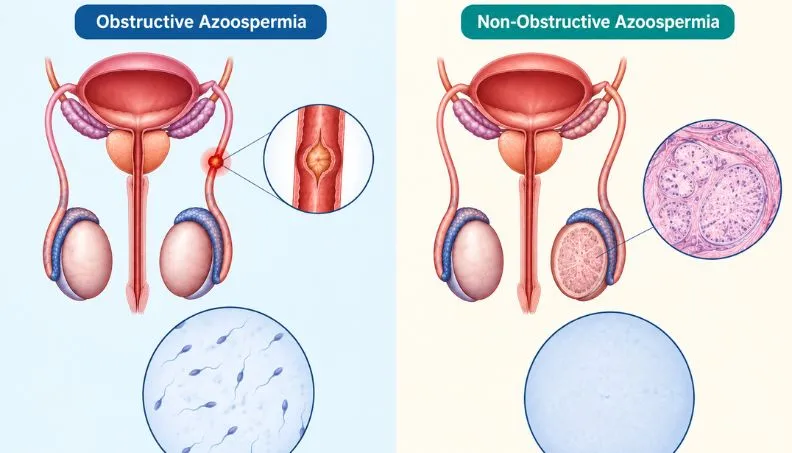
In obstructive azoospermia, sperm is being produced normally but something is physically blocking it from reaching the semen.
In non-obstructive azoospermia, the testes themselves aren’t producing enough sperm.
This is exactly the question behind what is the difference between obstructive and non-obstructive azoospermia, and it’s the first thing worth understanding clearly.
Obstructive Azoospermia (OA) | Non-Obstructive Azoospermia (NOA) | |
What’s happening | Sperm production is normal, a blockage prevents release | Sperm production itself is impaired or absent |
Testicular size | Usually normal | Often smaller than average |
FSH hormone level | Usually normal | Often elevated |
Common causes | Vasectomy, infection, congenital absence of the vas deferens | Genetic factors, undescended testes history, hormonal disorders |
Sperm retrieval outlook | Sperm is almost always found, since production is normal | Sperm may or may not be found, this varies by underlying cause |
This table reflects general patterns, not a certainty for every individual, your own hormone levels, exam findings, and history determine where you actually fall.

Dr Mannan IVF Centre
Experience world-class fertility care with Dr. Mannan Gupta at the Best IVF Centre in Delhi
What Causes Each Type?
The causes are genuinely different, which is exactly why lumping the two together does patients a disservice.
- Obstructive azoospermia causes commonly include a prior vasectomy, a past infection that scarred the reproductive tract, or a congenital absence of the vas deferens blockage, the tube that carries sperm out of the body
- Non-obstructive azoospermia more often stems from genetic conditions, a history of undescended testes (cryptorchidism) in childhood, hormonal disorders like hypogonadotropic hypogonadism, or in some cases, prior chemotherapy
- Some men have retrograde ejaculation, where sperm travels backward into the bladder instead of out, this can look like azoospermia on a semen test but is a completely different, often more manageable, issue
- This is why a proper workup matters, treating the wrong underlying cause wastes time on an approach that was never going to work
How Do Doctors Actually Diagnose Which Type You Have?
A combination of physical exam, hormone testing, and sometimes a small tissue sample determines which type you have.
- A physical exam checking testicular size and feeling for the vas deferens can already suggest which type is more likely
- An FSH hormone test helps distinguish the two, elevated FSH with small testes points toward non-obstructive azoospermia.
- As the NIH’s National Library of Medicine explains, this test is used specifically to evaluate sperm production and testicular function in men being investigated for infertility.
- A post-ejaculate urine test rules out retrograde ejaculation before assuming a more invasive diagnosis
- In some cases, a testicular biopsy provides the most definitive answer about whether sperm production is happening at all. You can read more about what this procedure involves on our Testicular Biopsy page.
Working out which type you have isn’t something a semen report alone can tell you. Call Now or Book an Appointment with Dr. Mannan Gupta at Dr. Mannan IVF Centre, Delhi, for the physical exam and hormone workup that actually settles it.
This is how we ultimately settle how is azoospermia diagnosed for cases that aren’t clear-cut on exam alone
What Treatment Options Exist for Each Type?
Treatment genuinely diverges here, and understanding this early helps set realistic expectations.
- For obstructive azoospermia, options include surgical reconstruction (like vasectomy reversal) to restore natural flow, or direct sperm retrieval methods like TESA (testicular sperm aspiration) for use with IVF/ICSI, this answers can obstructive azoospermia be treated without surgery for men who’d rather avoid reconstruction
- For non-obstructive azoospermia treatment, options may start with addressing an underlying hormonal cause, when one is found, followed by microsurgical testicular sperm extraction if needed.
- You can read more about how PESA, MESA, TESA and micro-TESE work on our MESA, TESA and Micro-TESE Procedures page.
- Sperm retrieval in obstructive cases is successful in the large majority of attempts, since sperm production itself isn’t the problem
- In non-obstructive cases, retrieval is genuinely less predictable, some men will have sperm found, others won’t, and this is a real possibility couples deserve to be prepared for, not blindsided by, which is part of why the honest answer to is non-obstructive azoospermia curable is “it depends on the cause,” not a simple yes
Can Men With Azoospermia Still Have Biological Children?
For many men, yes, though the path and probability depend heavily on the type and underlying cause.
- Men with obstructive azoospermia have a strong chance of biological fatherhood through sperm retrieval combined with IVF/ICSI
- Men with non-obstructive azoospermia may still achieve biological fatherhood, particularly with newer microsurgical extraction techniques, though outcomes vary based on the specific cause
- When sperm truly cannot be retrieved, donor sperm remains an option for couples who wish to continue with IVF or IUI
- I always discuss all realistic pathways, including donor options, honestly and early, rather than letting a couple discover them only after other attempts haven’t worked
If you or your partner has received an azoospermia diagnosis and you’re unsure what it means for your specific situation, an evaluation can give you real clarity rather than uncertainty. I offer azoospermia treatment in Delhi and see patients for male infertility and IVF consultations at Dr. Mannan IVF Centre.
What Should You Expect Emotionally and Practically From This Process?
This diagnosis often brings grief, confusion, and pressure, and that’s a completely normal response, not something to push past quickly.
- Give yourself and your partner time to process the diagnosis before jumping straight into decisions
- Ask your doctor to explain your specific type and cause clearly, understanding the “why” often reduces anxiety around the unknown
- Involve your partner in every step of decision-making, this is a shared journey, not just a medical process for one person
- Counseling support, whether through your fertility clinic or independently, can help couples navigate the emotional weight of this diagnosis alongside the medical one
Final Thoughts
Obstructive and non-obstructive azoospermia share a diagnosis on paper, no sperm in the ejaculate, but they are fundamentally different conditions with different causes, different tests, and different treatment paths.
Knowing which type you’re dealing with is the single most important step toward understanding your real options, and for many men, biological fatherhood remains genuinely possible.
The uncertainty of not knowing is often harder than the diagnosis itself, a proper evaluation replaces that uncertainty with a clear, honest picture of where you actually stand.
Frequently Asked Questions
Can a man with azoospermia still have biological children?
Often yes, particularly with obstructive azoospermia, through sperm retrieval combined with IVF or ICSI, though outcomes for non-obstructive cases vary by underlying cause.
Does azoospermia mean zero sperm forever?
Not necessarily, in obstructive cases, sperm is being produced and can often be retrieved directly, in non-obstructive cases, this depends on whether any sperm production is occurring at all.
Is a testicular biopsy painful?
It’s typically done under local or light anesthesia and causes only mild, short-lived discomfort for most patients.
Does a vasectomy always cause permanent azoospermia?
Not always, vasectomy reversal can restore fertility in many cases, depending on how much time has passed and individual anatomical factors.
Can azoospermia be genetic?
Yes, particularly in non-obstructive cases, certain genetic conditions can affect sperm production, this is why genetic counseling is sometimes recommended.How Do Doctors Actually Diagnose Which Type You Have?
What if sperm retrieval doesn't find any sperm?
This is a real possibility in non-obstructive cases, when it happens, donor sperm remains an option for couples wishing to continue with fertility treatment.
How long does the whole diagnostic process usually take?
It varies, but a focused workup, including hormone tests and physical exam, can often clarify your type within a few weeks, further steps depend on those findings.
Medical Disclaimer
This article is for general educational purposes and does not replace an individual consultation, examination or diagnostic testing. Azoospermia can have different causes, and treatment options and outcomes vary between individuals. Please consult a qualified fertility specialist for advice based on your medical history, examination and test results.
