
Egg Retrieval Procedure: Is It Painful, and How Long Is Recovery?

Dr Mannan Gupta
Medically Reviewed by Dr. Mannan Gupta On Nov. 19, 2026
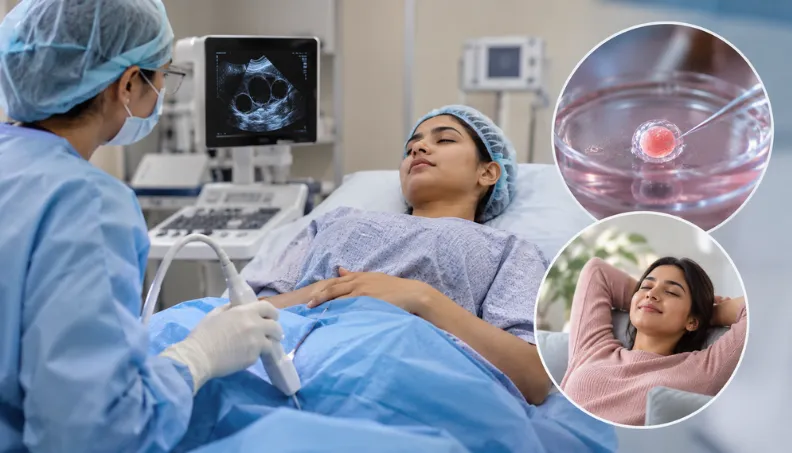
This image is AI-generated and intended for illustrative purposes only.
If you are preparing for IVF, you may be wondering whether the egg retrieval procedure is painful and how much time you will need to recover. It is natural to feel anxious before this stage, especially if you have never undergone a fertility procedure.
The good news is that egg retrieval is usually performed under sedation or anaesthesia to minimise discomfort during the procedure.
After it, some women experience mild abdominal cramps, bloating, pelvic heaviness or light spotting. Many can return to their usual routine within a day or two, although recovery varies depending on the ovarian response and individual health.
As an IVF specialist, I believe it helps to understand what happens before, during and after egg collection. Knowing what to expect can make the process less uncertain and help you recognise which symptoms are part of routine recovery and which need medical attention.
Key Takeaways
- Egg retrieval, also called egg collection or ovum pick-up (OPU), is a short procedure performed as part of IVF.
- It is generally carried out under sedation or anaesthesia, so pain during the procedure is minimised.
- The procedure commonly takes around 15–30 minutes, depending on the number and accessibility of follicles.
- Mild cramps, bloating, pelvic discomfort and light spotting may occur after egg retrieval.
- Many women feel better within 24–48 hours, but some need a few additional days.
- Severe pain, heavy bleeding, fever, breathing difficulty or rapidly increasing abdominal swelling require prompt medical assessment.
What Is the Egg Retrieval Procedure in IVF?
Egg retrieval is the process of collecting eggs from the ovarian follicles before they are released during ovulation. It is an important stage of an IVF cycle.
During a natural menstrual cycle, usually one egg matures and is released. During IVF, fertility medicines stimulate the ovaries to develop multiple follicles. Each follicle may contain an egg.
Once the follicles are considered ready, a trigger injection is given to help the eggs complete their final maturation. Egg retrieval is usually scheduled approximately 34–36 hours after the trigger injection, before ovulation occurs.
The procedure is performed using ultrasound guidance. A thin needle is passed through the vaginal wall into the ovarian follicles, and the fluid containing the eggs is collected.
The embryology team examines the collected fluid to identify the eggs. These eggs may then be fertilised with sperm in the laboratory or frozen, depending on the treatment plan.
Is Egg Retrieval Painful During IVF?
Most patients do not experience significant pain during egg retrieval because the procedure is performed with sedation or anaesthesia. The exact type of pain relief depends on the clinic’s protocol and the patient’s medical assessment.
During the procedure, an ultrasound probe is placed inside the vagina to locate the ovaries. A fine needle is guided through the vaginal wall to collect fluid from the follicles.
You may be sleepy or relaxed during the procedure and may not remember much of it afterwards. The anaesthesia or sedation team monitors your breathing, pulse and blood pressure as required.
After waking up, you may notice:
- Mild period-like abdominal cramps
- Pelvic tenderness or pressure
- Bloating or a feeling of fullness
- Light vaginal spotting
- Temporary drowsiness or nausea from sedation
The level of discomfort varies. The number and position of follicles, ovarian response, individual pain sensitivity and medical history can influence the experience.
It is important to discuss any previous reaction to anaesthesia, allergies or medical conditions with your fertility team before the procedure.

Dr Mannan IVF Centre
Experience world-class fertility care with Dr. Mannan Gupta at the Best IVF Centre in Delhi
How Long Does the Egg Retrieval Procedure Take?
The egg retrieval procedure itself commonly takes around 15–30 minutes, although the time can vary depending on the number of follicles and how easily the ovaries can be accessed.
The complete appointment takes longer because you need time for preparation, sedation and post-procedure observation.
Stage | What happens |
Before the procedure | The team reviews your treatment plan, confirms the trigger timing and prepares you for sedation |
During egg retrieval | The doctor uses ultrasound guidance to collect fluid from the follicles |
Laboratory assessment | The embryology team examines the collected fluid and identifies the eggs |
Recovery | You rest while the team monitors your condition after sedation |
Discharge | You receive instructions about medicines, activity and symptoms to watch for |
You may be able to go home after a few hours of observation if you are medically stable. Because sedation can affect alertness and coordination, arrange for a responsible adult to take you home.
What Happens Before Egg Retrieval?
Preparation begins before the day of the procedure. Your fertility specialist monitors how your ovaries respond to stimulation medicines and decides when the follicles are ready.
We’ve walked through this entire process, stimulation through retrieval and the two-week wait, week by week, in What Happens to Your Body During IVF? — Week by Week.
The main steps include:
- Follicle monitoring
Ultrasound scans and, when required, blood tests help assess follicle development and hormone levels.
- Trigger injection
When the follicles are considered ready, a trigger injection is prescribed. It helps the eggs complete their final maturation.
- Confirming the retrieval time
The timing of the trigger injection is important. Egg retrieval is generally scheduled around 34–36 hours afterwards, according to the prescribed protocol.
- Fasting and medication instructions
If sedation or anaesthesia is planned, you may be asked not to eat or drink for a specified period before the procedure. Follow the exact instructions given by your clinic. Do not change or skip regular medicines unless your medical team advises you to do so.
- Arranging transport
You should arrange for someone to accompany you home because the effects of sedation may continue after discharge.
The timing of the first beta hCG test depends on whether a Day 3 or Day 5 embryo was transferred and the clinic’s treatment protocol.
A commonly used testing schedule is:
Embryo transfer | Common first blood-test timing |
Day 5 blastocyst transfer | Around 9–11 days after transfer |
Day 3 embryo transfer | Around 11 days after transfer, sometimes later according to clinic protocol |
Your fertility clinic may recommend a different date based on the treatment cycle and medication schedule.
Testing too early can be misleading. If hCG medication was used as an ovulation trigger, traces of the injected hormone may remain in the body and affect the result. This can cause a positive test even when pregnancy has not occurred.
The best approach is to follow the date given by your fertility team rather than testing repeatedly at home.
What Is the Recovery Time After Egg Retrieval?
The egg retrieval recovery time is different for each patient. Many women experience the most noticeable discomfort during the first 24–48 hours, while bloating or pelvic heaviness may take longer to settle.
A general recovery timeline is:
Time after egg retrieval | What you may experience |
First few hours | Drowsiness, mild cramps, pelvic pressure or nausea |
First 24 hours | Mild abdominal discomfort, tiredness and light spotting |
24–48 hours | Cramping and soreness often begin to settle |
Next few days | Many women gradually return to routine activities as they feel comfortable |
Following days or longer | Bloating or pelvic fullness may persist, particularly when the ovaries remain enlarged |
This is a general guide, not a fixed recovery schedule. Your recovery may take longer depending on the number of follicles, ovarian response, medication protocol and whether complications develop.
If you have persistent discomfort or symptoms that are getting worse rather than improving, contact your fertility clinic.
What Are the Common Side Effects After Egg Retrieval?
Mild discomfort after egg retrieval is common because the ovaries have been stimulated and a needle has been used to collect fluid from the follicles.
The symptoms may include:
Abdominal cramps: You may feel period-like cramps or mild lower abdominal pain after the procedure.
Bloating: The ovaries may remain enlarged after stimulation, causing temporary abdominal fullness.
Light vaginal spotting: A small amount of blood-stained discharge may occur where the retrieval needle passed through the vaginal wall.
Pelvic tenderness: The lower abdomen or pelvic area may feel sore for a short time.
Fatigue or nausea: These symptoms may occur as the effects of sedation or anaesthesia wear off.
These symptoms should generally improve rather than become progressively worse. Your doctor can advise which pain relief is suitable for you. Do not take medicines without checking with your fertility team, particularly if you are preparing for a fresh embryo transfer.
What Should You Do After Egg Retrieval to Recover?
Following your clinic’s post-procedure instructions is important for a comfortable and safe recovery.
Consider these general precautions:
- Rest on the day of the procedure: Avoid work, strenuous activity and unnecessary travel while recovering from sedation.
- Drink fluids as advised: Maintain hydration and follow any fluid or dietary instructions from your doctor.
- Choose comfortable meals: If you feel nauseated after sedation, start with light food as advised by your medical team.
- Avoid strenuous exercise: Do not resume running, jumping, heavy lifting or intense workouts until your doctor confirms it is safe.
- Avoid driving after sedation: Do not drive, operate machinery or make important decisions for the period specified by your anaesthesia team, commonly at least 24 hours.
- Follow medication instructions: Take prescribed medicines as directed and ask before using additional pain relief.
- Attend follow-up appointments: Your clinic may contact you about the number of eggs collected, fertilisation plans and the next stage of treatment.
Because the ovaries can remain enlarged after stimulation, your doctor may also advise temporarily avoiding activities that involve sudden twisting or intense movement.
When Should You Contact a Doctor After Egg Retrieval?
Mild cramps and light spotting can occur, but severe or worsening symptoms should not be considered normal recovery.
Contact your fertility clinic promptly if you experience:
- Severe or increasing abdominal or pelvic pain
- Heavy vaginal bleeding
- Fever or chills
- Persistent vomiting or inability to keep fluids down
- Rapidly increasing abdominal swelling
- Reduced urine output
- Sudden weight gain or marked bloating
Seek urgent medical care if you experience difficulty breathing, chest pain, fainting or severe weakness.
One possible complication after ovarian stimulation is ovarian hyperstimulation syndrome (OHSS). It occurs when the ovaries respond excessively to fertility medicines. Symptoms may include increasing bloating, abdominal pain, nausea and vomiting.
The HFEA lists the same core symptoms, including shortness of breath, faintness and reduced urine output in more serious cases.
OHSS may develop or worsen after egg retrieval, so follow-up remains important even if the procedure itself went smoothly.
Rarely, egg retrieval can also cause bleeding, infection or injury to nearby structures. Prompt assessment helps the medical team identify and manage complications.
Does Egg Retrieval Affect Your Next Period?
Your next period may arrive at a different time from your usual menstrual cycle because of the fertility medicines and hormonal changes involved in IVF.
Some women notice their period within around one to two weeks after retrieval, but the timing can vary depending on the trigger medication, whether a fresh transfer is planned and the individual treatment protocol.
If your period is delayed, bleeding is unusually heavy or you have significant pain, inform your fertility specialist rather than assuming it is a normal cycle change.
How Many Eggs Are Retrieved During IVF?
The number of eggs collected during IVF varies from one woman to another. It depends on factors such as age, ovarian reserve, the number of follicles that develop during stimulation and the response to fertility medicines.
It is also important to understand that the number of follicles seen on ultrasound is not necessarily the same as the number of eggs collected. Not every follicle contains an egg, and not every retrieved egg will be mature.
After retrieval, the embryology team checks the eggs and identifies which are suitable for fertilisation. Some may be fertilised through conventional IVF or ICSI, depending on the treatment plan.
A higher number of retrieved eggs does not automatically guarantee a pregnancy. The maturity of the eggs, fertilisation, embryo development and other patient-specific factors also matter.
Is Egg Retrieval the Same as Egg Collection for Egg Freezing?
The egg retrieval procedure is essentially the same in IVF and egg freezing. In both cases, the doctor collects eggs from the ovaries using ultrasound guidance and a fine needle.
The difference is what happens to the eggs afterwards.
- During IVF: Retrieved eggs are fertilised with sperm in the laboratory. The resulting embryos may be transferred or frozen.
- During egg freezing: Mature eggs are frozen, usually through a process called vitrification, for possible future use. You can read more about this process on our Egg Freezing page.
The stimulation and retrieval stages may be similar, but the treatment goals and subsequent laboratory steps are different.
When Can You Resume Normal Activities After Egg Retrieval?
Many women can gradually return to routine activities within a day or two, provided they feel well and their doctor has not advised additional rest.
However, returning to normal activity does not mean that the ovaries have immediately returned to their usual size. After stimulation, they may remain enlarged for some time.
Your doctor may recommend avoiding:
- Heavy lifting
- High-impact exercise
- Running and jumping
- Activities involving sudden twisting
- Sexual intercourse for a period advised by the clinic
The duration of these restrictions depends on your ovarian response and symptoms. Follow your clinic’s instructions rather than using another patient’s recovery timeline as a guide.
If you are preparing for IVF or have questions about the egg collection process, you can discuss your treatment plan with a fertility specialist at Dr. Mannan IVF Centre in New Delhi.
FAQs About Beta hCG After Embryo Transfer
1. Is egg retrieval painful?
Egg retrieval is generally performed under sedation or anaesthesia to minimise pain during the procedure. Mild cramps, pelvic soreness or bloating may occur afterwards.
2. How long does egg retrieval take?
The procedure commonly takes around 15–30 minutes. Preparation and recovery take additional time, so you may remain at the clinic for a few hours.
3. How many days of rest are needed after egg retrieval?
Many women rest for the remainder of the procedure day and gradually resume routine activities over the next one or two days. Your recovery may take longer depending on your symptoms and ovarian response.
4. Can I go to work the day after egg retrieval?
Some women feel ready to return to work the following day, while others need more time. Avoid work if you are still experiencing pain, dizziness, significant bloating or fatigue. Follow your doctor’s advice.
5. Is bleeding normal after egg retrieval?
Light spotting or blood-stained discharge may occur for a short time. Heavy bleeding, increasing bleeding or bleeding accompanied by severe pain needs prompt medical assessment.
6. Can I walk after egg retrieval?
Gentle movement may be possible once you have recovered from sedation and feel comfortable. Avoid strenuous exercise and follow your doctor’s advice about activity restrictions.
7. Why does my stomach feel bloated after egg retrieval?
Bloating can occur because the ovaries remain enlarged after stimulation. Mild bloating may settle gradually, but rapidly increasing swelling, severe pain, vomiting or reduced urine output requires medical attention.
8. Can I take painkillers after egg retrieval?
Your fertility specialist can recommend suitable pain relief based on your treatment plan. Do not take additional medicines without checking, particularly if an embryo transfer is planned.
9. When can I have sex after egg retrieval?
Your doctor may advise avoiding sexual intercourse for a period after retrieval because the ovaries can remain enlarged and tender. Follow the specific instructions given by your clinic.
10. Can egg retrieval cause ovarian hyperstimulation syndrome?
Yes. OHSS can develop after ovarian stimulation and may become noticeable after egg retrieval. Increasing abdominal swelling, pain, vomiting, reduced urine output or breathing difficulty requires prompt medical assessment.
Final Thoughts
The egg retrieval procedure is an important stage of IVF, and it is understandable to have questions about pain and recovery. Sedation or anaesthesia helps minimise discomfort during the procedure, while mild cramps, bloating and spotting may occur afterwards.
Many women recover sufficiently to resume routine activities within a few days, but the timeline depends on their ovarian response and individual health. Knowing the expected symptoms and warning signs can help you prepare and seek medical advice when needed.
If you are planning IVF, discuss the procedure, pain relief, recovery instructions and possible risks with your fertility specialist before your scheduled egg collection.
Medical Disclaimer:
This article is intended for general educational purposes and does not replace individual medical advice, diagnosis or treatment. The egg retrieval procedure, anaesthesia plan, recovery time and activity restrictions vary according to individual medical circumstances. Consult your fertility specialist for personalised instructions and seek prompt medical attention for severe or worsening symptoms.
