

Dr Mannan Gupta
Medically Reviewed by Dr. Mannan Gupta On Sept 21, 2026
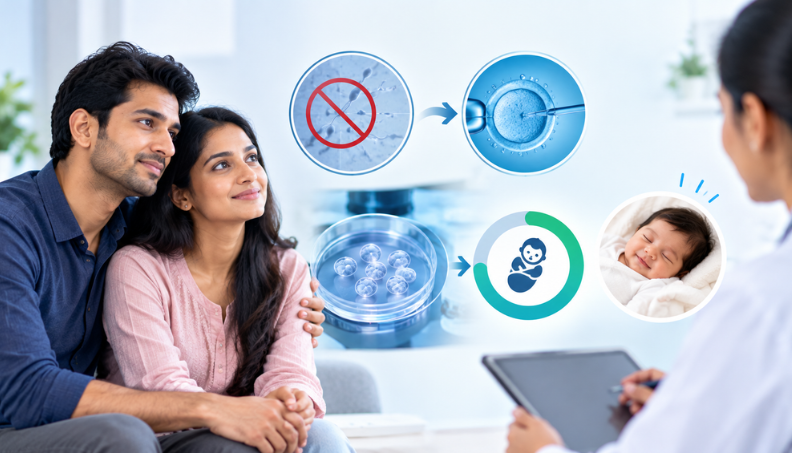
If your semen report shows no sperm, it’s natural to feel frightened about your chances of becoming a father.
I often tell my patients that a diagnosis of azoospermia does not automatically mean that biological parenthood is impossible.
In suitable cases, azoospermia IVF success rate depends on why sperm are absent, whether sperm can be retrieved, the female partner’s age and ovarian reserve, embryo development and several other factors.
Key Takeaways
- Azoospermia means no sperm are found in the ejaculate, but sperm may still be present inside the testicles.
- Obstructive and non-obstructive azoospermia need different treatment approaches.
- Sperm retrieval and IVF success are two different measurements.
- Micro-TESE can help selected men with non-obstructive azoospermia find sperm for ICSI.
- The female partner’s age and egg quality remain important predictors of IVF outcome.
What does azoospermia mean?
Azoospermia means that no sperm are detected in the semen after appropriate laboratory examination.
When I see this result, I don’t immediately assume that the testicles aren’t producing sperm.
We’ve covered this basic question in more depth, including what a zero-sperm report does and doesn’t tell you, in Does a Zero Sperm Count Mean You Can’t Have Children?
The next question is whether sperm production is occurring but sperm cannot reach the semen, or whether sperm production itself is impaired.
This distinction is essential because it changes what we do next.
What are the two main types of azoospermia?
There are two major types: obstructive azoospermia and non-obstructive azoospermia.
We’ve gone into the full distinction between the two, including how each is diagnosed and treated, in Obstructive vs Non-Obstructive Azoospermia: What Is the Difference?
- Obstructive azoospermia
In obstructive azoospermia, the testicles may still produce sperm, but a blockage prevents sperm from reaching the ejaculate.
Possible causes include previous surgery, infection, congenital absence of the vas deferens or blockage in the reproductive tract.
Because sperm production may be preserved, sperm can often be obtained from the testicle or epididymis and used for ICSI.
- Non-obstructive azoospermia
Non-obstructive azoospermia means that sperm production inside the testicles is severely reduced or absent.
This can occur because of genetic conditions, hormonal problems, previous testicular injury, undescended testes, certain medical treatments or unexplained testicular failure.
Even in some cases where the semen contains no sperm, small areas of sperm production may remain inside the testicles.

Dr Mannan IVF Centre
Experience world-class fertility care with Dr. Mannan Gupta at the Best IVF Centre in Delhi
How does a doctor find out which type you have?
The diagnosis usually starts with repeat semen testing, medical history, physical examination and hormone evaluation.
I may assess:
- Semen volume and repeated semen results
- Testicular size and examination findings
- FSH and testosterone levels
- Previous infections or surgeries
- History of undescended testes or testicular injury
- Genetic factors when indicated
Guidelines recommend evaluating azoospermic men to distinguish obstruction from impaired sperm production using the clinical history, examination and hormonal findings.
What tests may be needed before IVF?
The right tests depend on the suspected cause of azoospermia.
Hormone testing can help assess testicular function. In selected men, genetic testing such as karyotyping or Y-chromosome microdeletion testing is recommended because certain genetic findings can affect the chance of sperm retrieval and may have implications for future children.
Men with suspected congenital absence of the vas deferens may also require CFTR-related genetic evaluation.
I don’t recommend ordering every test for every patient. The evaluation should be guided by the clinical findings.
What are the chances of finding sperm in azoospermia?
The chance of sperm retrieval depends strongly on whether the azoospermia is obstructive or non-obstructive.
For obstructive cases, sperm production may be preserved, so retrieval from the epididymis or testicle is often possible. The AUA/ASRM guideline supports surgical sperm retrieval from either location in men with obstruction.
For non-obstructive cases, the situation is less predictable. A systematic review and meta-analysis involving more than 21,000 men found an overall sperm retrieval rate of about 47% per TESE procedure across published studies.
This number is a population-level estimate, not your personal prediction. Your underlying diagnosis, testicular findings and previous treatment can change the likelihood.
What is micro-TESE and when is it used?
Micro-TESE is a surgical technique used to search the testicular tissue for small areas where sperm production may still be occurring.
You can read more about how this and related sperm retrieval procedures work on our MESA, TESA and Micro-TESE Procedures page.
During the procedure, the surgeon examines the testicular tissue under magnification and looks for tubules that are more likely to contain sperm.
For men with non-obstructive azoospermia who need surgical sperm retrieval, current AUA/ASRM guidance recommends microdissection TESE.
Research also shows that sperm retrieval outcomes vary considerably between different causes of non-obstructive azoospermia.
How successful is micro-TESE with ICSI?
Micro-TESE can provide sperm for ICSI in a substantial proportion of carefully selected men with non-obstructive azoospermia, but it isn’t successful in every case.
Research hosted by the NIH’s National Library of Medicine confirms micro-TESE as the standard first-line retrieval approach for these men, while noting that outcomes still vary by underlying cause.
A large cohort study of 968 men with non-obstructive azoospermia reported sperm retrieval in 44.6% of men undergoing micro-TESE. Among couples who proceeded to ICSI after sperm retrieval, outcomes included clinical pregnancies and live births.
Another recent study reported a 39.4% retrieval rate in 627 men with non-obstructive azoospermia, with outcomes differing according to the underlying cause.
These figures show why I prefer to give patients an individual estimate instead of promising a fixed percentage.
Does IVF work after sperm is retrieved?
Yes, IVF with ICSI can be used when viable sperm are successfully retrieved.
ICSI means that an embryologist injects a single sperm directly into a mature egg. This allows us to use a very small number of sperm, which is especially useful when sperm are obtained surgically.
The AUA/ASRM guideline confirms that either fresh or cryopreserved surgically retrieved sperm can be used for ICSI in appropriate cases.
Once sperm has been retrieved, though, the treatment doesn’t end there. Eggs still need to fertilise, embryos need to develop, and an embryo must implant and progress into a pregnancy.
Why can't one IVF success rate be given for azoospermia?
There is no single IVF success rate that applies to every man with azoospermia.
This is one of the most important points I explain during consultation.
There are several stages:
- Can we retrieve viable sperm?
- Can the sperm fertilise the eggs?
- Can embryos develop?
- Can an embryo implant?
- Can the pregnancy progress to a live birth?
A patient may have a good chance of sperm retrieval but still have an IVF outcome influenced by the female partner’s age, egg quality, embryo development and other reproductive factors.
Large registry research has found that couples with obstructive or non-obstructive azoospermia can have broadly comparable assisted reproduction outcomes to other male-factor infertility groups after adjustment, with age of both partners remaining important.
Every percentage above is a population average, not a prediction about you. The only way to know your actual odds is a direct evaluation. Book an Appointment with Dr. Mannan Gupta at Dr. Mannan IVF Centre, Delhi, or Call Now to find out where you actually stand.
Does the female partner's age affect IVF success in azoospermia?
Yes, the female partner’s age and egg quality can have a major influence on IVF outcome.
Finding sperm is only the first part of the process. The number and quality of eggs available, embryo development and ovarian reserve all matter.
This is why I assess both partners together rather than treating azoospermia as an isolated male problem.
The AUA/ASRM guideline also recommends concurrent evaluation of both partners during infertility assessment.
What happens if sperm cannot be found?
If sperm cannot be retrieved, we discuss the next options openly rather than giving false reassurance.
The options depend on the reason sperm couldn’t be found and the couple’s wishes.
In selected situations, another retrieval strategy may be considered. If genetic or medical findings make sperm retrieval unlikely to succeed, donor sperm or other family-building options may also be discussed.
There is no single next step that is right for every couple.
What happens if sperm cannot be found?
If sperm cannot be retrieved, we discuss the next options openly rather than giving false reassurance.
The options depend on the reason sperm couldn’t be found and the couple’s wishes.
In selected situations, another retrieval strategy may be considered. If genetic or medical findings make sperm retrieval unlikely to succeed, donor sperm or other family-building options may also be discussed.
There is no single next step that is right for every couple.
Can azoospermia be treated before IVF?
Some causes of azoospermia can be treated before assisted reproduction.
If the problem is related to a correctable obstruction, reconstructive surgery may be considered in selected men.
Certain hormonal disorders can also respond to medical treatment. For non-obstructive azoospermia, treatment depends heavily on the underlying cause and whether any sperm production remains.
I first try to identify a treatable cause before moving directly to sperm retrieval or IVF treatment.
What can improve your chances before treatment?
A careful diagnosis and a coordinated male and female fertility assessment are more useful than taking random fertility supplements.
Before treatment, I advise patients to:
- Avoid smoking and tobacco
- Limit alcohol
- Maintain a healthy weight
- Manage diabetes and other medical conditions
- Avoid unnecessary heat exposure to the testes
- Review medicines that may affect fertility
- Complete recommended hormonal and genetic testing
- Choose a fertility centre with appropriate sperm retrieval and embryology expertise
Don’t start testosterone treatment on your own if you’re trying to have a child. Testosterone therapy can suppress sperm production and should be discussed with a fertility specialist.
Is azoospermia IVF treatment possible in Delhi?
Yes, men with azoospermia can be evaluated for IVF with surgical sperm retrieval and ICSI when medically appropriate.
If you’re looking for azoospermia treatment in Delhi, I recommend choosing a centre where the male fertility evaluation, sperm retrieval and IVF laboratory can work together.
The first consultation should focus on finding the cause, understanding whether sperm retrieval is realistic and discussing the options before you commit to treatment.
What should you ask your doctor before starting IVF?
Ask for your chances at each stage, not just one overall IVF percentage.
I recommend asking:
- What type of azoospermia do I have?
- Is sperm production likely to be present?
- Do I need genetic testing?
- Which sperm retrieval method is appropriate?
- What is my estimated chance of sperm retrieval?
- What happens if sperm isn’t found?
- How does my partner’s age affect our IVF plan?
- Will sperm be frozen as a backup when possible?
- What are the donor-sperm alternatives if retrieval fails?
Clear answers to these questions can make the treatment journey easier to understand and help you make decisions with confidence.
Can a man with azoospermia have a baby through IVF?
Yes, some men with azoospermia can father a biological child through sperm retrieval followed by IVF and ICSI.
The possibility depends on whether viable sperm can be found and on the fertility factors affecting both partners.
If you’ve received a zero-sperm report and aren’t sure what it means for your chances of becoming a father, I recommend a detailed fertility evaluation before assuming that IVF won’t work.
I, Dr. Mannan Gupta, IVF Specialist at Dr. Mannan IVF Centre, Delhi, can assess the cause of azoospermia, discuss sperm retrieval options, and help you understand the most appropriate IVF pathway for you and your partner.
Frequently Asked Questions
Can azoospermia be cured permanently?
Azoospermia can be reversible in some men, but it isn’t permanently curable in every case. The possibility depends on whether the cause is an obstruction, hormonal problem, genetic condition or impaired sperm production.
Can sperm appear naturally after a zero sperm count?
Yes, sperm may occasionally be detected later, particularly when the original finding was related to a temporary or treatable problem. I usually recommend confirming azoospermia properly before making major treatment decisions.
Does azoospermia affect sexual performance?
No, azoospermia doesn’t necessarily affect sexual desire, erections or the ability to have intercourse. A man can have normal sexual function while having no sperm in his semen.
Can a man with azoospermia still produce testosterone?
Yes, many men with azoospermia produce testosterone normally. Sperm production and testosterone production are related to the testes but are not the same function.
Is azoospermia caused by masturbation?
No, masturbation doesn’t cause permanent azoospermia. A persistent zero-sperm result needs a medical evaluation to identify the actual cause.
Can stress cause azoospermia?
Stress alone isn’t usually considered a direct cause of persistent azoospermia. Severe illness, hormonal problems, medications and other medical conditions should be assessed when sperm are absent.
Can azoospermia be caused by childhood illness?
Yes, certain childhood conditions can affect future sperm production. Undescended testes, some infections and testicular injuries are among the medical history points I look for during evaluation.
Does azoospermia increase the risk of passing a genetic problem to my child?
Some genetic causes of azoospermia can have implications for biological children. When genetic testing identifies a relevant abnormality, I recommend appropriate genetic counselling for the couple.
Can azoospermia happen after chemotherapy?
Yes, chemotherapy can impair sperm production and may cause temporary or permanent azoospermia. The effect depends on the drugs used, treatment intensity and individual testicular recovery.
How do I know whether my testicles are producing sperm?
A semen test alone cannot always tell us whether small areas of sperm production remain inside the testicles. Your medical history, examination, hormone results, genetic evaluation and, when appropriate, sperm retrieval help us assess the situation.
Final Thoughts
Azoospermia can be emotionally difficult, but a zero-sperm report doesn’t automatically close the door to biological fatherhood.
In my clinical practice, I start by asking why sperm are absent. Once we understand whether the problem is obstructive or related to sperm production, we can discuss the most appropriate route forward.
The most useful question isn’t simply, “What is my IVF success rate?” It is, “What is my chance at each stage of treatment, and what can we do to improve my chances?”
That approach gives you a clearer picture and helps you make an informed fertility decision.
Medical Disclaimer:
Content regarding azoospermia, surgical sperm retrieval (TESA/micro-TESE), and ICSI/IVF success rates is for educational purposes only and not a substitute for clinical medical advice. Always consult a qualified reproductive endocrinologist or andrologist for an accurate diagnostic evaluation and personalized fertility planning.
