

Dr Mannan Gupta
Medically Reviewed by Dr. Mannan Gupta On Sept 26, 2026
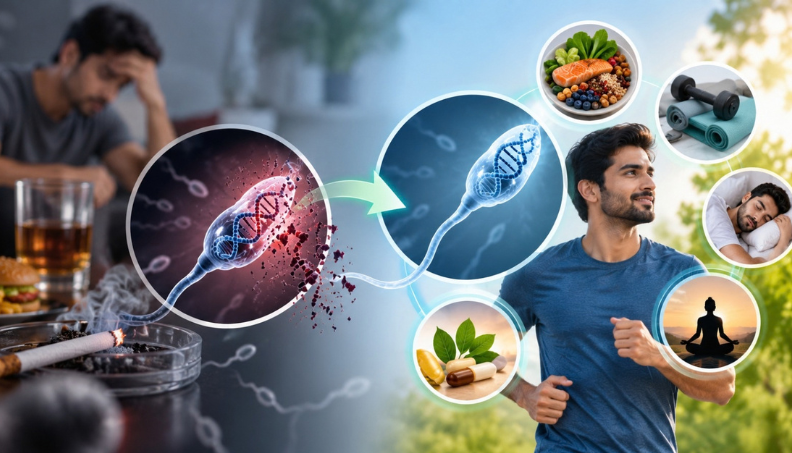
If you’ve been told that your sperm DNA fragmentation is high, it’s understandable to feel worried about what it means for your chances of becoming a father.
I’m Dr. Mannan Gupta, IVF Specialist at Dr. Mannan IVF Centre in Delhi, and when patients ask me whether they can reduce sperm DNA fragmentation naturally, I explain that lifestyle changes can help in some men, but they work best when we also look for an underlying medical cause.
Key Takeaways
- Sperm DNA damage can sometimes improve when reversible risk factors are addressed.
- Stopping smoking, improving daily habits and protecting sperm from excessive heat are sensible first steps.
- Antioxidant supplements may help some men, but evidence is not strong enough to recommend one universal formula.
- Varicocele and other medical conditions may require targeted treatment.
- Changes are usually assessed over about three months because sperm production takes time.
What exactly is sperm DNA fragmentation?
Sperm DNA fragmentation means that some of the genetic material inside sperm has breaks or damage. This is different from simply measuring sperm count, movement or shape.
I often explain it this way in consultation: a semen analysis tells us about several visible characteristics of sperm, while a DNA fragmentation assessment looks at the integrity of the genetic material they carry.
A higher level of fragmentation has been associated with poorer reproductive outcomes, including miscarriage, although the test isn’t a diagnosis of permanent infertility. Current guidelines also don’t recommend SDF testing as a routine first test for every infertile man.
What can cause sperm DNA damage?
Sperm DNA can be affected by oxidative stress, lifestyle factors, medical conditions and environmental exposures.
Some factors I look for include:
- Smoking and tobacco exposure, which has one of the clearest associations with higher SDF among lifestyle factors studied.
- Varicocele, a condition involving enlarged veins around the testicle.
- Metabolic problems, including impaired glucose regulation.
- Certain infections, medications and toxic exposures.
- Increasing paternal age.
- Excessive heat exposure and other factors that can affect testicular function.
This is why I don’t recommend treating a laboratory number in isolation. The important question is why your sperm DNA is fragmented.

Dr Mannan IVF Centre
Experience world-class fertility care with Dr. Mannan Gupta at the Best IVF Centre in Delhi
Can sperm DNA fragmentation improve naturally?
Yes, it can improve in some men, but natural improvement isn’t guaranteed.
A 2025 systematic review and meta-analysis found that lifestyle interventions were associated with a modest reduction in SDF after three months.
This matches a meta-analysis hosted by the NIH’s National Library of Medicine, which found varicocelectomy to be the most effective intervention, described lifestyle changes as needing more comparable studies, and called antioxidant evidence questionable.
The researchers also found evidence supporting a reduction after varicocele repair, while the results for antioxidants were more uncertain.
In practice, I focus first on changes that have a clear health benefit regardless of the SDF result.
That usually means:
- Stop smoking and tobacco completely.
- Keep alcohol intake low or avoid it while actively trying to conceive.
- Exercise regularly without excessive training.
- Eat a balanced diet based mainly on vegetables, fruits, whole grains, nuts, seeds, pulses and appropriate protein sources.
- Maintain a healthy weight and manage blood sugar if needed.
- Get consistent, adequate sleep.
- Avoid unnecessary heat exposure around the testes.
The goal isn’t to find one magic food. It’s to reduce the factors that may be damaging sperm over time.
Can diet improve sperm DNA quality?
A balanced diet may support sperm health, but no individual food has been proven to repair fragmented sperm DNA.
I encourage patients to build meals around whole foods rather than buying expensive fertility products.
Useful choices include:
- Fresh fruits and vegetables
- Nuts and seeds
- Whole grains and pulses
- Fish and other appropriate protein sources
- Foods containing naturally occurring antioxidants
A diet rich in fruits, vegetables, whole grains, nuts and fish has been associated with better sperm DNA measures in some research. However, diet should be viewed as part of an overall fertility plan, not as a stand-alone treatment.
Does exercise help reduce sperm DNA damage?
Regular moderate exercise can support general metabolic and reproductive health, but more exercise isn’t always better.
I usually recommend consistent physical activity that you can maintain rather than sudden, intense training.
Your plan should also consider:
- Current fitness level
- Body weight
- Sleep
- Recovery time
- Existing medical conditions
The evidence for lifestyle interventions specifically lowering SDF is promising but still limited, so I don’t tell patients that exercise alone will normalize a high result.
Should you stop smoking if your DNA fragmentation is high?
Yes, stopping smoking is one of the most important changes you can make for sperm health.
Research has repeatedly linked smoking with poorer sperm DNA integrity. A systematic review and meta-analysis found smoking was among the lifestyle factors most strongly associated with higher SDF.
If you’re trying for a baby, don’t wait for another test before stopping.
Tobacco cessation is more important than adding a random fertility supplement to your routine.
Can stress, poor sleep, and heat affect sperm DNA?
They may contribute to poorer sperm quality, particularly when combined with other unhealthy habits.
I ask patients about sleep, work patterns, exercise, stress and heat exposure because sperm health doesn’t exist separately from your overall health.
Simple steps include:
- Maintain a regular sleep schedule.
- Take breaks if your work involves prolonged sitting.
- Avoid repeated high-heat exposure, such as frequent hot baths or saunas.
- Don’t place a hot laptop directly against the groin for long periods.
- Use stress-management techniques that you can realistically maintain.
These steps are supportive measures. They should not replace medical assessment when SDF is persistently high.
Do antioxidant supplements actually work?
The evidence is mixed, so I don’t recommend taking a large combination of antioxidants without a reason.
Some studies have reported lower SDF after antioxidant treatment. A 2025 meta-analysis also found a reduction in SDF after antioxidant therapy, but the researchers described the evidence as uncertain because the studies varied considerably.
The AUA/ASRM guideline advises clinicians to tell patients that the clinical usefulness of antioxidants and vitamins in male infertility remains questionable, and current evidence isn’t sufficient to recommend specific agents.
Food-based nutrition is reasonable. Supplements should be individualized rather than treated as a guaranteed solution.
Could a varicocele be causing high sperm DNA fragmentation?
Yes, varicocele is one of the medical conditions I consider when SDF is elevated.
A varicocele can affect the testicular environment and has been associated with higher SDF. A large 2025 systematic review found that varicocele repair was associated with a clearer reduction in SDF than lifestyle interventions or antioxidants.
If I suspect a clinically relevant varicocele, I don’t simply advise more supplements. I assess the varicocele and the rest of your fertility history before deciding whether treatment is appropriate.
Not every varicocele needs surgery.
When should you get a sperm DNA fragmentation test?
SDF testing isn’t necessary for every man who is having difficulty conceiving.
AUA/ASRM does not recommend it during the routine initial evaluation of every infertile couple but recommends SDF assessment in men whose partners have recurrent pregnancy loss.
The 2026 ASRM recurrent pregnancy loss guidance says testing may be considered when recurrent miscarriage remains unexplained or occurs alongside infertility.
It may therefore become relevant when there is:
- Recurrent pregnancy loss
- Selected cases of infertility
- Repeated IVF or ICSI problems
- A suspected male factor that routine testing doesn’t fully explain
The exact test and interpretation also matter because different SDF methods aren’t interchangeable.
How long does it take to improve sperm DNA fragmentation?
Think in terms of months, not days.
Sperm production and maturation take time, so changes made today don’t immediately appear in a semen or SDF test.
A prospective pilot study involving men with elevated DFI found a reduction after a three-month lifestyle and antioxidant intervention, although the study was not designed to prove improved pregnancy or live-birth outcomes.
I generally review progress over a roughly three-month period when lifestyle changes are being used, while adjusting the timeline according to the underlying cause.
What if lifestyle changes don't lower the DNA fragmentation?
If your SDF remains high despite good lifestyle habits, it’s time to look deeper rather than simply adding more supplements.
I may consider whether there is:
- A clinically relevant varicocele
- Infection or inflammation
- A hormonal or metabolic issue
- Medication or environmental exposure
- Another male fertility factor
For selected patients undergoing assisted reproduction, approaches such as sperm selection or use of testicular sperm may be discussed. We’ve written about a case where this exact situation played out in If We Missed This… IVF Would Have Failed.
The aim is to identify the reason for the high result and choose the least invasive effective approach.
Ninety days of clean living is worth doing regardless. But if the number doesn’t move, or you’re already dealing with recurrent loss or repeated IVF setbacks, that’s not a lifestyle problem anymore, it’s a diagnostic one. Talk to Dr. Mannan Gupta at Dr. Mannan IVF Centre, Delhi. Book an Appointment or Call Now.
What can you do during the next 90 days?
Treat the next three months as a practical sperm-health window.
Focus on five things:
- Stop smoking and tobacco.
- Eat mostly whole, nutrient-rich foods.
- Exercise regularly and maintain a healthy weight.
- Protect your sleep and reduce avoidable heat exposure.
- See a fertility specialist if the result remains high or you have recurrent miscarriage, repeated treatment failure or other fertility concerns.
Don’t judge your progress by one supplement or one dietary change.
Consistency matters more than perfection.
Can high sperm DNA fragmentation be cured?
I wouldn’t use the word “cured” because SDF is a laboratory finding with several possible causes.
Some men see improvement when a reversible factor is treated or removed. Others may continue to have elevated SDF and need a different fertility strategy.
My approach is to identify the cause, correct what can be corrected and then decide whether further testing or assisted reproduction is appropriate.
If you’re looking for sperm DNA fragmentation treatment in Delhi, I recommend discussing the complete fertility history rather than treating the SDF number alone.
Frequently Asked Questions
1. Can antioxidants reduce sperm DNA fragmentation?
They may reduce SDF in some men, but the evidence isn’t strong enough to say that antioxidants work for everyone.
Some clinical studies report improvement, while guidelines continue to describe the overall clinical benefit as uncertain.
2. Can sperm DNA fragmentation be high with a normal semen analysis?
Yes, a man can have acceptable conventional semen parameters while still having abnormal sperm DNA integrity.
Semen analysis and SDF assess different aspects of sperm, which is why SDF can sometimes provide additional information in selected clinical situations.
3. Is high sperm DNA fragmentation the same as infertility?
No, a high SDF result does not mean that natural pregnancy is impossible.
It is one factor that may affect reproductive outcomes, and it needs to be interpreted alongside both partners’ fertility assessment.
4. Can sperm DNA fragmentation improve without supplements?
Yes, some men may improve after addressing lifestyle or medical factors without relying on supplements.
Smoking cessation, treatment of an appropriate varicocele and other targeted changes may be more relevant than taking multiple over-the-counter products.
5. Does a high SDF result mean IVF will fail?
No, high SDF does not mean IVF will definitely fail.
Your age, egg quality, sperm parameters, embryo development and the specific fertility diagnosis all influence treatment outcomes.
6. Should I repeat the sperm DNA fragmentation test?
Sometimes, repeating the test can be useful, but the timing and reason should be discussed with your fertility specialist.
Different testing methods and biological variation can affect interpretation, so I prefer to decide on repeat testing based on the clinical situation rather than repeating it automatically.
7. Can lifestyle changes guarantee better pregnancy chances?
No, lifestyle improvement can support sperm health but cannot guarantee pregnancy.
Current evidence shows that some interventions can reduce SDF, but whether lowering the laboratory value always translates into better pregnancy or live-birth outcomes remains uncertain.
8. When should a man see a fertility specialist for high SDF?
You should consider specialist evaluation when SDF is persistently elevated, particularly if you have infertility, recurrent miscarriage or repeated IVF/ICSI problems.
The purpose is not simply to repeat tests. It is to look for a treatable male factor and decide whether any change in fertility treatment is justified.
9. Could pollution in Delhi affect sperm DNA?
Environmental pollution may be associated with higher sperm DNA fragmentation, but it shouldn’t be assumed to be the sole cause of an individual’s result.
Research has found an association between pollution exposure and SDF, but individual risk depends on multiple factors.
10. Can I improve sperm DNA fragmentation while preparing for IVF?
Yes, optimizing modifiable factors before IVF is reasonable, but the plan should be individualized.
I would focus on smoking cessation, healthy nutrition, exercise, sleep, medical conditions and evaluation for factors such as varicocele rather than relying on a generic supplement protocol.
How can I find out whether I need sperm DNA fragmentation treatment in Delhi?
The first step is a fertility consultation that considers both partners, your reproductive history and previous test results.
If you need an assessment in Delhi, you can consult Dr. Mannan Gupta, IVF Specialist at Dr. Mannan IVF Centre, located at Elantis Super Speciality Hospital, 29 Ring Road, Lajpat Nagar IV, New Delhi.
If your SDF result is worrying you, I encourage you not to panic or start multiple supplements on your own.
As an IVF specialist at Dr. Mannan IVF Centre in Delhi, I can assess your male fertility factors, previous reports and reproductive history and help you decide whether lifestyle management, further evaluation or an assisted reproduction strategy makes sense for you.
Final Thoughts
Sperm DNA fragmentation is not a verdict on your ability to become a father.
In my clinical approach, I look beyond the number. We identify possible causes, improve the factors that can be changed, treat medical problems when necessary and then choose the fertility pathway that fits the couple.
Healthy sperm development takes time, so give your body a consistent three-month window rather than looking for an overnight solution. And if you have recurrent miscarriage, repeated fertility-treatment failure or persistently high SDF, don’t rely on lifestyle changes alone. A proper fertility assessment can tell you what needs attention next.
Medical Disclaimer:
Content regarding sperm DNA fragmentation, lifestyle changes, and fertility interventions is for educational purposes only and does not constitute medical advice. Always consult a qualified urologist or reproductive specialist for personalized diagnosis and care.
