

Dr Mannan Gupta
Medically Reviewed by Dr. Mannan Gupta On Sept 23, 2026
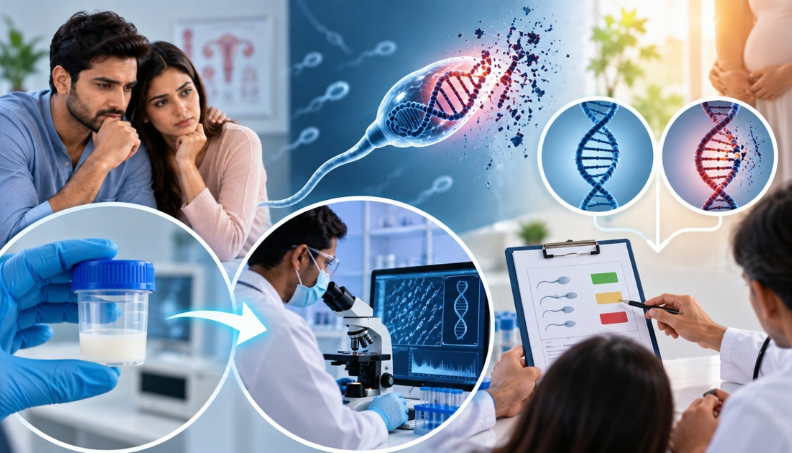
If you’ve been advised a DNA fragmentation test in Delhi, you may have questions about the cost, the sample collection, the report, and what a high result means for your fertility.
I’m Dr. Mannan Gupta, IVF Specialist at Dr. Mannan IVF Centre, Delhi, and I often explain to my patients that this test gives us information about sperm DNA quality that a routine semen analysis cannot provide.
Key Takeaways
- The test checks for damage or breaks in the DNA inside sperm cells.
- It is different from a routine semen analysis.
- The cost varies by laboratory, test method and location.
- A high result doesn’t automatically mean that IVF will fail.
- Your result should be interpreted with your complete fertility history.
What is a sperm DNA fragmentation test?
A sperm DNA fragmentation test measures the amount of damaged or fragmented DNA present inside sperm cells.
A routine semen analysis mainly looks at sperm count, movement and shape. DNA fragmentation testing looks at another part of sperm health, the integrity of its genetic material.
This distinction matters because a man can have reasonable semen parameters and still have increased sperm DNA damage.
In my practice, I don’t look at this test in isolation. I consider the semen analysis, medical history, previous fertility treatment, pregnancy history and the woman’s fertility factors before deciding what the result means.
Why might an IVF specialist recommend this test?
The test may be useful when there is a clinical reason to investigate sperm DNA quality more closely.
I may discuss testing in situations such as:
- Unexplained infertility
- Repeated IVF or ICSI failure
- Recurrent pregnancy loss
- A diagnosed varicocele
- Certain male fertility problems
- Lifestyle or medical factors that may affect sperm DNA
- Selected cases where routine semen testing doesn’t explain the fertility problem
Clinical recommendations have discussed SDF testing in settings such as recurrent pregnancy loss, unexplained infertility, varicocele and repeated assisted reproduction failure. We’ve written about a real case where this exact scenario changed the treatment plan in If We Missed This… IVF Would Have Failed.
This doesn’t mean that every man preparing for IVF needs the test. I recommend it when the result may help answer an important clinical question.

Dr Mannan IVF Centre
Experience world-class fertility care with Dr. Mannan Gupta at the Best IVF Centre in Delhi
How is the sperm DNA fragmentation test done?
The test is performed using a semen sample, so there is no blood draw or surgical procedure involved.
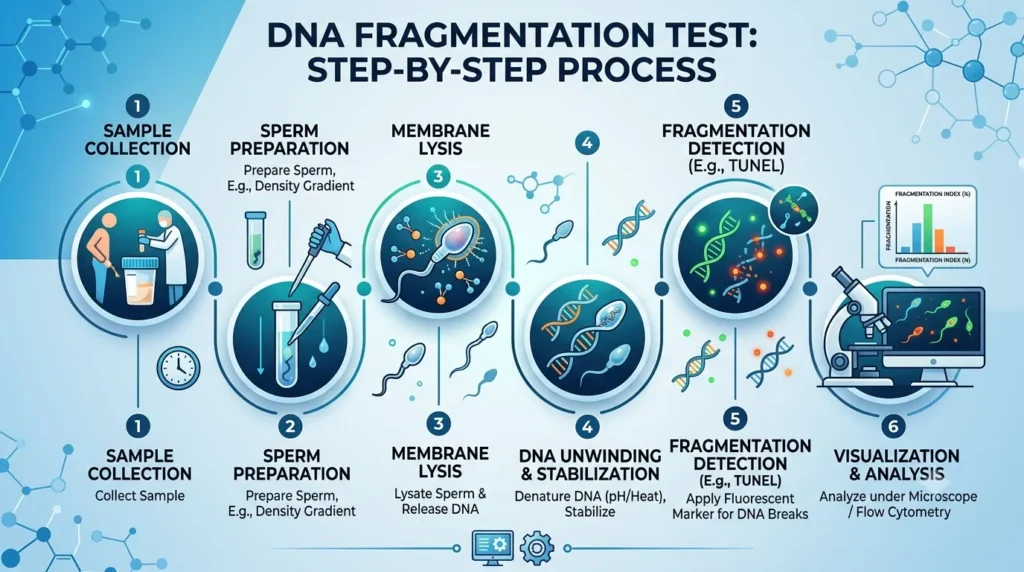
The usual process is:
- You receive instructions about the required abstinence period.
- You provide a semen sample in a sterile container.
- The laboratory processes the sample using its selected DNA fragmentation method.
- The laboratory measures the proportion of sperm showing DNA damage.
- Your report provides a percentage or index that your fertility specialist interprets.
Many laboratories recommend around 2 to 5 days of ejaculatory abstinence, although the exact instructions can vary according to the laboratory and test method.
Follow the specific instructions given by the laboratory performing your test rather than using an internet recommendation.
Do you need to fast before the test?
No, fasting is generally not required for a sperm DNA fragmentation test.
The important preparation relates to the semen sample, particularly the laboratory’s instructions about abstinence, collection and sample handling.
For example, one major diagnostic provider currently lists no fasting requirement and recommends 2 to 3 days of abstinence before sample collection.
Which tests are used to measure sperm DNA fragmentation?
Several laboratory methods can measure sperm DNA fragmentation, and they don’t all work in exactly the same way.
Common methods include:
- SCSA, or sperm chromatin structure assay
- TUNEL test
- SCD, or sperm chromatin dispersion test
- Comet assay
The method matters because different tests can produce different ranges and use different interpretation thresholds.
When I review a report, I therefore look at which assay was used, not just the percentage printed on the page.
How much does a DNA fragmentation test cost in Delhi?
The cost of sperm DNA fragmentation testing in Delhi can vary depending on the laboratory, testing method and reporting process.
Current publicly listed prices give a useful indication. One Delhi diagnostic centre lists a sperm DNA fragmentation microscopy test at ₹4,830, while other Indian diagnostic providers currently list prices around ₹6,000 to ₹10,000.
So, as a practical estimate, you may commonly see a price in the ₹5,000 to ₹10,000 range, but the actual Delhi price should be confirmed with the laboratory before testing.
The price may differ because of:
- The DNA fragmentation assay used
- Laboratory technology
- Whether the test is performed locally or outsourced
- Reporting and processing charges
- Whether it is bundled with other male fertility tests
Don’t choose a laboratory only because it offers the lowest price. For fertility testing, proper sample handling, validated methods and appropriate reporting are important.
What does the DNA fragmentation index mean?
The DNA fragmentation index, often called DFI, represents the proportion of sperm showing DNA fragmentation according to the particular testing method.
For example, if a report shows a DFI of 25%, it means that the test has identified DNA fragmentation in a defined proportion of the sperm evaluated.
But there is an important point here.
There is no single universal DFI number that can be called “normal” for every DNA fragmentation test.
SCSA, TUNEL, SCD and Comet assays measure DNA damage differently, and reported thresholds vary between methods and clinical situations. Recent literature continues to highlight this problem.
That is why I don’t advise patients to look at a percentage online and decide whether they are fertile or infertile.
What does a low DNA fragmentation result mean?
A low result generally indicates that a smaller proportion of the tested sperm show DNA fragmentation according to that laboratory’s method.
This is reassuring information about sperm DNA integrity.
However, a low DNA fragmentation result does not guarantee pregnancy or IVF success.
Egg quality, female age, ovarian reserve, embryo development, sperm count and motility, the uterus and several other factors can influence the final outcome.
What does a high DNA fragmentation result mean?
A high result means that a larger proportion of the tested sperm show DNA damage, but it does not mean that pregnancy is impossible.
This is one of the most important things I tell my patients.
A high result may prompt us to look for contributing factors such as oxidative stress, varicocele, infection, smoking, metabolic problems or other medical and lifestyle factors.
Research has linked elevated SDF with some adverse reproductive outcomes, including lower clinical pregnancy rates in IVF and increased pregnancy loss in some ART settings.
However, the evidence is not strong enough to use SDF alone as a definite prediction of whether an individual couple will achieve a live birth.
A high number is a clinical clue, not a final fertility verdict.
Can a high DNA fragmentation result be improved?
In some men, sperm DNA fragmentation can improve when contributing factors are identified and addressed.
Management may include:
- Stopping smoking and tobacco exposure
- Reducing excessive alcohol intake
- Improving weight and metabolic health
- Regular physical activity
- Managing an identified infection
- Evaluating and treating a clinically important varicocele
- Reviewing relevant medicines and medical conditions
- Considering antioxidants only when medically appropriate
A 2025 systematic review and meta-analysis evaluated interventions including lifestyle changes, varicocele treatment, antioxidants and FSH treatment, although the evidence differs between interventions and patients.
I don’t recommend starting antioxidant supplements simply because a report shows a high number. The cause and the overall fertility plan should come first.
How long does it take to get the report?
The reporting time depends on the laboratory and the assay used.
Current laboratory listings show turnaround times ranging from about 1 day to several working days, with some providers listing around 5 days.
If your IVF treatment is already scheduled, ask the laboratory about the expected turnaround time before giving the sample.
Can you have a normal semen analysis but high DNA fragmentation?
Yes, this is possible.
Semen analysis and DNA fragmentation testing answer different questions.
A semen analysis may show acceptable sperm count, movement and shape while a DNA fragmentation test identifies a problem with sperm DNA integrity.
This is one reason why advanced sperm testing may sometimes be considered when the standard semen report doesn’t fully explain a couple’s fertility history.
Does high DNA fragmentation mean IVF will fail?
No, high DNA fragmentation does not mean that IVF will definitely fail.
Recent evidence suggests that elevated SDF may be associated with poorer outcomes in some ART settings, but the strength of the association varies by treatment type and study quality. This matches an umbrella meta-analysis hosted by the NIH’s National Library of Medicine, which searched the literature through July 2025 and found stronger associations with clinical pregnancy in IVF and IUI, a weaker association in ICSI, and limited evidence for live birth specifically.
I use the result to guide a treatment discussion, not to predict your future from one percentage.
Depending on your situation, we may discuss lifestyle or medical treatment, sperm preparation, ICSI or other approaches. The appropriate option depends on the cause and the complete fertility picture.
Is DNA fragmentation testing needed before every IVF cycle?
No, it isn’t routinely necessary for every IVF patient.
If you’re having your first IVF cycle and there are no specific male fertility concerns, your doctor may decide that a routine semen assessment is enough.
The test becomes more relevant in selected situations such as unexplained infertility, recurrent pregnancy loss, varicocele or repeated ART failure.
Good fertility care isn’t about ordering every available test. It’s about choosing the tests that can actually change your management.
What should you do if your report shows high DFI?
Don’t panic or start treatment based only on the number.
First, check:
- Which test method was used
- What reference range the laboratory has provided
- Whether the sample was collected according to instructions
- Your semen analysis results
- Your medical and fertility history
- Whether there are treatable male fertility factors
I prefer to interpret the report in context rather than label a patient based on a single result.
If you have had repeated IVF failure, recurrent pregnancy loss, unexplained infertility or an abnormal sperm assessment, a fertility consultation can help determine whether DNA fragmentation testing is useful for you.
When should you repeat the test?
A repeat test may be considered when the result could affect treatment decisions or when you’ve made changes that may affect sperm health.
The timing depends on why the test was performed, the original result, the assay used and what treatment or lifestyle changes have been made.
Don’t repeat the test simply to chase a lower number unless your fertility specialist believes the result will change your care.
Where can you discuss DNA fragmentation testing in Delhi?
A fertility specialist can help you decide whether the test is appropriate and explain what the result means for your individual IVF plan.
If you’re considering sperm DNA fragmentation testing in Delhi. Bring your report to a specialist rather than interpreting it alone. Book an Appointment with Dr. Mannan Gupta at Dr. Mannan IVF Centre, Delhi, or Call Now.
Frequently Asked Questions
Is the DNA fragmentation test painful?
No, the test itself isn’t painful because it uses a semen sample. You provide the sample according to the laboratory’s collection instructions.
Can I eat normally before a DNA fragmentation test?
Yes, you can generally eat normally because fasting isn’t usually required. Follow the specific instructions given by your testing laboratory.
Can high DNA fragmentation affect natural pregnancy?
It may reduce reproductive potential in some men, but it doesn’t make natural conception impossible. A high result should be interpreted alongside the couple’s overall fertility assessment.
Does age increase sperm DNA fragmentation?
Sperm DNA damage may become more common with increasing paternal age. Age is only one factor, so I consider it together with semen parameters, medical history and other fertility factors.
Can stress increase sperm DNA fragmentation?
Chronic stress may contribute indirectly to poorer sperm health through hormonal, lifestyle and oxidative-stress pathways. Managing stress, sleeping adequately and maintaining healthy daily habits can support overall reproductive health.
Does masturbation reduce sperm DNA fragmentation?
The relationship isn’t simple enough to recommend masturbation as a treatment for high DNA fragmentation. Ejaculation frequency can affect semen characteristics, so your specialist may give specific instructions before testing or IVF.
Can heat exposure damage sperm DNA?
Prolonged heat exposure may adversely affect sperm health. If you’re concerned about sperm quality, I generally advise avoiding repeated excessive heat exposure to the testicular area.
Can antibiotics reduce sperm DNA fragmentation?
Antibiotics can help when a bacterial infection is contributing to a fertility problem, but they aren’t a general treatment for high DNA fragmentation. They should only be used when a clinician identifies an appropriate indication.
Is DNA fragmentation covered by health insurance in India?
Coverage isn’t guaranteed and depends on your specific insurance policy. Fertility investigations are often paid out of pocket, so check your policy wording or confirm directly with the insurer before testing.
Can a high DFI result be completely reversed?
Not always, but improvement may be possible when an underlying cause can be addressed. I focus on finding and treating modifiable factors rather than promising that a particular percentage will return to a specific number.
Final Thoughts
A DNA fragmentation report can provide useful information about sperm quality, but it should never be treated as a final judgment on your fertility.
I encourage my patients to look at the complete picture, including both partners’ fertility factors, semen parameters, medical history and previous treatment outcomes.
If your result is high, there may still be meaningful treatment options. The next step is understanding why the result is high and whether changing the management plan can help.
Medical Disclaimer:
This article is intended for general medical education and does not replace an individual consultation with an IVF specialist, reproductive medicine specialist or qualified fertility professional. DNA fragmentation assays differ in methodology and reference ranges, so results should be interpreted according to the specific laboratory test and your clinical situation. Do not start supplements, medicines or fertility treatment based solely on information in this article.
