
Hormonal Treatment for Azoospermia: When Does It Actually Work?

Dr Mannan Gupta
Medically Reviewed by Dr. Mannan Gupta On Sept 17, 2026
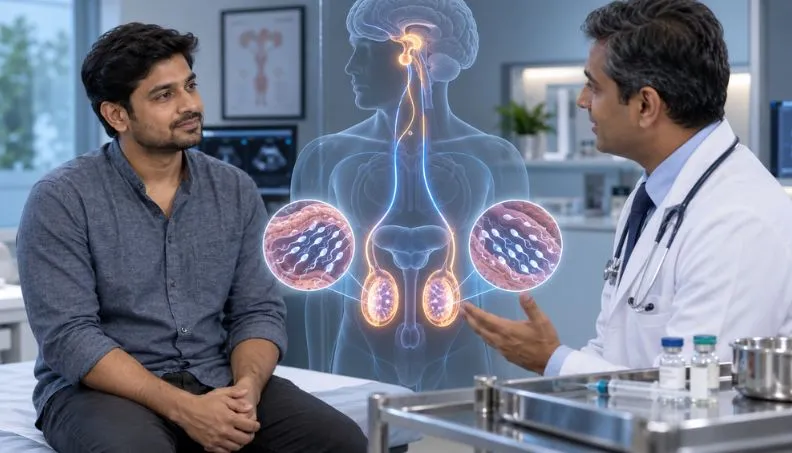
When a man hears the word “azoospermia” for the first time, it usually feels like a door slamming shut.
But azoospermia does not mean you can never father a child, and in a specific group of men, hormonal treatment for azoospermia can genuinely bring sperm back into the semen.
I’m Dr. Mannan Gupta, IVF specialist in Delhi at Dr. Mannan IVF Centre in Delhi, and I want to walk you through exactly when this treatment works, when it doesn’t, and what I tell patients honestly in my clinic every week.
Key Takeaways
- Hormonal treatment helps only a specific type of azoospermia, not all types
- Your FSH, LH, and testosterone levels decide if you’re even a candidate
- Treatment usually needs 3 to 6 months before you see results, sometimes longer
- If hormones don’t work, surgical sperm retrieval is still very much an option
- Getting the right diagnosis first saves you months of wasted treatment
What Is Azoospermia and Why Does It Happen?
Azoospermia simply means there’s no sperm found in your semen sample. It’s not the same as needing a low sperm count treatment, that’s a different situation where sperm exists but in small numbers. Azoospermia is zero, confirmed on at least two separate semen analyses.
- It affects roughly 1 in 100 men, and shows up in a large share of men being evaluated for infertility.
- There are two broad types: obstructive (sperm is being made but blocked from coming out) and non-obstructive azoospermia (the testes aren’t producing enough sperm to begin with).
- We’ve covered what a zero sperm count actually means, and doesn’t mean, in more depth in Does a Zero Sperm Count Mean You Can’t Have Children?
- Hormonal treatment is only relevant to the non-obstructive type, and even then, only a portion of those cases.
- In my practice, the first thing I tell a new patient is: don’t panic at the word, panic at not knowing which type you have.
What Causes the Hormonal Type of Azoospermia?
This type happens when your brain isn’t sending the right signals to your testes to make sperm. It’s called hypogonadotropic hypogonadism, and it’s genuinely treatable with hormone therapy for azoospermia.
- Your testes need FSH and LH, hormones released by the pituitary gland, to trigger spermatogenesis (the process of sperm production) and testosterone output.
- If the pituitary or hypothalamus isn’t signaling properly, the testes stay understimulated even though they’re structurally normal.
- A review hosted by the NIH’s National Library of Medicine confirms FSH-based hormone therapy as a recognized treatment path specifically for this cause of male infertility.
- Causes include pituitary tumours, certain genetic conditions, chronic steroid or opioid use, obesity, and sometimes no clear cause at all.
- This is different from primary testicular failure, where the testes themselves are damaged and can’t respond no matter how much hormone signal they get.
- We’ve gone into the full distinction between this and other causes in Obstructive vs Non-Obstructive Azoospermia: What Is the Difference?

Dr Mannan IVF Centre
Experience world-class fertility care with Dr. Mannan Gupta at the Best IVF Centre in Delhi
How Serious Is It — and Can It Reverse on Its Own?
On its own, no. This type of azoospermia doesn’t fix itself, but it responds well to correct treatment when caught early.
- Left untreated, the testes can go through a slow decline in function the longer the low-signal state continues.
- The earlier you’re diagnosed and treated, the better your response tends to be. I’ve seen men wait two, three years on their own before coming in, and that delay does cost them.
- It’s not an emergency, but it’s also not something to sit on indefinitely while hoping.
How Do I Find Out If Hormones Are Even the Problem?
A simple blood test tells us this. You don’t need to guess.
- We check FSH and LH levels, testosterone, and sometimes prolactin and thyroid function.
- Low or low-normal FSH and LH with signs of testosterone deficiency points toward the hormonal, treatable type.
- High FSH with small, soft testes usually points toward primary testicular failure, where hormone injections rarely bring sperm back.
- A physical exam and testicular volume check, along with a semen analysis, matter as much as the blood report.
- I always tell patients: this one test result changes your entire treatment plan, so don’t skip it or self-medicate based on a general “low testosterone” diagnosis from an online test.
This isn’t something to piece together from an online test or a general practitioner’s low-testosterone read. Book an Appointment with Dr. Mannan Gupta at Dr. Mannan IVF Centre, Delhi, or Call Now to get the right hormonal workup done .
When Does Hormonal Treatment for Azoospermia Actually Work?
It works best in men with hypogonadotropic hypogonadism, normal testicular size, and no long-standing testicular damage. This is the honest answer competitors rarely give you.
- Men with genuinely low FSH/LH and low testosterone respond the most reliably.
- Younger age and shorter duration of infertility improve the odds.
- Men with very high baseline FSH and shrunken testes generally do not respond to hormone injections. In these cases, I’m direct with patients rather than putting them through months of treatment that isn’t likely to help.
- If you’ve had undescended testes as a child, chemotherapy, or radiation exposure, your response is usually more limited, and we set expectations accordingly from day one.
What Does the Treatment Itself Involve?
It’s an injection-based protocol, not a pill, and it takes patience.
- The standard approach uses hCG (human chorionic gonadotropin) to restart testosterone production, sometimes combined with FSH injections to directly stimulate sperm-producing cells.
- Regular blood monitoring every few weeks tracks testosterone and semen parameters so we can adjust the dose.
- If you’re wondering how long hormone treatment takes to work for azoospermia, most men need a minimum of 3 to 6 months before any sperm appears in the semen, and some take up to a year.
- A repeat semen analysis is done periodically, not weekly, because sperm production is a slow biological process, not something that changes overnight.
What If Hormone Therapy Doesn't Bring Sperm Back?
This isn’t the end of the road, and I want every patient to hear that clearly.
- If hormones don’t restore sperm in the ejaculate, surgical sperm retrieval (TESA or micro-TESE) can often still find sperm directly inside the testicular tissue.
- You can read more about how these procedures work on our MESA, TESA and Micro-TESE Procedures page. That retrieved sperm can be used with ICSI as part of IVF.
- That retrieved sperm can be used with ICSI (a technique where a single sperm is injected into an egg) as part of IVF.
- Hormonal pretreatment can sometimes improve retrieval success even when it doesn’t restore natural sperm production, though the evidence here is still developing and I discuss this honestly with each couple rather than overselling it.
- The goal was never just “sperm in semen.” The real goal is biological fatherhood, and there’s more than one route to it.
How Does This Journey Affect You and Your Marriage Emotionally?
I won’t pretend this part is easy. It usually isn’t.
- Men often carry this diagnosis silently, feeling it reflects on their masculinity, which it does not.
- Couples I’ve counselled describe the waiting period as harder than the treatment itself.
- Talking openly with your partner and your doctor, instead of researching alone at 2 a.m., changes how you cope with this.
- A short course of counselling alongside treatment helps far more couples than they expect going in.
Can Lifestyle Changes Support Hormonal Recovery?
They help, but they’re a support, not a substitute for medical treatment.
- Losing excess weight improves hormonal balance in obese men significantly, since fat tissue converts testosterone into estrogen.
- Cutting anabolic steroid use completely is non-negotiable if you’re on any, since steroids directly suppress the exact hormones we’re trying to restore.
- Reducing alcohol, quitting smoking, and managing stress all support the hormonal environment sperm production needs.
- None of these alone will reverse azoospermia, but combined with correct medical treatment, they improve your odds meaningfully.
If you’re looking into azoospermia treatment in Delhi and want a clear answer on whether hormonal treatment applies to your case, I see patients for this at Dr. Mannan IVF Centre, where we start with proper hormonal and testicular assessment before recommending any treatment path.
Final Thoughts
Azoospermia is not a dead end, but it does need the right diagnosis before the right treatment.
Hormonal treatment genuinely works, and works well, for the men whose bodies have the right hormonal profile for it.
For others, it isn’t the answer, and surgical sperm retrieval combined with IVF becomes the more honest path forward.
What I want every patient reading this to take away is simple: get tested properly, understand which category you fall into, and don’t lose months chasing a treatment that was never going to work for your specific case.
Frequently Asked Questions
Is azoospermia the same as being completely infertile?
No. Many men with azoospermia still father biological children through hormonal treatment, surgical sperm retrieval, or IVF/ICSI depending on the cause.
Can azoospermia be cured with medicine alone?
In the hormonal type, medicine can restore sperm production, but in cases of primary testicular failure, medicine alone usually isn’t enough.
Does hormone therapy increase sperm count?
Yes, in men with the correct hormonal profile, it can restore sperm production from zero to measurable levels over several months.
Is TESA needed if hormone treatment fails?
Yes, if hormonal treatment doesn’t restore sperm in the ejaculate, TESA or micro-TESE is usually the next step to retrieve sperm directly from the testicle.
Will hormone treatment affect my libido or mood?
Some men notice changes in energy and mood as testosterone levels shift during treatment, and we monitor for this at every follow-up.
Is this treatment painful?
The injections are subcutaneous, similar to insulin injections, and most patients tolerate them well with minimal discomfort.
Can I try hormone therapy without doing a semen analysis first?
No. Treatment decisions depend entirely on your hormone levels and semen analysis findings together, not on symptoms alone.
Does age affect how well hormone treatment works?
Yes, younger men generally respond better, though age alone doesn’t rule anyone out without proper testing first.
Is hormonal azoospermia genetic?
It can be, in some cases linked to conditions like Kallmann syndrome, though many cases have no inherited cause at all.
If hormone treatment works, is the fertility improvement permanent?
Not always. Some men need to continue maintenance treatment, particularly if the underlying pituitary signaling problem doesn’t fully resolve.
Medical Disclaimer
Content regarding azoospermia, hormone therapy, and surgical sperm retrieval (TESA/micro-TESE) is for educational purposes only and not a substitute for clinical medical advice. Always consult a qualified reproductive endocrinologist or andrologist for individualized diagnostic testing and fertility planning.
