
Dr Mannan Gupta
Medically Reviewed by Dr. Mannan Gupta On July 14, 2026

There is a particular kind of grief that comes after an ectopic pregnancy, the loss of a pregnancy you had already begun to imagine a future with, layered with the fear of whether you can safely try again.
IVF provides a specialized path forward that can help restore your hope for a healthy pregnancy while actively reducing the risk of a repeat ectopic occurrence.
If you’re exploring IVF treatment after ectopic pregnancy in Delhi, I want to say this clearly at the very start: for most women in your situation, IVF doesn’t just offer a path forward; it can genuinely lower your risk of facing another ectopic pregnancy.
Key Takeaways
- IVF can reduce, not increase, your risk of a repeat ectopic pregnancy in most cases
- Blastocyst-stage embryo transfer has been shown to lower ectopic risk compared to earlier-stage transfer
- A previous ectopic pregnancy does not lower your chances of a successful IVF pregnancy
- Early monitoring in your next pregnancy confirms location well before any risk develops
- Emotional readiness matters just as much as physical healing before starting IVF
What Does "IVF After Ectopic Pregnancy" Actually Mean?
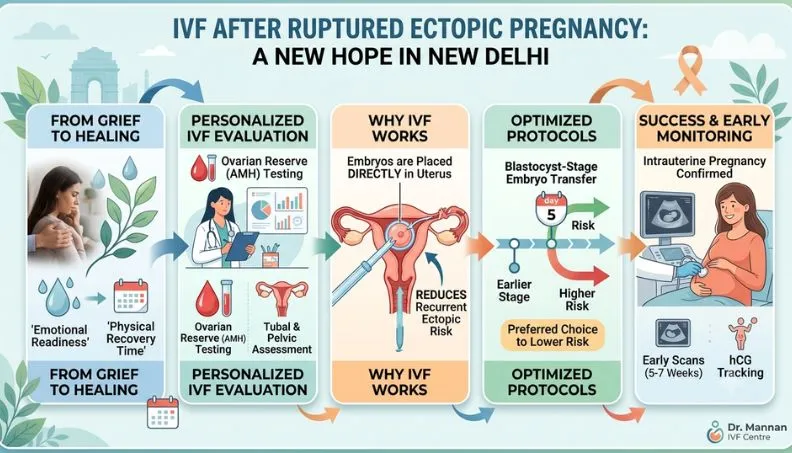
Put simply, it means using IVF to place the embryo directly into the uterus, bypassing the fallopian tube where the previous pregnancy went wrong.
- Understanding What Changes After Tubal Loss
When a fallopian tube is removed or damaged after a ruptured ectopic pregnancy, natural conception becomes harder, sometimes because one tube is gone and sometimes because scarring affects how an embryo travels.
IVF sidesteps this problem entirely by fertilizing the egg outside the body and transferring the resulting embryo straight into the uterus, where a pregnancy is meant to develop.
If you are still processing what happened during your ectopic pregnancy, including the early signs, what the rupture involved, and why IVF patients face elevated risk, our guide on ectopic pregnancy after IVF: signs, risks and what happens when it ruptures covers the full clinical picture from early warning to emergency care, which many patients find helpful context before starting a new cycle.
- Why This Path Brings Both Fear and Hope
It’s completely natural to feel two things at once here: hope for a new pregnancy and fear that it might happen “wrong” again the way the last one did. This isn’t overthinking; it’s a normal emotional response, and one we take seriously in how we guide patients through the process, not just the medicine.
What Increases the Risk of Another Ectopic Pregnancy?
Understanding your specific risk factors helps us build a safer, more personalized IVF plan rather than treating every case the same way.
- Tubal Damage and Scar Tissue
Previous tubal surgery, pelvic infections, or endometriosis can leave scar tissue that narrows or blocks the fallopian tube.
Even with IVF bypassing the tube for embryo placement, in rare cases an embryo can still migrate backward into a damaged tube, which is why we monitor closely rather than assume risk is zero.
- Prior Ectopic History
Research shows that women with a history of recurrent ectopic pregnancy who undergo IVF actually see their ectopic rate drop to levels similar to women with no ectopic history at all once appropriate protocols are followed. This is genuinely reassuring data, not just a hopeful assumption.
- Embryo Transfer Choices
One of the most practical, evidence-backed decisions we make is the stage at which we transfer the embryo.
Data shows blastocyst-stage transfer significantly reduces the odds of ectopic pregnancy compared to earlier cleavage-stage transfer, a detail that genuinely changes outcomes and one we factor into every protocol for patients with a prior ectopic history.
Dr Mannan IVF Centre
Experience world-class fertility care with Dr. Mannan Gupta at the Best IVF Centre in Delhi
How Soon Can IVF Begin After a Ruptured Ectopic Pregnancy?
Most women can safely begin IVF preparation once the body has physically healed, typically a few months after surgery, though this varies by individual case.
- Physical Healing Timeline
After laparoscopic surgery for a ruptured ectopic pregnancy, we generally recommend allowing the surgical site to heal fully and hormone levels (particularly hCG) to return completely to zero before starting any fertility treatment. This is usually a matter of weeks, not months, for most patients.
- Emotional Readiness
Physical healing and emotional readiness don’t always move at the same pace, and that’s completely okay. We never rush a patient into IVF before she feels ready; this journey works best when both body and mind are prepared to move forward.
How Do We Assess Whether IVF Is the Right Path for You?
We start with a complete picture of your reproductive health, not just the history of your last pregnancy.
- Reviewing Tubal and Ovarian Health
An ultrasound and, where needed, further imaging help us understand the condition of your remaining tube (if any) and both ovaries. This tells us not just whether IVF is appropriate but how to tailor the protocol specifically to you.
A key part of this assessment is ovarian reserve testing, particularly AMH (Anti-Müllerian Hormone), which gives us a clear picture of how many eggs remain and how the ovaries are likely to respond to stimulation.
If you have recently received an AMH result and want to understand what it means for your IVF prospects after ectopic surgery, our guide on what AMH levels mean and how they predict IVF success explains the numbers, the clinical thresholds, and what they mean for your specific situation.
- Personalising the Protocol
Every patient’s hormonal profile, ovarian reserve, and prior obstetric history shape a different stimulation plan. There is no single “standard” IVF protocol after an ectopic pregnancy; the plan is built around your specific situation.
If you would like to understand what a full IVF evaluation involves before your first consultation, our IVF Treatment in New Delhi page outlines the clinical approach at Dr. Mannan IVF Centre, including what personalized protocol design looks like for patients with a prior ectopic history.
What Does the IVF Process Look Like After Ectopic Loss?
The core process is the same as any IVF cycle, but with additional precautions built in specifically because of your history.
- Stimulation and Monitoring
Hormonal stimulation encourages the ovaries to produce multiple eggs, which are then retrieved and fertilized in the lab. Monitoring throughout this phase is slightly closer for patients with a prior ectopic pregnancy, simply to catch any concern early.
- Why Blastocyst Transfer Is Often Preferred
As mentioned earlier, allowing embryos to develop to the blastocyst stage (around day 5) before transfer has been shown to meaningfully lower ectopic risk. It also allows better assessment of embryo quality before transfer.
- Confirming Pregnancy Location Early
Once a pregnancy is confirmed through beta-hCG blood tests, we schedule an early transvaginal ultrasound, usually between 5 and 7 weeks, specifically to confirm the pregnancy is developing inside the uterus. This single step is one of the most effective ways to catch any problem long before it becomes an emergency.
What Does Recovery and Ongoing Monitoring Look Like?
Recovery here isn’t just physical; it includes a structured monitoring plan that continues well into the first trimester.
- Early Scans and hCG Tracking
Regular hCG level tracking in the first two weeks after a positive test tells us the pregnancy is progressing normally. This is followed by scheduled ultrasounds to confirm heartbeat and correct positioning.
- What “Safe” Looks Like Week by Week
By around 7 to 8 weeks, once we’ve confirmed an intrauterine pregnancy with a visible heartbeat, much of the acute ectopic-related anxiety can genuinely begin to ease. We continue standard prenatal monitoring from there, just as we would for any healthy pregnancy.
How Does This Journey Affect Emotional Well-Being?
This part deserves as much attention as the clinical side because IVF after loss is rarely just a medical process.
- Grief Alongside Hope
Many women feel guilty for hoping again so soon after a loss, as though moving forward means forgetting what happened. It doesn’t. Hope and grief can exist side by side, and neither cancels out the other.
- Support Systems That Help
Partners, family, and counseling support all play a meaningful role during this time. We encourage patients to lean on these systems openly rather than carrying the emotional weight of this journey alone.
Can Future Ectopic Risk Be Reduced Long-Term?
Yes, through a combination of careful protocol choices and vigilant early monitoring, most patients see a meaningfully lower risk in subsequent IVF cycles.
- Protocol Adjustments
Blastocyst transfer, careful assessment of tubal health, and personalized stimulation protocols all contribute to reducing recurrence risk over time.
For women who have also experienced a failed IVF cycle in addition to their ectopic history, a structured post-failure review can identify protocol refinements that meaningfully improve the next attempt.
Our Failed IVF Treatment in New Delhi page covers exactly this kind of evaluation: what is assessed, what is adjusted, and how that changes outcomes in subsequent cycles.
- Lifestyle and Monitoring Habits
Prompt treatment of any pelvic infection, avoiding smoking, and attending every scheduled scan in early pregnancy all support a safer outcome—small, manageable habits that make a real clinical difference.
Final Thoughts
Facing IVF after a ruptured ectopic pregnancy means carrying both grief and hope forward together, and that is not a contradiction; it’s simply what healing looks like.
The evidence is genuinely reassuring: IVF does not lower your chances of success, and with the right protocol, it can meaningfully reduce your risk of facing another ectopic pregnancy.
With careful planning, early monitoring, and support at every step, a healthy pregnancy is very much within reach.
If you’re ready to explore what this path could look like for you, Dr. Mannan Gupta and our team at Dr. Mannan IVF Centre are here to guide you through it with care and clarity. Reach out through drmannanivfcentre.com to book a consultation and take the next step toward the family you’re hoping for, right here in New Delhi.
Frequently Asked Questions
Does having one fallopian tube removed reduce my IVF success rate?
No, IVF success rates are generally similar regardless of whether you have one or both tubes, since embryos are placed directly into the uterus. Your ovarian reserve and egg quality matter far more than tube count for IVF outcomes.
Can stress from my previous ectopic pregnancy affect my IVF cycle?
Emotional stress alone doesn’t directly cause IVF failure, though managing it well can make the process feel more manageable. Speaking with a counselor alongside your fertility treatment is often genuinely helpful.
Will I need extra monitoring compared to a regular IVF patient?
Yes, patients with a prior ectopic pregnancy typically receive earlier and more frequent scans in the first trimester to confirm the pregnancy’s location. This is a precaution, not a sign that something is expected to go wrong.
How many IVF cycles might I need after an ectopic pregnancy?
This varies significantly by individual factors like age and ovarian reserve, with many women achieving pregnancy within one to three cycles. Your fertility specialist can give you a more personalized estimate after initial testing.
Is a frozen embryo transfer safer than a fresh one after ectopic pregnancy?
Both can be safe options, though the right choice depends on your specific hormonal and uterine lining conditions at the time. Your doctor will recommend whichever approach best supports the uterus for implantation in your case.
Can I still have a natural pregnancy after IVF was recommended?
It’s possible in some cases, particularly if you still have one healthy, open fallopian tube. However, IVF is often recommended specifically because it offers a more controlled and lower-risk path after tubal damage.
Does age affect IVF success after an ectopic pregnancy?
Yes, age affects egg quality and ovarian reserve, which influence IVF success independent of your ectopic pregnancy history. This is why fertility assessment includes ovarian reserve testing regardless of your obstetric history.
How is an ectopic pregnancy during IVF different from a natural one?
Clinically, it’s managed the same way through monitoring, medication, or surgery depending on severity. The difference lies mainly in how closely it’s monitored, since IVF pregnancies are typically tracked earlier and more frequently.
Will insurance or IVF packages cover treatment after an ectopic pregnancy?
This depends entirely on your specific insurance policy or clinic package, so it’s best discussed directly with the clinic’s counseling team. Many clinics can guide you through what’s included for patients with your specific medical history.
Can I try IVF again if a previous IVF cycle also resulted in an ectopic pregnancy?
Yes, a previous ectopic pregnancy during IVF doesn’t disqualify you from trying again, especially with protocol adjustments like blastocyst transfer. Many women go on to have successful intrauterine pregnancies in subsequent cycles.
