

Dr Mannan Gupta
Medically Reviewed by Dr. Mannan Gupta On Oct 22, 2026
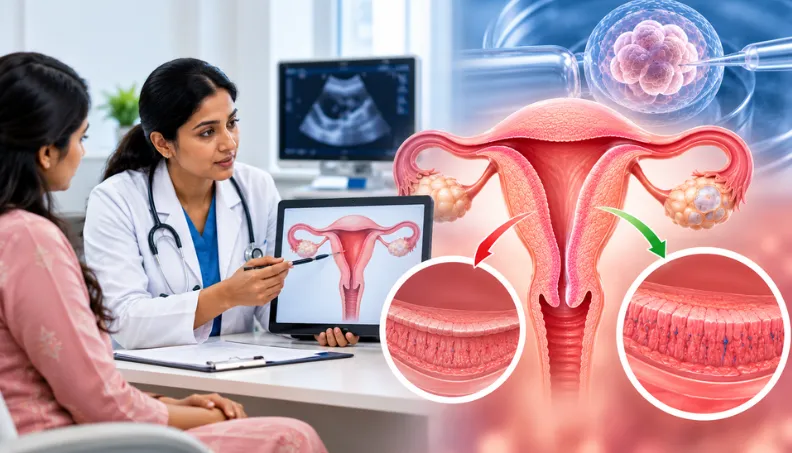
This image is AI-generated and intended for illustrative purposes only.
A thin uterine lining can make you worry that pregnancy or IVF may not work, but a thin endometrium is not the same as being unable to conceive.
I’m Dr. Mannan Gupta, IVF Specialist at Dr. Mannan IVF Centre in New Delhi, and I usually start by finding out why the lining is thin before deciding what treatment is appropriate.
Key Takeaways
- A thin endometrium can have several causes, including previous uterine procedures, adhesions, hormonal factors and some uterine conditions.
- Endometrial thickness is important, but it is not the only factor that determines implantation.
- Treatment depends on the cause and may involve adjusting the preparation protocol or treating a problem inside the uterus.
- PRP, aspirin, sildenafil and other add-on treatments should not be treated as guaranteed solutions because evidence remains limited or mixed for several of them.
- If the lining repeatedly remains thin before IVF or embryo transfer, a fertility specialist may recommend further assessment before proceeding.
What does a thin endometrium mean for pregnancy?
A thin endometrium means the lining inside the uterus has not developed to the thickness expected at a particular stage of the menstrual or treatment cycle. The endometrium is the tissue where an embryo needs to implant and continue developing.
In fertility treatment, the lining is usually assessed by transvaginal ultrasound. Many clinical studies and guidelines use less than 7 mm as a practical definition of a thin lining, although some use an 8 mm threshold. There is no single measurement that can predict pregnancy for every woman.
This is important because I don’t want you to look at one ultrasound number and assume that pregnancy is impossible. Successful pregnancies can occur with thinner linings, while a thicker lining does not automatically mean that implantation will occur.
The ultrasound pattern, hormone exposure, uterine cavity, embryo quality and your individual medical history all matter.
Can you get pregnant with a thin uterine lining?
Yes, pregnancy can still happen with a thin endometrium. The effect depends on how thin the lining is, why it is thin, the type of treatment being used and other fertility factors.
Research has found an association between thinner endometrium and lower pregnancy outcomes in some IVF settings, particularly in frozen embryo transfer cycles. However, endometrial thickness alone has limited ability to predict an individual woman’s pregnancy outcome.
If you’re trying naturally, your doctor may look beyond the measurement itself and assess ovulation, the uterus, fallopian tubes and other causes of infertility.
If you’re preparing for IVF, the decision is more specific. We need to know whether the lining is responding to the treatment protocol and whether there is a correctable reason for the poor development.

Dr Mannan IVF Centre
Experience world-class fertility care with Dr. Mannan Gupta at the Best IVF Centre in Delhi
What causes the endometrium to become thin?
There isn’t one single cause of a thin endometrium. Previous uterine procedures and damage to the uterine lining are important possibilities, but hormonal and structural factors can also play a role.
Some possible factors include:
- Previous dilation and curettage or other procedures involving the uterine cavity
- Intrauterine adhesions, sometimes called Asherman’s syndrome
- Previous uterine surgery
- Certain infections or inflammatory conditions
- Poor response of the endometrium to estrogen
- Uterine abnormalities such as polyps or fibroids affecting the cavity
- Previous treatment that may have damaged the endometrial tissue
- A lining that is naturally thinner in some women without one obvious cause
The Indian Council of Medical Research recommends transvaginal ultrasound as part of female infertility assessment, including assessment of endometrial thickness and pattern and checking for conditions such as fibroids, adenomyosis and polyps.
This is confirmed in ICMR’s own Standard Treatment Workflow for Female Infertility, issued by the Department of Health Research, Ministry of Health and Family Welfare, Government of India.
That is why I would not recommend simply taking a medicine to “make the lining thick” without first asking what is causing the problem.
How is a thin endometrium diagnosed before IVF?
The first step is usually a transvaginal ultrasound performed at the appropriate point in the cycle. The scan measures the lining and can also provide information about its appearance and the uterus.
Depending on your history, further assessment may include:
- Reviewing previous IVF or embryo-transfer cycles
- Checking how the lining responded to estrogen or another preparation protocol
- Reviewing previous uterine surgeries or procedures
- Looking for fibroids, polyps or adenomyosis
- Assessing the uterine cavity when adhesions or another structural problem is suspected
- Considering hysteroscopy or sonohysterography when clinically appropriate
The Canadian Fertility and Andrology Society guideline notes that ultrasound measurement can be affected by several factors, including fibroids, adenomyosis, polyps, uterine position, previous surgery and differences between observers.
So, the number on the scan should always be interpreted in context.
What treatment can help a thin endometrium?
Treatment should target the underlying reason rather than relying on one universal “lining treatment.”
If the lining is not developing adequately during an IVF or frozen embryo transfer preparation cycle, your fertility specialist may review the hormonal preparation and modify the protocol. Estrogen exposure is an important part of endometrial development in hormone-prepared cycles, but the exact dose, route and duration should be decided individually.
If a structural problem is found, treating that problem may be more important than adding another medication.
For example, if intrauterine adhesions are present, hysteroscopic treatment may be considered. If a polyp or another cavity abnormality is affecting the uterine environment, its management may form part of the fertility plan.
The ICMR female infertility workflow specifically includes hysteroscopic management such as polypectomy, septum resection and adhesiolysis when uterine cavity pathology is identified.
Can estrogen treatment improve a thin endometrium?
Estrogen is commonly used to prepare and support the endometrium, particularly in hormone-prepared frozen embryo transfer cycles. The purpose is to encourage the lining to develop before progesterone is introduced and the embryo transfer is timed.
If your lining remains thin despite treatment, your doctor may review the dose, route, duration and overall preparation protocol.
However, more estrogen is not automatically better. Increasing medication without medical supervision can cause side effects and may not solve the underlying problem.
If repeated cycles show poor endometrial development, I would focus on understanding the pattern rather than simply increasing medication each time.
What if the thin lining is caused by adhesions or scarring?
If scar tissue has reduced the uterine cavity, treating the adhesions may be an important part of the fertility plan. You can read more about how we approach hysteroscopic correction of adhesions, polyps and other uterine cavity issues on our Fertility Enhancing Surgery page.
Intrauterine adhesions can develop after procedures involving the uterus and can interfere with normal endometrial development. Hysteroscopy allows the uterine cavity to be viewed directly and, when adhesions are present, may allow treatment during the same procedure.
A clinical guideline recommends considering hysteroscopy or sonohysterography in selected patients with thin endometrium to look for pathological causes.
This is one reason I don’t consider a thin ultrasound measurement to be the final diagnosis. Sometimes the more important question is what is happening inside the uterine cavity.
Is PRP a proven treatment for thin endometrium?
PRP is being studied for refractory thin endometrium, but it should not be described as a guaranteed or universally proven treatment.
Platelet-rich plasma contains growth factors and has been investigated as an intrauterine treatment in women whose lining remains thin despite standard management.
Some studies have reported an increase in endometrial thickness after PRP. For example, a small prospective study from AIIMS New Delhi reported an increase in endometrial thickness after PRP, but its sample size was small and the study was not enough to establish PRP as a standard treatment for every patient.
More recent research continues to investigate PRP, which tells us that this remains an evolving area rather than a settled treatment.
I would therefore discuss why PRP is being considered, what evidence applies to your situation, its cost and alternatives before proceeding.
Should you take aspirin, sildenafil or supplements to thicken the lining?
You should not start aspirin, sildenafil, vitamin E, L-arginine or other medicines simply because you have read that they may improve blood flow to the uterus.
Several approaches have been investigated for thin endometrium, but evidence for improving pregnancy or live birth outcomes is inconsistent. The Canadian guideline, for example, recommends against using aspirin specifically to improve pregnancy rates in patients with thin endometrium undergoing embryo transfer.
Some treatments may have a role in selected situations, but that is different from saying they work for everyone.
The same principle applies to supplements and so-called endometrial rejuvenation treatments. A treatment should have a reason behind it, not just a promise attached to it.
Should embryo transfer be postponed if the lining is thin?
Sometimes, postponing embryo transfer may be considered if the lining remains persistently thin and the clinical situation suggests that another preparation cycle could be more appropriate.
This is particularly relevant when embryos have already been created and frozen. A later frozen embryo transfer can allow the fertility team to reassess the uterine lining and modify the preparation before transfer.
There is no single thickness at which every clinic must cancel a transfer. The decision depends on the lining, its pattern, the cause, previous treatment response, embryo factors and the overall clinical situation.
This is why I prefer an individual discussion rather than telling every patient with a lining below a particular number that transfer must or must not happen.
Can thin endometrium cause IVF failure?
A thin endometrium may be one factor associated with lower implantation or pregnancy rates in some IVF settings, but it should not automatically be blamed for an unsuccessful IVF cycle.
Embryo chromosomal status, embryo development, uterine abnormalities, timing of progesterone exposure and other factors can influence implantation.
If you have experienced repeated failed transfers, it may be more useful to review the entire cycle than to focus only on the endometrial measurement.
I discuss this broader approach in Failed Embryo Transfer: What to Do Next and How to Cope, particularly when a good-quality embryo has not implanted.
What should you do if your endometrium stays thin during IVF?
If your lining repeatedly remains thin, don’t simply repeat the same treatment without reviewing why it is happening.
I would usually want to understand:
- What was the maximum lining thickness achieved?
- At what stage of the cycle was it measured?
- What did the ultrasound pattern look like?
- How did the lining respond to previous hormonal preparation?
- Have you had D&C, uterine surgery or another procedure?
- Could there be an adhesion, polyp or other cavity problem?
- Have previous embryo transfers failed?
- Is another preparation protocol appropriate?
The answer may be as simple as adjusting the treatment protocol, or it may require investigation of the uterine cavity.
If you are preparing for IVF in Delhi and have repeatedly been told that your lining is thin, you may wish to seek advice from our team at Dr. Mannan IVF Centre to understand the possible causes and discuss treatment options before deciding on your next embryo transfer.
Can lifestyle changes improve a thin endometrium?
Healthy lifestyle habits support general reproductive health, but there is no diet or home remedy proven to reliably correct a persistently thin endometrium.
I encourage patients to focus on practical basics such as:
- Eating a balanced diet
- Maintaining a healthy weight where appropriate
- Avoiding smoking
- Limiting alcohol
- Staying physically active according to individual health needs
- Taking prescribed medicines correctly
- Attending scheduled monitoring appointments
These habits are supportive, but they should not replace evaluation when there is a persistent problem with the uterine lining.
What does the treatment plan usually look like?
The treatment plan depends on whether the problem is hormonal, structural, treatment-related or unexplained.
A typical clinical approach may involve:
- Confirming the finding with appropriately timed ultrasound.
- Reviewing your medical and fertility history, including previous procedures and IVF cycles.
- Looking for a correctable uterine problem when your history suggests one.
- Adjusting endometrial preparation if the lining is not responding adequately.
- Considering whether embryo transfer should proceed or be deferred based on the complete clinical picture.
- Discussing additional treatments cautiously when standard approaches have not worked.
The aim is not simply to produce a larger number on an ultrasound report. The aim is to create the best possible treatment plan for your individual reproductive situation.
Frequently Asked Questions
1. Can a 5 mm endometrium support pregnancy?
Yes, pregnancy can occur with a thinner lining, although lower endometrial thickness may be associated with poorer outcomes in some IVF settings. Your individual situation matters more than one number alone.
2. What is the ideal endometrial thickness for IVF?
There is no single thickness that guarantees implantation. Many clinical guidelines use around 7 mm as an important reference point, particularly for frozen embryo transfer, but thickness must be interpreted along with other clinical factors.
3.Can a thin endometrium be permanently cured?
Not always. Some causes, such as intrauterine adhesions, may be treatable, while other cases remain difficult to correct. The treatment depends on the underlying cause.
4. Can I improve my uterine lining naturally?
A healthy lifestyle supports overall fertility, but there is no proven food, drink or home remedy that reliably thickens a persistently thin endometrium.
5. Does thin endometrium always mean IVF will fail?
No. A thin lining can be associated with lower implantation or pregnancy rates in some IVF settings, but it does not mean that pregnancy is impossible.
6. Is hysteroscopy needed for every woman with thin endometrium?
No. Hysteroscopy is not automatically required for everyone. It may be considered when the medical history or repeated thin lining raises concern about adhesions or another uterine cavity problem.
7. Does PRP guarantee pregnancy in women with thin endometrium?
No. PRP is an emerging treatment with some encouraging research, but the evidence is not strong enough to describe it as a guaranteed solution or universally appropriate treatment.
Final Thoughts
Being told that your endometrium is thin can be upsetting, especially when you are already going through fertility treatment. It does not mean that pregnancy is impossible.
The important step is to understand why the lining is thin and whether there is something that can be corrected or adjusted before pregnancy or embryo transfer.
If you’re undergoing IVF in Delhi, I would encourage you to discuss the ultrasound findings, previous treatment response and your complete fertility history with an IVF specialist before deciding what to do next.
Medical Disclaimer:
This article is provided for general educational purposes only. It does not replace an individual medical consultation, physical examination, diagnosis or personalised treatment plan. Thin endometrium can have different causes, and treatment should be decided by a qualified fertility specialist based on your individual medical history and investigations.
