
Why Surgery Was Needed After Methotrexate Failed for Ectopic?

Dr Mannan Gupta
Medically Reviewed by Dr. Mannan Gupta On July 17, 2026

If you were told methotrexate would end your ectopic pregnancy without surgery and then found yourself in an operating theater days later anyway, you’re likely feeling confused, maybe even a little betrayed by your own body or your treatment plan.
I want to address that directly: methotrexate not working is a known, expected outcome in a meaningful percentage of cases; it is not a failure of your care, and it doesn’t mean something went wrong that could have been prevented.
As an IVF specialist offering ectopic pregnancy surgery in New Delhi, I see this exact situation regularly, and I want to walk you through why it happens and what it means for you now.
Key takeaways:
- Methotrexate fails in roughly 10-30% of cases depending on individual hCG levels and other factors
- Failure is usually identified through hCG blood test trends, not sudden symptoms
- A second methotrexate dose is sometimes tried before surgery becomes necessary
- Needing surgery after methotrexate does not change your future fertility outlook
- The emotional adjustment of a “failed” medical treatment is real and deserves attention, not just the physical recovery
What Is Methotrexate and Why Was It Used First?
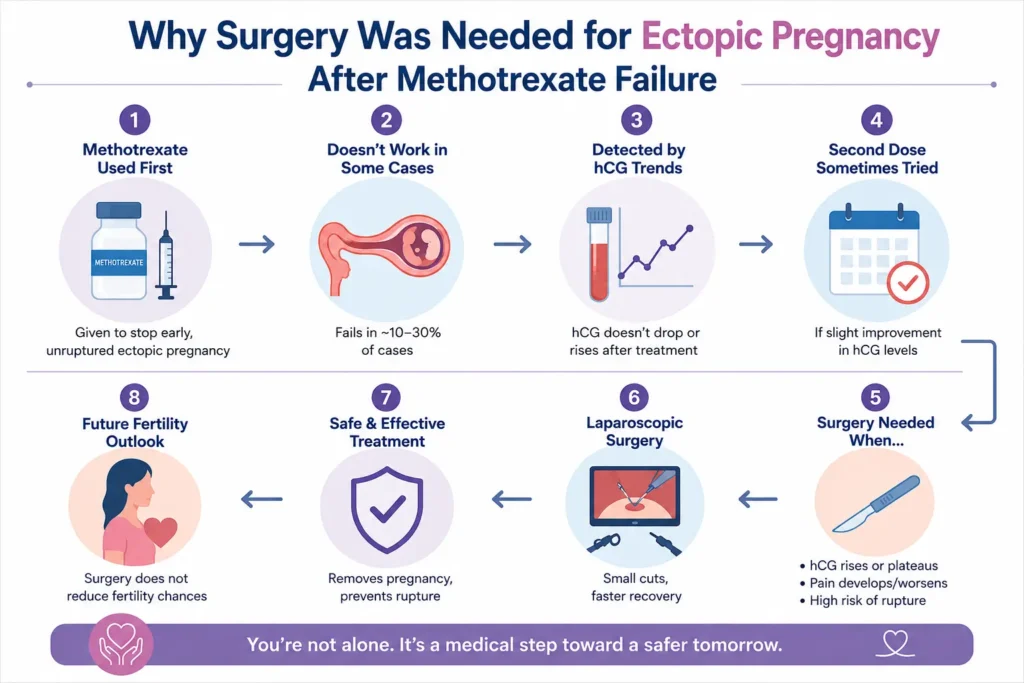
Methotrexate is a medication that stops rapidly dividing cells from growing, which is used to end an early, unruptured ectopic pregnancy without surgery.
It works because pregnancy tissue divides quickly, and methotrexate blocks that process, allowing your body to gradually absorb the tissue over several weeks.
It’s typically offered first because it avoids surgery entirely when conditions are right no incisions, no anesthesia, and no time off for surgical recovery.
But it only works well under specific conditions: your hCG level (the pregnancy hormone) needs to be relatively low, generally under 5,000 IU/L for good success odds; there should be no visible heartbeat in the pregnancy; and you need to be reliably available for repeated blood tests over several weeks.
If those conditions were met in your case, methotrexate was a reasonable first choice, not a wrong one.
Why Do Some Ectopic Pregnancies Not Respond to Methotrexate?
Methotrexate fails in an estimated 10-30% of cases, most commonly because the hCG level doesn’t drop as expected or actually rises after treatment.
This is measured through repeat blood tests in the days following the injection; it’s not something you’d feel or notice physically at first.
Higher starting hCG levels are one of the strongest predictors of failure one study found success dropped meaningfully once hCG rose above 5,000-10,000 IU/L.
The presence of a visible fetal heartbeat on ultrasound also lowers success rates significantly. Some pregnancies located in less common sites like the cornual region of the uterus also respond less reliably to medication than typical tubal pregnancies.
None of these factors were things you could have controlled or predicted with certainty in advance. Doctors offer methotrexate based on probability, not certainty, and a meaningful minority of appropriately selected patients will still need surgery.

Dr Mannan IVF Centre
Experience world-class fertility care with Dr. Mannan Gupta at the Best IVF Centre in Delhi
How Serious Was It, Really?
When hCG plateaus or rises instead of falling after methotrexate, it means the pregnancy tissue is still active, and that carries a real risk of tubal rupture the longer it’s left untreated.
This is why your doctor moved to surgery rather than waiting longer or trying a third round of monitoring.
A plateau isn’t automatically an emergency the way a rupture is, but it removes the option of continued watching and waiting.
Once methotrexate has clearly not worked, delaying further increases the risk of the tube stretching and eventually tearing, which is a much more dangerous emergency situation than a planned surgical procedure.
Your care team’s decision to move to surgery at that point wasn’t caution for caution’s sake; it was based on the clinical reality that time was no longer working in your favor.
How Do Doctors Decide Between a Second Dose and Surgery?
A second dose of methotrexate is sometimes given if hCG trends suggest a partial response, but surgery becomes the clear choice when hCG rises significantly, plateaus over multiple tests, or if you develop worsening pain. This decision isn’t arbitrary; it follows a structured pattern of blood test monitoring.
If your hCG dropped even slightly after the first dose, a second dose may have been reasonable to try.
But if levels rose, stayed flat over consecutive tests, or you started developing pain or other symptoms, continuing to wait on medication stops making clinical sense.
Pain that develops or worsens after methotrexate treatment should never be dismissed as “normal side effects” it needs same-day evaluation, since it can signal the tube is under strain.
What Does the Surgery Involve After Methotrexate Didn't Work?
Surgery after methotrexate failure is typically done laparoscopically through small incisions with a camera and fine instruments and involves either removing the affected fallopian tube or, less often, removing just the pregnancy tissue while preserving the tube.
The choice depends on how much damage exists and whether the tube shows signs of impending rupture.
One nuance worth knowing: research following patients through the GEM3 trial found no meaningful difference in future pregnancy outcomes between women who conceived after methotrexate alone versus those who needed surgery afterward.
In other words, needing surgery after a failed medication attempt does not put you at a fertility disadvantage compared to methotrexate working on its own.
For women who want to understand what fertility-preserving surgical options exist and what post-surgical fertility planning looks like, our Fertility Enhancing Surgery in New Delhi page outlines the full range of approaches available.
If you want to understand exactly what happens inside the operating theatre during this procedure, including how the laparoscopic approach works, how the decision between salpingectomy and salpingostomy is made in real time, and what the team’s priorities are from the moment anesthesia begins, our detailed guide on what really happens when we remove a ruptured ectopic pregnancy walks through the surgical process step by step in plain language.
Many patients find this context genuinely helpful both before going into surgery and during recovery.
What Does Recovery Look Like After This Combined Treatment Path?
Physical recovery after surgery following methotrexate failure follows the same general timeline as ectopic surgery on its own: one to two weeks before light activity, four to six weeks before full exercise.
Because your body was already exposed to methotrexate, your doctor will also monitor for any lingering medication side effects like mouth sores or sun sensitivity during early recovery.
Follow-up hCG blood tests continue after surgery, just as they would for surgery-first patients, to confirm levels are falling steadily to zero.
One thing to expect: because you already had blood draws through the methotrexate phase, this second round of monitoring can feel repetitive and tiring that’s a legitimate frustration, not something to feel guilty about voicing to your care team.
For a complete, week-by-week guide to what post-surgical recovery involves including what warning signs need same-day attention, how emotional recovery progresses, and when it is safe to try again our detailed guide on follow-up care after a ruptured ectopic pregnancy covers all of this in full.
How Does This Affect Me Emotionally?
Having a treatment plan change from medication to surgery creates a distinct kind of emotional strain a sense of your body or the plan “failing” that’s different from knowing surgery was needed from the start. This deserves acknowledgment, not just physical aftercare instructions.
Many women describe feeling like they did something wrong, or that their body “rejected” a gentler treatment option.
This isn’t accurate, and it isn’t fair to yourself treatment failure rates are a known statistical reality of medicine, not a reflection of anything you did. If you’re finding yourself replaying “What if I’d done something differently?” that’s a common but ultimately unhelpful loop worth naming to a counselor or your care team rather than carrying alone.
What Does This Mean for Future Pregnancies?
Needing surgery after methotrexate failure does not lower your chances of a healthy future pregnancy, based on the pregnancy outcome data available.
Your fertility outlook is shaped mainly by which tube (if any) was affected, not by which treatment path you took to get there.
For any future pregnancy, your care team will likely recommend an early ultrasound around 6 weeks specifically to confirm the pregnancy’s location before waiting for a routine dating scan.
If your case involved specific complicating factors, like a cornual or unusual pregnancy location, that information will shape monitoring in future pregnancies too.
For women in New Delhi who are considering IVF as their path forward, particularly where tubal damage on both sides makes natural conception uncertain our IVF Treatment in New Delhi page explains what a post-ectopic IVF evaluation involves and what the protocol looks like for patients with this specific history.
Final Thoughts
Methotrexate not working doesn’t mean your treatment was mismanaged; it means your body’s response fell into the percentage of cases where medication alone isn’t enough, and your care team responded appropriately by moving to surgery before the situation became more dangerous.
The hCG trend that showed the medication wasn’t working, the surgery that followed, and the recovery ahead of you are all part of a coherent, medically sound process, not a chain of failures.
Your future fertility outlook remains good, and the emotional adjustment to this unexpected turn is worth as much attention as your physical healing.
If you’re processing this experience or thinking ahead to a future pregnancy, I’d encourage you to book a consultation with me, Dr. Mannan Gupta, at Dr. Mannan IVF Centre, New Delhi. We can go through your specific case, your hCG history, and build a clear plan for what comes next.
Frequently Asked Questions
Does having a second methotrexate dose fail mean something is unusual about my case?
No, needing a second dose that still doesn’t work happens in a documented subset of cases and isn’t a sign of an unusual or rare problem with your body.
Can I try methotrexate again for a future ectopic pregnancy even after it failed once?
Possibly your doctor will look at the specific factors behind the earlier failure, like your hCG level or pregnancy location, before deciding if it’s worth trying again.
Is it my fault if I didn't get blood tests done exactly on schedule?
Missing a single test rarely determines success or failure on its own, so try not to carry that as blame the bigger factors are usually hCG level and pregnancy location.
How long after failed methotrexate can I safely have the surgery?
Surgery is usually arranged promptly once failure is confirmed through blood tests, often within days, precisely to avoid the risk of the tube rupturing while waiting.
Will the methotrexate still in my system affect the surgery itself?
Generally no surgeons account for recent methotrexate use, though your doctor may monitor for lingering side effects like mouth sores during your post-op recovery.
Can I get pregnant again right away after this whole combined treatment?
It’s usually recommended to wait until your hCG has fully returned to zero and methotrexate has cleared your system, which your doctor will confirm through blood work before you try again.
Does needing surgery after methotrexate mean I'll definitely need surgery next time too?
No, each ectopic pregnancy is assessed on its own hCG level, size, and location, so a future case could still be eligible for medication-only treatment.
Why didn't my doctor just do surgery first if there was a chance methotrexate wouldn't work?
Because methotrexate succeeds in the majority of appropriately selected cases and avoids surgical risks and recovery time, it’s generally worth trying first when your case meets the criteria.
Can stress from this experience affect my next pregnancy?
Stress itself hasn’t been shown to directly cause another ectopic pregnancy, but it’s still worth addressing your anxiety with your care team going into a future pregnancy, since early monitoring can ease a lot of that worry.
Is it normal to feel angry at the process even though everyone did the right thing?
Yes, feeling frustrated or angry about a treatment plan changing unexpectedly is a normal reaction, even when every clinical decision made along the way was medically sound.
