

Dr Mannan Gupta
Medically Reviewed by Dr. Mannan Gupta On Nov. 26, 2026
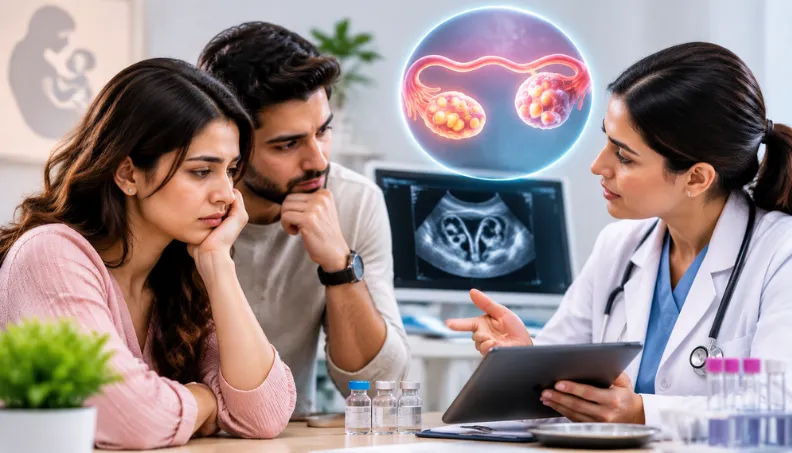
This image is AI-generated and intended for illustrative purposes only.
A poor ovarian response during an IVF cycle means the ovaries produced fewer follicles or eggs than expected after stimulation medication. It may be possible to optimise the treatment approach before the next IVF cycle, but there is no guaranteed way to increase the number of eggs or restore ovarian reserve.
The next step is to understand why the previous cycle resulted in a low response. Your IVF specialist may review your ovarian reserve tests, age, medication doses, stimulation protocol, follicle development and egg retrieval results before planning another cycle.
The aim is not simply to collect more eggs. It is to choose an approach that gives you a reasonable opportunity for egg development, fertilisation and embryo formation while considering your individual circumstances.
Key Takeaways
- Poor ovarian response does not automatically mean that the next IVF cycle will have the same result.
- Reviewing the previous stimulation cycle can help identify areas where treatment may be adjusted.
- Increasing IVF medication doses does not necessarily improve the number of eggs or live-birth chances.
- Mild stimulation and conventional IVF protocols may both be considered for women with a low ovarian response.
- Supplements such as DHEA and CoQ10 are not established solutions for poor ovarian response.
- Age, ovarian reserve, previous IVF results and overall fertility assessment help guide the next treatment plan.
What Causes Poor Ovarian Response During IVF?
Poor ovarian response occurs when the ovaries produce fewer follicles or eggs than expected after receiving fertility stimulation medication.
During IVF, injectable hormones called gonadotropins stimulate the ovaries to develop multiple follicles. Each follicle may contain an egg, although not every follicle produces a mature egg suitable for fertilisation.
A low response may be associated with:
- Diminished ovarian reserve: Fewer eggs may be available for recruitment during stimulation.
- Increasing age: Ovarian reserve and egg quality generally decline with age.
- Previous ovarian surgery: Certain procedures may affect the amount of functioning ovarian tissue.
- Previous chemotherapy or radiotherapy: Some treatments can affect ovarian function.
- Individual variation in medication response: Women may respond differently to the same stimulation protocol.
A low egg count during one IVF cycle does not always establish the reason for the response. Your doctor needs to consider the complete treatment history.
Can Poor Ovarian Response Be Improved Before the Next IVF Cycle?
The treatment approach may be optimised before another IVF cycle, but ovarian reserve cannot reliably be restored through medication, supplements or lifestyle changes.
Your specialist may review the previous cycle and consider whether a different stimulation protocol, medication combination or monitoring plan is appropriate.
For example, the doctor may assess whether the starting medication dose was suitable, how the follicles developed, whether some follicles grew faster than others and how many mature eggs were collected.
The expected benefit depends on the underlying cause. If the low response mainly reflects a limited number of recruitable follicles, changing the protocol may not substantially increase egg numbers. However, an individualised plan can help avoid repeating an approach that was unsuitable.

Dr Mannan IVF Centre
Experience world-class fertility care with Dr. Mannan Gupta at the Best IVF Centre in Delhi
What Should Be Reviewed Before Starting the Next IVF Cycle?
A detailed review of the previous IVF cycle is an important part of planning further treatment.
Your IVF specialist may examine the following:
Assessment | Why It Matters |
Previous stimulation protocol | Helps assess the medication approach used during the last cycle |
Medication dose and duration | Shows how the ovaries responded to the prescribed treatment |
Antral follicle count (AFC) | Estimates the number of small follicles visible on ultrasound |
Anti-Müllerian hormone (AMH) | Helps predict ovarian response to stimulation |
Follicle development | Shows how many follicles grew and how evenly they developed |
Number of eggs retrieved | Helps assess the outcome of stimulation and retrieval |
Number of mature eggs | Indicates how many retrieved eggs were mature enough for fertilisation |
Fertilisation and embryo development | Provides information about what happened after egg retrieval |
AMH and AFC are useful for estimating ovarian response, but they cannot independently predict whether IVF will result in a pregnancy or live birth. Age and other clinical factors also need to be considered.
Your doctor may recommend additional investigations depending on your medical history and previous treatment findings.
Can Changing the IVF Stimulation Protocol Improve Ovarian Response?
Changing the stimulation protocol may be considered when the previous approach did not produce the expected response. However, no single protocol is suitable for every woman with poor ovarian response.
Some approaches that may be discussed include:
Conventional IVF Stimulation
Conventional stimulation uses injectable fertility hormones to encourage multiple follicles to develop.
The starting dose and treatment duration are planned according to the patient’s ovarian reserve and previous response. You can read more about this process on our IVF Treatment page. A higher dose is not automatically more effective, particularly when the ovaries have a limited number of recruitable follicles.
Mild IVF Stimulation
Mild stimulation uses lower doses of injectable hormones, sometimes combined with oral medicines such as letrozole or clomiphene citrate.
It may be considered for selected women with poor ovarian response. The approach aims to stimulate a smaller number of follicles while reducing medication requirements.
The Indian Fertility Society’s 2024 guideline considers mild stimulation and conventional stimulation reasonable options for poor responders. The choice depends on individual characteristics and previous treatment response.
Modified Natural Cycle IVF
A modified natural cycle uses the follicle developing naturally during the menstrual cycle, with medication given when clinically required.
This approach may be considered in selected women with very low ovarian reserve. However, it is not routinely preferred over conventional stimulation for all women with a low response.
Your specialist can explain the expected egg yield, limitations and suitability of each approach before treatment begins.
Does Increasing IVF Injection Dosage Help Improve Egg Production?
Increasing the dose of IVF injections does not necessarily produce more eggs in women with poor ovarian response.
Gonadotropin injections stimulate the follicles that are available for development. If the ovaries have a limited number of recruitable follicles, using a higher medication dose may not increase the number of eggs collected.
The Indian Fertility Society’s 2024 guideline does not recommend increasing gonadotropin doses beyond standard levels to improve live-birth rates in expected poor responders. This is consistent with a meta-analysis hosted by the NIH’s National Library of Medicine, which found no meaningful live birth advantage from higher-intensity stimulation in poor responders across 15 randomised controlled trials.
Your specialist may still review the starting dose and medication combination used previously. However, do not increase, reduce or change fertility medication without medical guidance.
Can Supplements Improve Poor Ovarian Response Before IVF?
No supplement has been proven to reliably restore ovarian reserve or guarantee an improved response in the next IVF cycle.
We’ve discussed how DHEA and CoQ10 fit into an individualised protocol, and where the evidence actually stands, in Repeated IVF Failures? Your Egg Quality May Be the Problem.
Some supplements are discussed in fertility treatment, but their evidence and suitability vary.
Supplement or Treatment | What to Know |
Coenzyme Q10 (CoQ10) | Has been studied for its possible role in reproductive health, but it is not an established treatment for poor ovarian response. |
DHEA | Current ESHRE guidance does not recommend routine DHEA use for low responders undergoing ovarian stimulation. |
Antioxidants | Evidence is insufficient to recommend antioxidant pretreatment as a standard solution for poor ovarian response. |
Vitamin supplements | May be recommended for nutritional deficiencies or other medical reasons, but they do not restore ovarian reserve. |
The Indian Fertility Society’s guideline does not recommend routine CoQ10 or DHEA supplementation for poor responders. The updated ESHRE guideline also advises against DHEA use in low responders.
Do not start fertility supplements or hormonal medicines without discussing their potential benefits, risks and interactions with your doctor.
Can Diet and Lifestyle Changes Improve Ovarian Response?
Healthy lifestyle habits support general reproductive and preconception health, but they have not been shown to reliably increase egg numbers in women with poor ovarian response.
Before another IVF cycle, you can discuss practical health measures with your specialist.
These may include:
- Eating a balanced diet with vegetables, fruits, whole grains, protein and healthy fats.
- Maintaining a healthy weight where possible.
- Avoiding smoking and tobacco products.
- Limiting or avoiding alcohol while planning fertility treatment.
- Getting adequate sleep and maintaining regular physical activity.
- Managing existing health conditions with appropriate medical advice.
These measures may support general health during fertility treatment. However, they should not be presented as a way to reverse diminished ovarian reserve or guarantee better IVF results.
How Long Should You Wait Before the Next IVF Cycle?
There is no single waiting period that applies to every woman after a poor ovarian response.
The timing depends on your recovery from the previous cycle, menstrual cycle, ovarian findings, treatment history and the proposed stimulation approach.
Some women may be able to discuss another cycle after their next menstrual period, while others may need additional assessment or recovery time.
Your specialist may recommend waiting if there are medical reasons to do so. If the aim is to accumulate eggs or embryos across multiple retrievals, the treatment schedule may also differ.
Avoid delaying treatment for several months solely to try unproven supplements or lifestyle programmes, particularly if age is an important factor in your fertility assessment.
Does Poor Ovarian Response Mean the Next IVF Cycle Will Fail?
No. A poor response in one IVF cycle does not automatically mean that the next cycle will fail.
The outcome depends on several factors, including:
- Your age and ovarian reserve.
- The number of follicles that develop.
- The number of eggs retrieved and their maturity.
- Fertilisation and embryo development.
- Sperm-related factors.
- Uterine and endometrial health.
- The overall treatment plan.
A cycle that produces fewer eggs may still result in a suitable embryo. Similarly, collecting more eggs does not guarantee pregnancy.
It is important to discuss realistic expectations with your IVF specialist rather than judging the chances of success only by the number of eggs retrieved.
When Should You Consult an IVF Specialist After Poor Ovarian Response?
Consider consulting an IVF specialist before starting another cycle if you had fewer eggs retrieved than expected, very few mature eggs, limited follicle development or repeated low responses to stimulation.
A consultation is also useful if your AMH or AFC results suggest reduced ovarian reserve, or if you are unsure whether the previous stimulation protocol was appropriate.
Bring your previous IVF reports, stimulation medication details, ultrasound findings, egg retrieval report and embryo development records. These details can help your doctor review the previous cycle and discuss the next steps.
If you are considering another IVF cycle, you can discuss your previous treatment reports and available options with a fertility specialist at Dr. Mannan IVF Centre, New Delhi.
Frequently Asked Questions
1. Can poor ovarian response be reversed before IVF?
Poor ovarian response cannot reliably be reversed because it may be related to reduced ovarian reserve. However, the stimulation protocol and treatment plan can be reviewed before another IVF cycle.
2. Can AMH levels improve before the next IVF cycle?
AMH levels can fluctuate, but no proven treatment reliably restores ovarian reserve or increases the number of available eggs. AMH should be interpreted alongside age, AFC and previous IVF results.
3. Does increasing IVF injection dosage produce more eggs?
Not necessarily. Increasing gonadotropin doses beyond standard levels has not been shown to improve live-birth rates in expected poor responders. The appropriate dose should be selected by the treating specialist.
4. Is mild IVF better for poor ovarian responders?
Mild IVF may be suitable for some women, while conventional stimulation may be appropriate for others. Both approaches are considered reasonable options in the Indian Fertility Society’s guidance.
5. Can CoQ10 improve egg quality before IVF?
CoQ10 has been studied for its possible effects on reproductive health, but there is insufficient evidence to recommend it routinely for poor ovarian response. Discuss supplements with your doctor before taking them.
6. Is DHEA recommended before another IVF cycle?
Current ESHRE guidance does not recommend DHEA for low responders undergoing ovarian stimulation. It should not be started without medical advice.
7. How many eggs are considered a poor ovarian response?
There is no single egg number that defines poor response in every situation. The assessment depends on age, ovarian reserve, expected response and the number of follicles and eggs observed during treatment.
8. Should I change my IVF clinic after a poor response?
A poor response alone does not mean that your previous clinic or treatment was inappropriate. You may discuss the cycle results with your current specialist or seek a second opinion if you need further clarification about the treatment plan.
9. Can stress cause poor ovarian response during IVF?
Stress can affect emotional well-being during fertility treatment, but it is not established as a direct cause of poor ovarian response. A low response should be assessed through ovarian reserve, treatment history and clinical findings.
10. Can IVF still work with only one or two eggs retrieved?
Pregnancy may still be possible when one or two eggs are retrieved, although the number of eggs available for fertilisation and embryo development is limited. The outcome depends on egg maturity, fertilisation, embryo development and other fertility factors.
Medical Disclaimer:
This article is intended for general educational purposes and should not replace an individual medical consultation. Poor ovarian response and IVF outcomes vary from person to person. Treatment protocols, medication doses and the timing of another IVF cycle should be decided by a qualified fertility specialist after reviewing your medical history and previous treatment records.
