
Step-by-Step IUI Process in Delhi: From First Scan to Pregnancy Test

Dr Mannan Gupta
Medically Reviewed by Dr. Mannan Gupta On Feb 16, 2026
Embarking on a fertility journey can feel overwhelming, but understanding the roadmap ahead often brings much-needed peace of mind.
If you are exploring Intrauterine Insemination (IUI), you are likely looking for a clear path forward.
The IUI process is a structured medical journey that involves monitoring the female cycle, preparing a concentrated sperm sample, and placing it directly into the uterus during the peak fertile window to maximize the chances of natural-style conception.
As an expert with over 10 years of experience, I, Dr. Mannan Gupta, have spent a years at Dr. Mannan IVF Centre helping couples navigate these steps with medical precision and heartfelt care.
Key Takeaways
- Initial Phase: Focuses on baseline scans and blood tests to check reproductive health.
- Stimulation: Involves mild medication to encourage healthy egg development.
- The Procedure: A quick, painless office-based step that bypasses cervical barriers.
- Post-IUI: Requires a “two-week wait” before a definitive pregnancy test.
What is the first step in the IUI process?
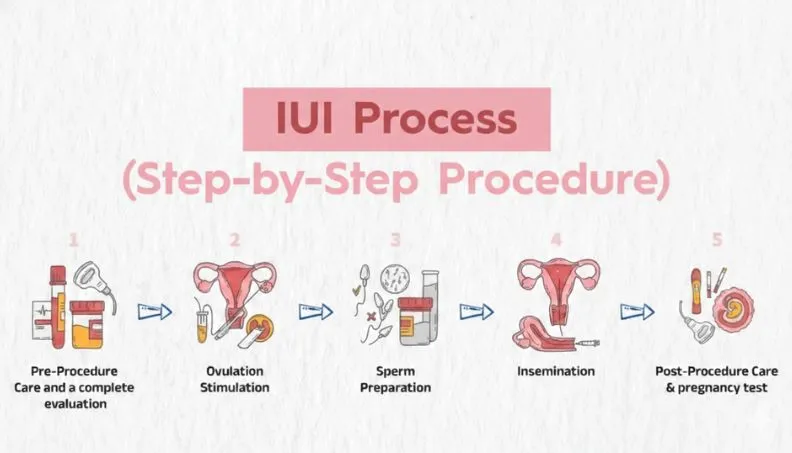
The journey begins on the second or third day of your menstrual cycle with a baseline ultrasound scan.
This is a crucial diagnostic moment where we check the ovaries for any cysts and ensure the uterine lining is ready for a new cycle.
As an IUI specialist in New Delhi, I also use this time to review blood work, specifically looking at hormones like FSH and LH. These tests act as a “green light,” confirming that your body is in the ideal state to begin stimulation.
How do we track egg growth and development?
Once the baseline is clear, we move into the follicular monitoring phase. You may be prescribed mild fertility medications (oral or injectable) to encourage one or two follicles to reach an optimal size.
Throughout the next 10 to 12 days, you will visit our clinic for a few quick “scans.”
We are looking for follicles that measure between 18mm and 20mm, which indicates the egg inside is mature and ready for the IUI Procedure.
Dr Mannan IVF Centre
Experience world-class fertility care with Dr. Mannan Gupta at the Best IVF Centre in Delhi
When is the "trigger shot" administered?
Timing is the heartbeat of a successful IUI cycle. When the follicles reach the right size, we administer a trigger injection of HCG (Human Chorionic Gonadotropin).
This injection tells your body to release the mature eggs approximately 36 hours later. We schedule the insemination precisely around this window to ensure the sperm and egg meet at the perfect moment.
What happens on the day of the IUI procedure?
On the day of the procedure, the male partner provides a semen sample at our IUI treatment hospital in New Delhi.
This sample undergoes “sperm washing,” a specialized lab process that removes debris and concentrates the most motile, healthy sperm into a small volume.
The insemination itself is remarkably simple. We use a thin, flexible catheter to gently place the concentrated sperm through the cervix and directly into the uterine cavity.
Most patients describe it as being no more uncomfortable than a routine pap smear.
How does IUI compare to other fertility treatments?
It is helpful for patients to understand where IUI sits in the spectrum of assisted reproduction. While IUI is often the first step, it differs significantly from advanced procedures like IVF.
Feature | IUI (Intrauterine Insemination) | IVF (In Vitro Fertilization) |
Fertilization | Happens naturally inside the body | Happens in a controlled lab environment |
Surgery | No surgical intervention required | Requires minor surgery (Egg Retrieval) |
Typical Use | Mild male factor or unexplained infertility | Blocked tubes, severe male factor, or age |
Complexity | Low; mimics a natural cycle | High; involves multiple stages and specialists |
If you have questions about which path is right for your specific health history, our IVF Clinic in New Delhi provides comprehensive evaluations to guide your decision.
Why is the "Two-Week Wait" so significant?
After the procedure, the body enters the luteal phase. We often prescribe progesterone support (tablets or gels) to ensure the uterine lining remains thick and welcoming for a potential embryo.
The “two-week wait” is the period it takes for a fertilized egg to implant and for the body to produce enough HCG to be detected.
We advise against taking early home tests, as the “trigger shot” can sometimes cause a false positive result.
Take the First Step Toward Your Family Today
Your path to parenthood deserves a personalized approach backed by clinical excellence. If you are looking for expert guidance or wish to discuss your fertility options, we are here to listen and help.
Book Your Consultation with Dr. Mannan Gupta | Call: +91 9711681986 (Dr. Mannan IVF Centre, Delhi)
What are the recovery and activity guidelines?
There is no need for prolonged bed rest after an IUI. In fact, we encourage you to resume your normal daily routine. Staying active helps maintain good blood flow to the pelvic region.
We do suggest avoiding high-impact exercise or heavy lifting for a few days to minimize pelvic discomfort. Most importantly, focus on a balanced diet and hydration to support your body during the implantation window.
How do we support your emotional wellbeing?
Infertility is as much an emotional journey as a physical one. It is normal to feel a mix of hope and anxiety during this process.
We believe in a patient-first approach, offering a calm environment where your questions are always answered.
If the first cycle is not successful, it is not a reason to lose heart. Many couples find success in the second or third attempt.
We use the data from each cycle to refine our approach, ensuring you receive the most effective care possible.
Conclusion
The IUI process is a refined way of giving nature a helping hand. From that first baseline scan to the final pregnancy test, every step is designed to optimize your chances of success in a safe, controlled, and minimally invasive way.
At Dr. Mannan IVF Centre, Delhi, we are committed to providing you with the transparency and expertise needed to navigate this journey with confidence.
Remember, you aren’t just a patient; you are a partner in this process, and your dream of parenthood is our shared goal.
Frequently Asked Questions
1. Is IUI painful if I have a low pain tolerance?
Most patients find IUI to be very tolerable. It is a non-surgical procedure. If you are very anxious, we use the smallest catheters available to ensure the process is as smooth and quick as possible.
2. Can I drive myself home after the IUI procedure?
Yes, absolutely. Since no sedation or anesthesia is used, you are perfectly fine to drive and go about your day immediately after the 15-minute rest period we provide at the clinic.
3. Does the sperm "fall out" if I stand up after the procedure?
This is a common concern! The answer is no. The sperm is placed directly into the uterine cavity, which is a muscular organ that remains closed. Gravity will not affect your chances of success.
4. What should I do if I experience spotting after the insemination?
Light spotting is quite common and usually occurs because the catheter slightly irritated the cervix. It is not a period and does not mean the procedure failed. If spotting becomes heavy, you should contact our team.
5. Are the success rates different for IUI with donor sperm?
Success rates depend more on the female partner’s age and health. However, because donor sperm is pre-screened for high motility and quality, it often provides a very reliable sample for the washing process.
