

Dr Mannan Gupta
Medically Reviewed by Dr. Mannan Gupta On Mar 23, 2026
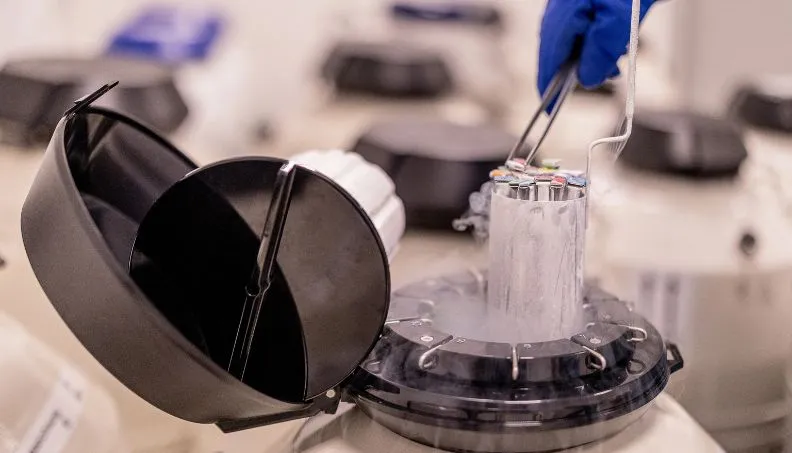
Two of the most common and important questions I hear from women considering fertility preservation are about the longevity and quantity of frozen eggs.
Thanks to a modern freezing technique called vitrification, your eggs can remain frozen indefinitely without any loss of quality, and the ideal number to freeze is typically 15-20 for women under 35.
Hello, I’m Dr Mannan Gupta, an IVF Specialist with over a decade of experience helping individuals and couples build their families.
At our egg freezing specialist clinic in New Delhi, we understand that these two questions are at the heart of your decision.
You want assurance that this investment in your future is both secure and effective. Let’s explore the science and provide the clear, medically-backed answers you deserve.
How Can Eggs Be Stored for So Long?
The key to long-term storage is a technology called vitrification. Unlike older, slow-freezing methods that could form damaging ice crystals within the egg, vitrification is a flash-freezing process.
We place the eggs in a special solution and cool them so rapidly that they turn into a glass-like, solid state without forming ice.
They are then stored in liquid nitrogen at a stable temperature of -196°C. At this temperature, all biological activity stops.
Essentially, your eggs are paused in time, remaining the same quality as the day they were frozen, no matter how many years pass.
Why is My Age So Important in Deciding How Many Eggs to Freeze?
While storage duration is not a concern, your age at the time of freezing is the most critical factor for future success. This is because egg quality—the genetic health of the egg—declines with age.
Younger eggs are more likely to be chromosomally normal. As you get older, a higher percentage of your eggs will have genetic abnormalities.
These eggs are less likely to fertilise, develop into a healthy embryo, or result in a successful pregnancy.
Therefore, to achieve the same chance of having a baby, an older woman needs to freeze a larger number of eggs than a younger woman.
Dr Mannan IVF Centre
Experience world-class fertility care with Dr. Mannan Gupta at the Best IVF Centre in Delhi
What is the Recommended Number of Eggs to Freeze?
The goal of egg freezing is to give you a high probability of having at least one child. Based on extensive data, here are the general recommendations:
- For Women Under 35: Freezing 15 to 20 mature eggs gives you an approximately 70% to 80% chance of at least one live birth. Many women can achieve this number in a single cycle.
- For Women Aged 38 to 40: To achieve a similar chance of success (around 65% to 75%), it’s recommended to freeze 25 to 30 mature eggs. This may require more than one freezing cycle.
- For Women Over 40: The number of eggs required increases significantly, and success rates are lower. A personalised consultation is essential to set realistic goals.
It’s important to remember that these are guidelines. One frozen egg does not equal one baby.
We account for natural attrition at each step: not all eggs will survive the thaw, not all will fertilise, and not all fertilised eggs will become viable embryos.
How Many Eggs Should You Freeze? Age-Based Success Guide
| Age Group | Recommended Eggs to Freeze | Estimated Chance of At Least One Live Birth | Notes |
|---|---|---|---|
| Under 35 | 15–20 mature eggs | ~70%–80% | Often achievable in a single cycle |
| 38–40 years | 25–30 mature eggs | ~65%–75% | May require multiple cycles |
| Over 40 | Higher number required | Lower success rates | Personalised consultation is essential |
What Steps Are Involved in the Egg Freezing Journey?
Your journey at our clinic is designed to be clear, supportive, and efficient.
- Initial Consultation and Testing: We start with a fertility assessment, including a blood test for Anti-Müllerian Hormone (AMH) and an ultrasound. This helps us estimate your ovarian reserve (egg count) and predict your response to treatment.
- Ovarian Stimulation: You will self-administer hormone injections for about 10-12 days. These medications help multiple eggs mature at once, rather than the single egg your body would normally prepare.
- Egg Retrieval: This is a short, minimally invasive procedure performed under light sedation at our freezing eggs hospital. It takes about 15-20 minutes, and you will not feel any discomfort.
- Vitrification and Storage: Our expert embryologists immediately freeze the collected mature eggs and place them into secure, long-term storage.
Ready to Secure Your Fertility Future?
Understanding your personal fertility and creating a plan is a powerful step. Schedule a consultation at Dr. Mannan IVF Centre, a trusted Fertility Clinic in New Delhi, to receive expert, individualised advice. Let us help you determine the right strategy for your family-building goals.
What Can I Expect During Recovery?
Physical recovery from the egg retrieval procedure is typically very quick. Most women experience some mild bloating or cramping, similar to menstrual discomfort, for a day or two.
You can usually resume normal activities the following day, though we advise avoiding intense exercise for about a week.
The emotional side is just as important. It is common to feel a sense of relief and empowerment after taking this proactive step.
Our team provides continuous support and is always available to answer questions and offer reassurance throughout your journey.
What Happens When I'm Ready to Use My Eggs?
When you decide the time is right, the process of using your eggs is straightforward. The eggs are thawed, and we then proceed with an IVF (In Vitro Fertilisation) cycle.
The thawed eggs are fertilised with sperm from your partner or a donor. The resulting embryo is then transferred into your uterus, with the hope of achieving a successful pregnancy.
The age of the eggs, not your current age, will be the primary determinant of success.
Conclusion
Deciding to freeze your eggs is a forward-thinking choice that grants you freedom and control over your reproductive timeline.
With modern vitrification, your eggs can be stored indefinitely, and by freezing an adequate number based on your age, you can give yourself a strong chance of building your family when you are ready.
Our team at Dr Mannan IVF Centre is committed to providing you with the highest standard of medical care and compassionate support to help you navigate this important journey with confidence.
Frequently Asked Questions
1. Is there a legal time limit on how long eggs can be stored in the UK?
Previously, there was a 10-year statutory storage limit. However, the law changed in 2022. Now, you can store your eggs for your own treatment for up to 55 years, provided you renew your consent every 10 years. This gives you much more flexibility.
2. Is it better to freeze eggs or embryos?
This depends entirely on your personal situation. Embryo freezing has slightly higher success rates per transfer because we know the egg has successfully fertilised. However, it requires a sperm source (a partner or donor). Egg freezing is the ideal option for women who are single or not ready to decide on a sperm source, offering complete reproductive autonomy.
3. Does the egg retrieval process hurt my chances of getting pregnant naturally later?
No. The egg freezing process retrieves a group of eggs that your body would have naturally discarded during that specific menstrual cycle. It does not “use up” your future egg supply or impact your ovarian reserve. Your ability to conceive naturally remains unchanged.
4. What happens to my frozen eggs if I decide not to use them?
You have several options. You can choose to have them respectfully discarded, donate them to another individual or couple struggling with infertility (a beautiful act of generosity), or donate them for approved scientific research to help advance the field of reproductive medicine.
5. How many cycles will I need to freeze enough eggs?
This depends on your age and ovarian reserve. A woman under 35 with a good ovarian reserve may be able to freeze 15-20 eggs in a single cycle. An older woman or someone with a lower reserve might need two or three cycles to reach her target number for a high chance of success. We will give you a realistic projection after your initial fertility assessment.
