
Frozen Embryo Transfer (FET) Cost and Procedure in Delhi
Dr Mannan Gupta
Medically Reviewed by Dr. Mannan Gupta On Oct 12, 2026
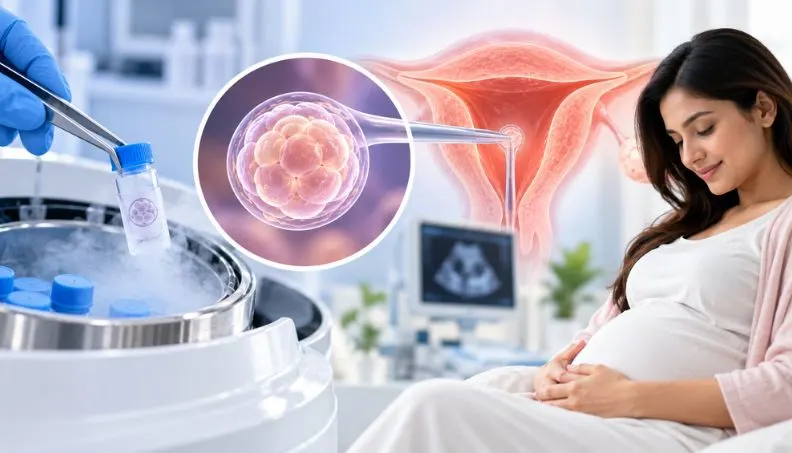
This image is AI-generated and intended for illustrative purposes only.
A Frozen Embryo Transfer (FET) is a fertility treatment in which an embryo that was frozen during an earlier IVF cycle is thawed and transferred into the uterus.
Unlike a fresh IVF cycle, FET usually does not require another round of ovarian stimulation or egg retrieval.
I’m Dr. Mannan Gupta, IVF Specialist at Dr. Mannan IVF Centre in New Delhi, and I often explain FET to patients who already have frozen embryos and want to understand what happens next, how much it may cost, and whether they need another full IVF cycle.
Key Takeaways
- FET uses an embryo that has already been created and frozen during an earlier treatment cycle.
- The uterus can be prepared through a natural cycle or with medicines, depending on your menstrual cycle and clinical situation.
- FET is generally less intensive than a complete IVF cycle because there is no new egg retrieval.
- FET cost in Delhi varies depending on medicines, monitoring, thawing, transfer, storage and other services included in the package.
- Your treatment plan should be decided after assessing your uterus, menstrual cycle, embryo quality and previous IVF history.
What is a frozen embryo transfer and why is it done?
A frozen embryo transfer is the process of thawing a previously frozen embryo and placing it into the uterus at the appropriate time for implantation.
The embryo may have been frozen after an earlier IVF or ICSI cycle because:
- There were additional embryos suitable for future use.
- A fresh transfer was not advisable at that time.
- The couple chose to freeze all suitable embryos.
- Embryos were frozen for fertility preservation or another medical reason.
- The couple wants to try for another pregnancy using embryos already stored.
FET allows you to use an existing embryo without repeating ovarian stimulation and egg collection.
The Assisted Reproductive Technology (Regulation) Act, 2021 provides the legal framework for regulating assisted reproductive technology clinics and banks in India.
How much does frozen embryo transfer cost in Delhi?
There isn’t one fixed FET cost in Delhi because clinics may include different services in their quoted price.
Publicly available Delhi estimates currently range from around ₹25,000 to ₹80,000 or more, depending on whether the quote covers only the transfer or includes medicines, monitoring and other parts of the FET cycle. Some Delhi estimates that bundle more services report costs approaching ₹1 lakh.
The cost may include some or all of the following:
- Consultation and treatment planning
- Ultrasound monitoring
- Endometrial preparation
- Estrogen or progesterone medicines
- Embryo thawing
- Embryo transfer
- Laboratory charges
- Embryo storage, if charged separately
The cost of creating the embryo during the earlier IVF cycle is not normally part of the FET cost.
I recommend asking for an itemised estimate rather than comparing only the headline package price. Two clinics may quote different amounts while including different services.
Call +91 9711681986 to know your exact frozen embryo transfer cost in Delhi.
Dr Mannan IVF Centre
Experience world-class fertility care with Dr. Mannan Gupta at the Best IVF Centre in Delhi
What happens before a frozen embryo transfer?
Before FET, I first need to determine whether your uterus is ready for an embryo transfer and which type of cycle is appropriate for you.
Depending on your menstrual cycle, there are two common approaches.
- Natural-cycle FET
If you have regular ovulation, your natural cycle may be monitored using ultrasound and, when appropriate, hormone or ovulation testing.
The transfer is then timed according to your ovulation and the developmental stage of the embryo.
- Medicated or hormone-prepared FET
If your cycles are irregular or another approach is clinically more appropriate, medicines may be used to prepare the uterine lining.
Estrogen is generally used to help develop the lining, followed by progesterone to create the hormonal environment needed for embryo transfer.
The exact protocol depends on your menstrual pattern, previous treatment, medical history and how your endometrium responds.
The HFEA also describes both natural-cycle and medication-supported approaches to using frozen embryos.
What are the steps involved in an FET cycle?
The FET procedure itself is usually much simpler than egg retrieval because the embryo has already been created and stored.
A typical cycle involves:
- Initial assessment
I review your previous IVF records, embryo information, menstrual cycle and relevant medical history. - Preparing the uterine lining
This may happen naturally or with hormonal medicines. - Ultrasound monitoring
The thickness and appearance of the endometrium are assessed, along with other factors needed to determine the correct timing. - Progesterone and transfer timing
When appropriate, progesterone support is started and the embryo transfer is scheduled according to the embryo’s developmental stage. - Embryo thawing
The embryology team carefully thaws the selected embryo before transfer. The embryo is assessed after warming. - Embryo transfer
A thin catheter is passed through the cervix and the embryo is placed into the uterus. This is generally an outpatient procedure and usually does not require anaesthesia. - Pregnancy testing
Your fertility team will tell you when to have the pregnancy test. Testing too early can create confusion, particularly when hormones or other medicines are involved.
Is FET painful?
Most patients tolerate embryo transfer well, and the procedure is generally not considered painful.
You may feel pressure or mild cramping while the catheter is passed through the cervix. Some women notice mild discomfort afterwards.
The experience is different from egg retrieval because there is no surgical egg collection during FET.
If you have significant pain, heavy bleeding or symptoms that concern you after the procedure, contact your fertility team rather than assuming the symptoms are normal.
How long does a frozen embryo transfer cycle take?
The duration depends on whether you have a natural or medicated cycle and how quickly your uterine lining is ready.
A medicated FET may involve several weeks of preparation, while a natural-cycle FET is timed around your own ovulation.
The transfer itself is brief. The longer part of the process is usually preparing and monitoring the uterine lining and timing the embryo transfer correctly.
If you are trying to understand the complete IVF pathway before reaching the frozen transfer stage, you can read my guide to IVF Treatment in New Delhi.
Does a frozen embryo survive the thawing process?
Most embryos that are suitable for freezing survive the warming process, but embryo survival cannot be guaranteed.
Modern embryo freezing commonly uses vitrification, a rapid freezing technique. After warming, the embryology team checks the embryo before it is prepared for transfer.
The quality and developmental stage of the embryo also matter when discussing what happens after thawing.
Patients sometimes worry that freezing means the embryo has been permanently damaged. I explain that the laboratory assesses the embryo carefully after warming before proceeding with transfer.
What affects the chances of pregnancy after FET?
FET success depends on several factors, not simply on whether the embryo is frozen or fresh.
Important factors include:
- Your age and reproductive history
- The age at which the embryo was created
- Embryo developmental stage and quality
- The condition of the uterus
- Endometrial preparation and timing
- Underlying fertility diagnosis
- Previous IVF or pregnancy history
- Whether the embryo has undergone genetic testing, where relevant
A frozen embryo transfer should therefore not be judged by a single success-rate number found online.
For example, published clinical data can show different outcomes according to age and the population being treated. Individual results can also differ between clinics and patient groups.
Is FET better than a fresh embryo transfer?
Neither approach is automatically better for every patient.
FET has important advantages because it allows an embryo created earlier to be transferred later without another egg retrieval. In some clinical situations, delaying transfer may be appropriate.
However, the decision between fresh and frozen transfer depends on your treatment circumstances, embryo availability, hormonal environment, medical history and clinic protocol.
I don’t recommend choosing fresh or frozen transfer simply because one sounds newer or more successful. The appropriate approach is the one that fits your individual situation.
What should I ask about the FET cost before starting?
Ask exactly what your quoted FET package includes before beginning the cycle.
I suggest asking your clinic:
- Does the price include consultation?
- Are ultrasound scans included?
- Are estrogen and progesterone medicines included?
- Is embryo thawing included?
- Is the embryo transfer procedure included?
- Is embryo storage charged separately?
- Are additional blood tests charged separately?
- What happens to the cost if the transfer is cancelled before the embryo is thawed?
- Are there additional laboratory charges?
This makes it easier to compare clinics fairly.
Get your itemised FET estimate before you commit to a cycle. Book an Appointment with Dr. Mannan Gupta at Dr. Mannan IVF Centre, New Delhi, to go through your embryos, cycle type and the exact cost.
What happens after the embryo transfer?
After FET, you generally continue the medicines prescribed by your fertility specialist and wait for the scheduled pregnancy test.
You don’t need prolonged bed rest after embryo transfer. Normal light daily activity is generally possible unless your doctor gives you specific restrictions.
I also advise patients not to interpret every cramp, sensation or spotting episode as a sign of success or failure. These symptoms alone cannot confirm whether implantation has occurred.
The pregnancy test and subsequent medical assessment are what provide the meaningful answer.
What if my previous IVF or embryo transfer failed?
One unsuccessful embryo transfer does not automatically mean that another transfer will fail.
If you have a frozen embryo available, your doctor may review what happened in the previous cycle before planning the next transfer.
That review may include the embryo, uterine factors, endometrial preparation, timing, hormonal support and the original reason for infertility.
If you have experienced an unsuccessful IVF cycle, you can also read my detailed guide on Why IVF Failed: 7 Real Reasons Doctors Don’t Always Explain.
I don’t believe every patient needs every available test after one unsuccessful transfer. Investigations should be based on your history and the clinical question we are trying to answer.
When should you consult an IVF specialist about FET?
You should discuss FET with a fertility specialist if you already have frozen embryos or are deciding whether to use embryos from a previous IVF cycle.
A consultation is particularly useful if:
- Your menstrual cycles have changed.
- You previously had an unsuccessful embryo transfer.
- Your uterine lining has been difficult to prepare.
- You have experienced recurrent pregnancy loss.
- You have questions about embryo quality or storage.
- You are unsure whether a natural or medicated FET is appropriate.
If you are based in Delhi and want to discuss your frozen embryos, treatment history and possible next steps, you can find Dr. Mannan IVF Centre in New Delhi for an individual assessment.
Frequently Asked Questions
1. Is frozen embryo transfer cheaper than IVF?
Yes, FET is usually less expensive than a complete fresh IVF cycle because ovarian stimulation and egg retrieval are not repeated. The exact cost depends on what the clinic includes in the FET package.
2. Can I have FET without taking injections?
Yes, some patients can undergo a natural-cycle FET if they ovulate regularly. Others may need hormonal preparation, so the protocol is decided individually.
3. How many embryos are transferred during FET?
The number depends on your individual treatment plan and the embryo-transfer strategy recommended by your fertility team. Single embryo transfer is commonly used when appropriate to reduce the risks associated with multiple pregnancy.
4. Can a frozen embryo transfer fail even if the embryo looks good?
Yes. Embryo appearance is only one factor in implantation. Uterine factors, embryo characteristics and other patient-specific factors can influence the outcome.
5. Can I use a frozen embryo years after IVF?
Yes, embryos can be stored for later use subject to applicable regulations, storage arrangements and valid consent. Your clinic will explain the storage requirements that apply to your embryos.
6. Do I need another egg retrieval before FET?
No. FET uses an embryo that has already been created and frozen, so another egg retrieval is not required for that transfer cycle.
7. Can I do FET after a failed IVF cycle?
Yes, if you have suitable frozen embryos available. Your doctor may first review the previous cycle and decide whether any changes are appropriate before planning the next transfer.
8. Is bed rest required after FET?
No. Prolonged bed rest is not routinely required after embryo transfer. Your fertility team may give you specific advice based on your individual situation.
Final Thoughts
A frozen embryo transfer can be an important next step for couples who already have embryos in storage. It avoids repeating ovarian stimulation and egg retrieval, but the preparation and timing still need careful planning.
There is no single FET protocol or cost that is right for everyone. Your embryo history, uterine condition, menstrual cycle and previous treatment should guide the plan.
If you’re considering FET in Delhi, I recommend discussing the treatment plan and getting a clear, itemised cost estimate before starting.
Medical Disclaimer:
This article is intended for general educational purposes only. It does not replace an individual consultation, physical examination, diagnosis, medical evaluation or personalised fertility treatment plan. FET suitability, medicines, timing and expected outcomes should be discussed with a qualified fertility specialist.
