

Dr Mannan Gupta
Medically Reviewed by Dr. Mannan Gupta On Aug 20, 2026
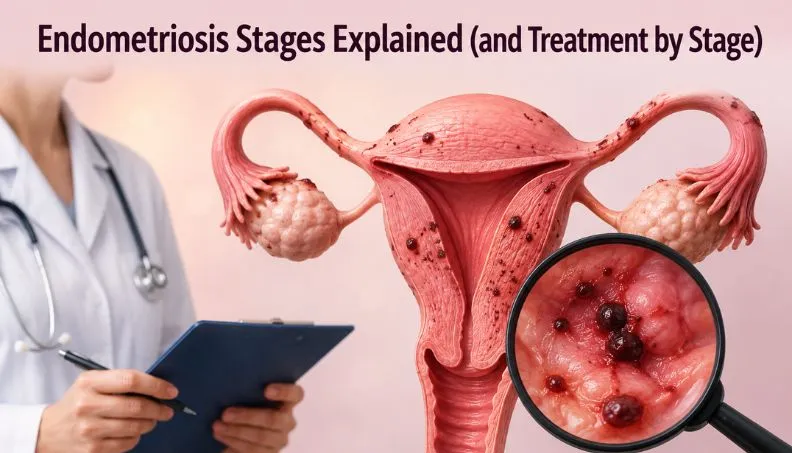
If you’ve just been told you have “stage 3 endometriosis” and you’re now sitting with your phone, trying to figure out how worried to be, let’s slow down for a second.
I’m Dr. Mannan Gupta, IVF Specialist and Obstetrician & Gynaecologist at Dr. Mannan IVF Centre in New Delhi, and one thing I tell every patient at this point is simple: your stage number tells us about the extent of the disease, not necessarily how much pain you’re in or what your future looks like.
If you’re considering stage 3 endometriosis treatment in Delhi, understanding what your stage means is an important first step.
Let’s go through what each stage actually means and what treatment may look like at each one.
Key Takeaways
- Endometriosis has four recognized stages, from minimal to severe, based on the number, size, and depth of lesions
- A lower stage does not mean less pain. Some women with stage 1 disease have significant symptoms
- Staging is confirmed during laparoscopy, not through imaging alone
- Treatment is tailored to your stage, symptoms, and whether you’re trying to conceive
- Fertility treatment, including IVF, becomes a more common conversation at stage 3 and stage 4
What Do the "Stages" of Endometriosis Actually Mean?
The stages describe how much endometriosis tissue is present and how deep it goes, not how severe your symptoms feel.
- The most widely used system, developed by the American Society for Reproductive Medicine (ASRM), ranges from Stage 1 (minimal) to Stage 4 (severe).
- Staging looks at the number of lesions, their size, location, and how deeply they’ve infiltrated the tissue.
- This system was originally designed to help predict fertility outcomes, not to measure pain. I explain this to almost every patient, because the terminology can feel more frightening than it needs to.
- A “stage 1” label doesn’t mean your symptoms are minor. It means the visible disease extent, at the time of surgery, was limited.
How Is Your Stage Determined?
Your stage is confirmed during laparoscopic surgery, when your doctor can directly see and, if needed, biopsy the affected areas.
- Imaging like ultrasound or MRI can suggest the presence of endometriosis, but the formal stage is assigned based on surgical findings.
- During laparoscopy, we assess lesion size, depth, and whether there are adhesions, which are bands of scar tissue that can bind pelvic organs together.
- Ovarian cysts caused by endometriosis, often called chocolate cysts, are commonly found from stage 3 onward, and they factor heavily into the staging score.
- If you’ve already read about how endometriosis is diagnosed, this is the natural next step, staging happens once a surgical diagnosis is made. For a plain-language overview of how the diagnosis and laparoscopy process works, the U.S. National Library of Medicine’s MedlinePlus page on endometriosis is a reliable starting point.

Dr Mannan IVF Centre
Experience world-class fertility care with Dr. Mannan Gupta at the Best IVF Centre in Delhi
What Do Stage 1 and Stage 2 Look Like, and How Are They Treated?
Stage 1 and 2 involve smaller, shallower implants, and treatment usually starts with the least invasive options first.
- Stage 1 (minimal) means a few small, shallow implants, typically on the peritoneum, the lining of the abdominal cavity.
- Stage 2 (mild) involves slightly more implants, still relatively shallow.
- First-line treatment at these stages is usually medication, not surgery, including anti-inflammatory painkillers and hormonal birth control to help control the disease’s activity.
- Fertility is generally less affected at this stage, though it varies by individual case.
- Many women manage well long-term at stage 1 or 2 with the right hormonal treatment plan and regular monitoring.
What Do Stage 3 and Stage 4 Look Like, and How Are They Treated?
Stage 3 and 4 involve deeper implants, larger cysts, and more significant scarring, and treatment often needs to be more involved.
Surgery to remove endometriosis tissue and cysts is more commonly recommended at these stages, particularly when pain is significant or fertility is a concern — I go through what this actually involves, using minimally invasive techniques, on our fertility enhancing surgery page.
- Stage 3 (moderate) typically includes deeper implants and cysts on at least one ovary, along with early adhesion formation.
- Stage 4 (severe) is the most extensive, with large cysts, widespread adhesions, and sometimes involvement of the bowel or bladder.
- Surgery to remove endometriosis tissue and cysts is more commonly recommended at these stages, particularly when pain is significant or fertility is a concern.
- Fertility is more likely to be affected here, since adhesions can physically obstruct the fallopian tubes or damage ovarian function.
- This is often where the conversation shifts toward IVF, especially if natural conception hasn’t been successful after surgical treatment.
Does a Higher Stage Always Mean Worse Pain?
No, and this is one of the most misunderstood parts of an endometriosis diagnosis.
- Pain severity and disease stage don’t move in a straight line together. A woman with stage 1 disease can experience debilitating pain, while someone at stage 3 may have relatively mild symptoms.
- The stage tells us about the physical extent of the disease, not your day-to-day experience of it.
- I always ask patients to describe their actual symptoms in detail, rather than relying on the stage number alone to guide how we manage their care.
- The disease also doesn’t necessarily progress from stage to stage over time. Some women stay at the same stage for years, while others see changes more quickly, and we don’t fully understand why that varies.
How Does Your Stage Affect Fertility and Family Planning?
Your stage plays a real role in fertility planning, but it doesn’t determine the outcome on its own.
- At stage 1 and 2, many women conceive without needing fertility treatment, though monitoring is still worthwhile if you’re trying.
- At stage 3 and 4, adhesions and cysts can make natural conception harder, and this is when I more often discuss options like surgical treatment followed by monitored conception attempts, or moving toward IVF.
- IVF can be a genuinely effective path forward for many women with more advanced endometriosis, since it bypasses some of the physical obstacles the disease creates.
- If you want to understand what that process actually looks like step by step, our guide to IVF treatment in New Delhi covers it in detail.
- Your stage is one factor among several. Age, ovarian reserve, and your partner’s fertility factors all matter just as much when we’re building a plan together.
If your stage has been confirmed and you’re trying to understand what it means for your fertility specifically, I see patients for endometriosis-related fertility planning at Dr. Mannan IVF Centre in New Delhi. You can reach the clinic directly at 97116 81986 to discuss your specific case.
What Does Long-Term Management Look Like at Any Stage?
Regardless of your stage, endometriosis is a long-term condition that needs an ongoing plan, not a one-time fix.
- Regular follow-up, whether through symptom tracking, periodic ultrasounds, or hormonal treatment adjustments, helps manage the condition over years, not just after diagnosis.
- Pain that returns or changes should always be discussed, since this can signal that your treatment plan needs adjusting.
- Emotional support matters as much as medical treatment. Living with a chronic condition that affects fertility and daily comfort takes a toll, and that’s a valid part of your care too.
- No matter your stage, you have real treatment options. This isn’t a condition where you’re simply told to wait and see.
Conclusion
Your endometriosis stage is a useful piece of information for planning treatment, but it’s not a verdict on how much pain you’ll live with or whether you’ll be able to conceive.
Stage 1 patients can have serious symptoms, and stage 4 patients can still build the family they’re planning for.
What matters most is having a treatment plan that’s actually built around your symptoms and your goals, not just a number from a surgical report.
If you have questions about your own stage or what comes next, that’s exactly the conversation worth having with your doctor.
Frequently Asked Questions
Can I move from a lower stage to a higher stage over time?
It’s possible, though the disease doesn’t progress in a predictable or guaranteed way, and some women stay at the same stage for years without change.
Is stage 4 endometriosis considered an emergency?
Not typically an emergency, but it usually needs a more active treatment plan given the extent of the disease, so timely evaluation matters.
Can endometriosis be cured completely at any stage?
No, there’s currently no cure, but symptoms at every stage can be effectively managed with the right combination of medical and, when needed, surgical treatment.
Do I need surgery again if my endometriosis comes back after treatment?
Recurrence is possible, and whether repeat surgery is needed depends on your symptoms and specific findings at that time, which is best assessed individually.
Does birth control help at every stage, or only early stages?
It can help manage symptoms at multiple stages, though its effectiveness as the sole treatment tends to be more limited in more advanced disease.
Can I get a second opinion on my stage after laparoscopy?
Yes, and if your treatment plan doesn’t feel right for your symptoms or goals, seeking a second opinion is a reasonable step.
Is it possible to have endometriosis with no visible stage assigned yet?
Yes, if you haven’t had laparoscopic surgery, your doctor may treat you clinically based on symptoms and imaging before an official stage is confirmed.
Does menopause affect endometriosis at any stage?
Symptoms often improve after menopause as hormone levels drop, though this isn’t guaranteed for every woman or every stage.
Can stage 1 or 2 endometriosis still cause infertility?
It’s less common, but it can happen, which is why symptom-based evaluation matters even at earlier stages if you’re trying to conceive.
How often should I be reassessed once my stage is known?
This depends on your treatment plan and symptoms, but regular follow-up, rather than a one-time evaluation, is the standard approach for ongoing management.
Medical Disclaimer:
This content is for general educational purposes only and does not replace professional medical advice, diagnosis, or treatment.
If you are managing endometriosis, your care should be tailored to your specific stage, symptoms, and fertility goals. Please consult a qualified gynaecologist for personalized guidance or to book an appointment.
