

Dr Mannan Gupta
Medically Reviewed by Dr. Mannan Gupta On Nov. 17, 2026
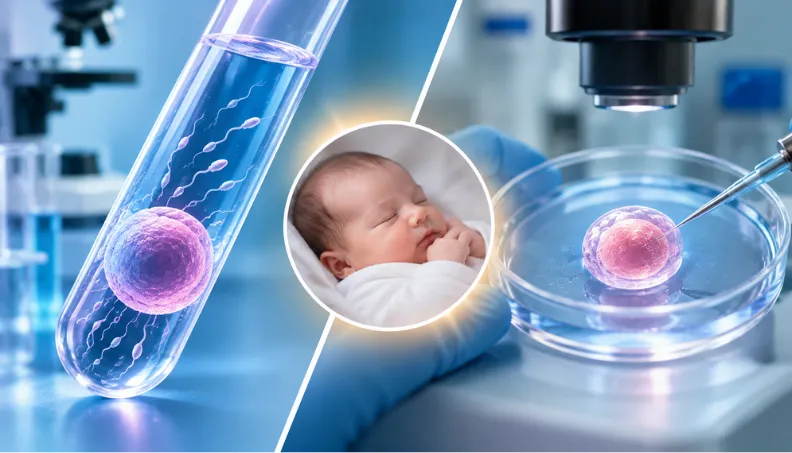
This image is AI-generated and intended for illustrative purposes only.
Many couples use the terms test tube baby and IVF as if they describe two different fertility treatments. This often leads to questions about whether one procedure is more advanced, safer or more effective than the other.
The simple answer is that a test tube baby and an IVF baby refer to the same method of conception. IVF stands for In Vitro Fertilisation, which means that an egg and sperm are brought together outside the body in a laboratory. The term “test tube baby” is a popular expression used to describe a child conceived through this treatment.
As an IVF specialist, I explain to patients that the name may sound unusual, but the process is a well-established form of assisted reproduction. The baby does not grow inside a test tube.
Only fertilisation and the early stages of embryo development take place in the laboratory. If the embryo implants successfully after transfer, pregnancy develops inside the uterus.
Key Takeaways
- Test tube baby and IVF refer to the same fertility treatment.
- IVF is the medical term, while test tube baby is a commonly used informal expression.
- Fertilisation takes place in a laboratory dish, not inside an ordinary test tube.
- The embryo is transferred to the uterus, where pregnancy develops.
- ICSI is a laboratory technique that may be used as part of an IVF cycle. It is not a separate name for a test tube baby.
- IVF may be recommended for different fertility conditions, depending on the couple’s medical assessment.
What Is a Test Tube Baby?
A test tube baby is a child conceived through in vitro fertilisation (IVF). The term became popular because fertilisation takes place outside the woman’s body in a laboratory.
During natural conception, an egg and sperm usually meet in the fallopian tube. In IVF, eggs are collected from the ovaries and brought together with sperm in a specialised laboratory environment. If fertilisation occurs, the resulting embryo is observed as it develops.
An embryo considered suitable for transfer may then be placed into the woman’s uterus. If implantation occurs and the pregnancy progresses, the baby develops inside the uterus.
The expression “test tube baby” can create the impression that a baby grows in a glass tube. This is not what happens. The laboratory supports only fertilisation and early embryo development. The rest of the pregnancy takes place inside the uterus.
What Is IVF and What Does It Stand For?
IVF stands for In Vitro Fertilisation. “In vitro” means outside a living body, while fertilisation refers to the joining of an egg and sperm.
IVF is a fertility treatment in which eggs are retrieved from the ovaries and fertilised with sperm in a laboratory. This matches how the NIH’s National Library of Medicine describes IVF as the most common and effective type of assisted reproductive technology.
A fertility specialist may recommend IVF when a person or couple has difficulty conceiving and the treatment is considered appropriate for their medical circumstances.
IVF may be considered in situations such as:
- Blocked or damaged fallopian tubes
- Certain types of male-factor infertility
- Endometriosis affecting fertility
- Ovulation-related fertility difficulties in selected cases
- Unexplained infertility after appropriate evaluation
- Previous fertility treatment that has not resulted in pregnancy
- Certain situations where genetic testing of embryos may be medically considered
The need for IVF depends on the cause of infertility, age, ovarian reserve, sperm parameters, reproductive history and other clinical findings. It is not automatically the first treatment for every couple.

Dr Mannan IVF Centre
Experience world-class fertility care with Dr. Mannan Gupta at the Best IVF Centre in Delhi
Is There Any Difference Between a Test Tube Baby and IVF?
There is no difference in the underlying fertilisation method. The two expressions refer to the same type of conception, although they are used differently.
Test Tube Baby | IVF |
Informal or popular expression | Medical term |
Commonly used to describe a child conceived through IVF | Refers to the fertility treatment |
Associated with fertilisation outside the body | Eggs and sperm are combined in a laboratory |
Not a separate treatment procedure | Standard clinical terminology used by fertility specialists |
In everyday conversation, people often say “test tube baby treatment” when they mean IVF treatment. There is no separate procedure that produces a test tube baby apart from IVF.
How Does the Test Tube Baby or IVF Process Work?
The test tube baby process follows the same main stages as an IVF cycle. The exact treatment plan may differ depending on the patient’s age, ovarian response, medical history and fertility diagnosis.
1. Fertility Assessment and Treatment Planning
The first step is to understand why pregnancy has not occurred. The specialist reviews the couple’s medical and reproductive history and may recommend investigations such as hormone tests, ultrasound assessment and semen analysis.
The findings help determine whether IVF is appropriate and which treatment approach may be considered.
2. Ovarian Stimulation
Medicines may be prescribed to stimulate the ovaries to develop multiple follicles. Follicles are fluid-filled structures that may contain developing eggs.
The response is monitored through ultrasound scans and, when required, blood tests. Medication and monitoring schedules are individualised.
3. Egg Retrieval
When the follicles are considered ready, a trigger medication may be given at a planned time. Eggs are then collected through a procedure performed under appropriate sedation or anaesthesia.
The retrieved eggs are assessed by the embryology team.
4. Sperm Collection and Fertilisation
A semen sample is collected and processed in the laboratory. The eggs and sperm are then brought together for fertilisation.
Depending on the clinical indication, the embryologist may use conventional IVF or a technique called intracytoplasmic sperm injection (ICSI).
5. Embryo Development and Assessment
If fertilisation occurs, the embryos are monitored in the laboratory as they develop. The embryology team assesses their development and suitability for transfer or freezing.
Not every retrieved egg will fertilise, and not every fertilised egg will develop into an embryo suitable for transfer.
6. Embryo Transfer
An embryo selected for transfer is placed into the uterus using a thin catheter. The procedure is generally performed without major surgery.
The specialist may recommend a fresh or frozen embryo transfer depending on the treatment plan and clinical findings.
7. Pregnancy Testing
A pregnancy blood test is scheduled after embryo transfer at the time advised by the clinic. Testing too early may not provide a reliable result.
A positive test is followed by medical monitoring and an ultrasound at the appropriate stage to assess the pregnancy.
Does a Test Tube Baby Actually Grow Inside a Test Tube?
No. A baby does not grow inside a test tube or laboratory container.
Only the fertilisation process and the early stages of embryo development take place in the embryology laboratory. Once an embryo is transferred and implants successfully, pregnancy develops inside the uterus.
The uterus provides the environment in which the pregnancy continues. The baby grows through the usual stages of pregnancy, whether conception occurred naturally or through IVF.
This is an important distinction because the phrase “test tube baby” can be misunderstood. It describes the method of conception, not where a baby grows throughout pregnancy.
Is IVF Different From ICSI?
Yes. IVF and ICSI are related, but they are not identical procedures.
In conventional IVF, eggs and prepared sperm are placed together in a laboratory dish so that fertilisation can occur.
In ICSI (Intracytoplasmic Sperm Injection), an embryologist injects a single sperm directly into a mature egg using specialised equipment.
ICSI may be considered in certain situations, including some cases of male-factor infertility or when previous fertilisation results indicate a possible need for this technique.
ICSI is performed as part of an IVF treatment cycle. It does not replace the other stages, such as egg retrieval, embryo development and embryo transfer. You can read more about both techniques on our IVF-ICSI Treatment page.
Is IVF the Same as IUI?
No. IVF and IUI are two different fertility treatments.
In intrauterine insemination (IUI), prepared sperm is placed directly into the uterus around the time of ovulation. Fertilisation is expected to occur inside the woman’s reproductive tract.
In IVF, eggs are retrieved from the ovaries and fertilised with sperm in a laboratory. An embryo is then transferred into the uterus.
Factor | IUI | IVF |
Fertilisation | Usually occurs inside the body | Takes place in a laboratory |
Egg retrieval | Not required | Required |
Sperm preparation | Yes | Yes |
Embryo development | Inside the body | Initially in the laboratory |
Embryo transfer | Not performed | Performed as part of treatment |
The choice between IUI and IVF depends on the fertility diagnosis, age, reproductive history and other medical factors. We’ve compared the cost and clinical differences between the two in Understanding the Average Cost of IUI Treatment in India.
Are Test Tube Babies Healthy Like Other Babies?
Children conceived through IVF can grow and develop like children conceived naturally. The method of conception does not mean that a child is abnormal or that the pregnancy will necessarily have complications.
However, it would not be medically accurate to say that IVF carries no risks. Pregnancy outcomes can be influenced by maternal age, underlying health conditions, the cause of infertility, the number of embryos transferred and other factors.
IVF pregnancies may also require closer monitoring in certain circumstances. Your doctor can explain the relevant risks based on your individual medical history.
The important point is that the term test tube baby does not describe a different kind of child. It refers to conception through IVF.
Is a Test Tube Baby Treatment More Expensive Than IVF?
There is no separate cost for a test tube baby procedure compared with IVF because they refer to the same treatment.
The total IVF cost depends on the treatment plan and the services required.
We’ve broken down exactly what drives this cost, stage by stage, in IVF Cost in Delhi: What You’re Actually Paying For.
Factors that may affect the estimate include:
- Fertility investigations and consultations
- Ovarian stimulation medicines
- Ultrasound and blood test monitoring
- Egg retrieval and related procedures
- Conventional IVF or ICSI, if indicated
- Embryo culture and assessment
- Embryo freezing and storage, if required
- Frozen embryo transfer, if planned
Some patients may need additional procedures or more than one treatment cycle. Therefore, a clinic should provide an itemised estimate based on the proposed treatment rather than relying on a general advertised price.
When Should You Consult an IVF Specialist?
Consider consulting a fertility specialist if you have been trying to conceive without success, have a known reproductive health condition or have been advised that assisted reproductive treatment may be appropriate.
A medical consultation can help identify possible causes of infertility and clarify whether timed intercourse, ovulation treatment, IUI or IVF may be suitable.
I encourage couples not to choose a treatment only because of its name or what they have heard from others. The right approach depends on the medical findings of both partners.
If you are considering IVF, you can discuss your fertility concerns and treatment options with a specialist at Dr. Mannan IVF Centre in New Delhi.
FAQs About Baby Gender Selection Through IVF in India
1. Is a test tube baby the same as an IVF baby?
Yes. A test tube baby is a popular term for a baby conceived through IVF. Both expressions refer to the same method of conception.
2. What is the difference between IVF and a test tube baby?
There is no difference in the medical procedure. IVF is the scientific term for the treatment, while test tube baby is an informal expression used to describe a child conceived through IVF.
3. Does a baby grow inside a test tube during IVF?
No. Fertilisation and early embryo development take place in a laboratory. After embryo transfer and successful implantation, the pregnancy develops inside the uterus.
4. Is ICSI another name for a test tube baby?
No. ICSI is a laboratory fertilisation technique that may be used during an IVF cycle. It involves injecting a single sperm directly into a mature egg.
5. Is IVF the same as artificial insemination?
No. IVF involves fertilising an egg outside the body in a laboratory. In intrauterine insemination, or IUI, prepared sperm is placed into the uterus and fertilisation is expected to occur inside the body.
6. Is the test tube baby process painful?
Some stages, such as ovarian stimulation, may involve injections and temporary discomfort. Egg retrieval is performed with appropriate pain relief or anaesthesia. The experience varies between patients, so the treating team should explain what to expect.
7. Can a test tube baby be born through a normal delivery?
Yes. IVF does not automatically mean that a caesarean delivery is required. The mode of delivery depends on the mother’s health, pregnancy progress, the baby’s position and other obstetric considerations.
8. Is IVF suitable for every couple who cannot conceive naturally?
No. IVF is one of several fertility treatment options. The appropriate approach depends on the cause of infertility, age, test results and reproductive history. Some patients may be suitable for other treatments.
Final Thoughts
Test tube baby and IVF are two expressions for the same fertility treatment. IVF is the medical term, while test tube baby is a familiar expression used by many people.
During IVF, eggs and sperm are brought together in a laboratory. If an embryo develops and is transferred successfully, pregnancy continues inside the uterus. The baby does not grow inside a test tube.
If you are exploring fertility treatment, understanding the terminology is a useful first step. A consultation with an IVF specialist can help you understand the cause of infertility and the treatment options that may be appropriate for you.
Medical Disclaimer:
This article is intended for general educational purposes and does not replace individual medical advice, diagnosis or treatment. IVF procedures, suitability and outcomes vary according to individual medical circumstances. Consult a qualified fertility specialist for an assessment before making treatment decisions.
