

Dr Mannan Gupta
Medically Reviewed by Dr. Mannan Gupta On Aug 07, 2026

If you’ve spent the last few nights searching “IVF cost in Delhi” and closing ten tabs with ten different numbers, you’re not alone.
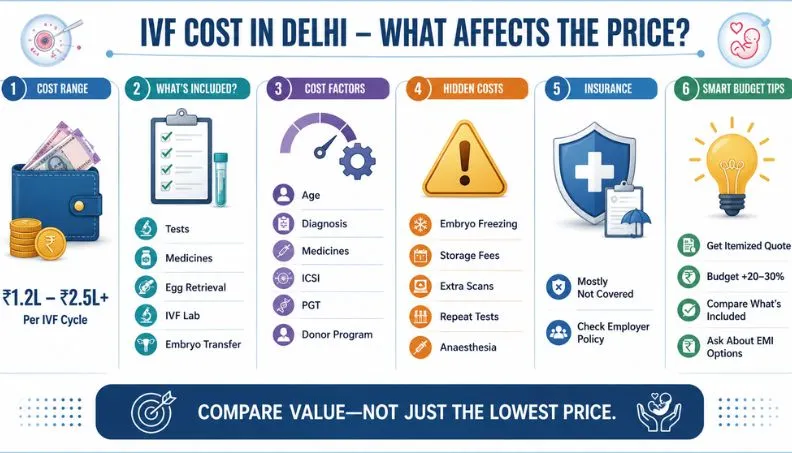
The honest answer is that a single IVF cycle in Delhi usually falls between ₹1.2 lakh and ₹2.5 lakh, though it can go higher depending on what your specific case needs.
I’m Dr. Mannan Gupta, IVF Specialist and Obstetrician-Gynaecologist at Dr. Mannan IVF Centre in New Delhi, and I want to walk you through where that money actually goes, because a number without context isn’t very useful to a couple trying to plan.
Key Takeaways
- IVF cost in Delhi typically ranges from ₹1.2 lakh to ₹2.5 lakh per cycle, before add-ons
- The final bill depends on your diagnosis, medication response, and any extra procedures like ICSI or genetic testing
- Cheaper quotes often exclude medicines, freezing fees, or repeat tests — ask what’s included upfront
- IVF is largely not covered by health insurance in India, though some newer policies are starting to change this
- Planning cycle-by-cycle, not just for one attempt, gives you a more realistic budget
What Does IVF Actually Cost in Delhi?
A base IVF cycle in Delhi generally costs between ₹1.2 lakh and ₹2.5 lakh, with well-established clinics sometimes charging more. I tell my patients not to anchor too hard on any single figure they see online.
- Base package price covers monitoring, egg retrieval, lab work, and embryo transfer, but not always medication
- Clinic reputation and location push prices up, especially in central and south Delhi
- Your specific diagnosis changes what’s needed — a straightforward case costs less than one involving male infertility or poor egg reserve
- First-time patients often underestimate medication cost, which can be a third or more of the total bill
If you want to understand what a full IVF evaluation and treatment plan actually involves before comparing quotes, our IVF Treatment in New Delhi page outlines the clinical approach at Dr. Mannan IVF Centre, including what the protocol design process looks like for different patient profiles.
Why Does the Quote I Got Differ From What Another Clinic Told Me?
Two clinics can quote very different numbers for the same treatment because they’re not always quoting the same list of inclusions. This is where most confusion comes from, and it’s a fair thing to be frustrated about.
- Some quotes are package prices that bundle everything; others are stage-wise, so the number you see is only the starting point
- Stimulation medication is priced separately in many clinics and varies by brand, dose, and how many days you need injections
- ICSI (a lab technique where a single sperm is injected directly into an egg) is often an add-on, not part of the base fee
- Ask directly: does this price include medicines, anaesthesia, embryo freezing, and the transfer itself, or are those separate line items?
Knowing exactly what questions to ask before you commit is the most effective way to compare clinics fairly. Our guide on how to choose an IVF clinic in Delhi gives you a structured list of the right questions to put to any clinic before signing anything.

Dr Mannan IVF Centre
Experience world-class fertility care with Dr. Mannan Gupta at the Best IVF Centre in Delhi
What Are the Actual Stages I'm Paying For?
IVF isn’t one bill, it’s four or five smaller ones that happen over roughly four to six weeks. Breaking it down this way makes the total feel less abstract.
- Initial workup: blood tests, AMH levels (a hormone test that estimates egg reserve), ultrasounds, and semen analysis for your partner.
- AMH is one of the most important tests in this phase because it directly shapes how much stimulation medication you will need patients with lower reserve typically require higher doses, which increases that part of the bill. If you have already received an AMH result and want to understand what it means for your protocol and cost, our guide on what AMH levels mean and how they predict IVF success explains the numbers in plain language.
- Ovarian stimulation: daily injections for about 10-14 days to help your ovaries produce multiple eggs, monitored through repeat ultrasounds and blood work
- Egg retrieval and lab work: a short procedure under sedation, followed by fertilization in the lab, with ICSI added if sperm quality needs it
- Embryo transfer: placing the embryo in the uterus, plus medication support afterward to help it implant
- Optional add-ons: genetic testing of embryos (PGT), embryo freezing, or a frozen embryo transfer in a later cycle
What Factors Actually Push the Cost Up or Down?
Your age, your diagnosis, and how your body responds to medication matter more than which clinic you pick. I say this because patients sometimes assume the most expensive option guarantees the best outcome, and that’s not automatically true.
- Age affects both egg quality and how much medication you need — younger patients often need lower doses
- Diagnosis complexity, such as low ovarian reserve or severe male-factor infertility, can mean extra procedures
- Donor eggs or donor sperm, if needed, add a separate and significant cost on top of the base cycle
- How many eggs you produce changes your medication bill, since stimulation drugs are often priced by dose
- Repeat cycles, if the first doesn’t succeed, mean the diagnostic and stimulation costs happen again
One add-on that affects cost significantly for older patients or those with prior failed cycles is PGT-A — preimplantation genetic testing that screens embryos for chromosomal abnormalities before transfer.
Whether it’s worth the additional cost depends on your specific situation; our guide on PGT-A Testing in IVF: Success Rate and Benefits explains who benefits most and what the evidence actually shows.
Does Insurance Cover Any of This in Delhi?
Most standard health insurance policies in India still don’t cover IVF, though this is slowly starting to shift. I’d rather tell you this plainly now than have you find out after budgeting around the assumption that it’s covered.
- Diagnostic tests leading up to IVF are sometimes reimbursable even when the procedure itself isn’t
- A small but growing number of insurers have begun offering fertility riders or maternity add-ons that include partial IVF cost
- Check your policy’s exclusion list specifically, not just the general maternity clause, since IVF is often listed separately
- If you’re employed, ask HR whether your corporate group policy has any fertility benefit, some larger companies now include this
What Hidden Costs Do Patients Usually Miss?
The number a clinic quotes you at the first consultation is rarely the number you end up paying, and that’s the part most cost articles skip entirely.
- Embryo storage fees if you freeze embryos for a future cycle, charged annually
- Cancelled cycle costs, since you’ve already paid for medication and monitoring even if the cycle doesn’t proceed to retrieval
- Repeat blood work or scans if your first round of monitoring shows something that needs a closer look
- Anaesthesia and hospital charges for the retrieval procedure, sometimes billed separately from the IVF package itself
- Medication brand differences — a generic and a branded version of the same hormone can differ substantially in price
How Should I Actually Plan My IVF Budget?
Plan for more than one cycle, not because I expect you to need it, but because budgeting for one attempt only sets you up to feel like a failure if it doesn’t work the first time. This is as much about your emotional planning as your financial one.
- Ask your clinic for a written, itemised estimate, not a verbal round number
- Budget 20-30% above the quoted base price to cover medication variability and monitoring
- If cost is a real constraint, ask about EMI options or staged payment plans, which many Delhi clinics now offer
- Consider whether frozen embryo transfer in a later cycle, using embryos from your first retrieval, is more cost-effective than starting fresh each time
If you’re trying to make sense of your own numbers rather than a general range, I’d rather look at your specific case directly. I see patients at Dr. Mannan IVF Centre in New Delhi for fertility evaluations and IVF planning, and a proper consultation gives you a cost estimate built around your actual diagnosis, not an average pulled from the internet. You can reach the centre at 9711681986.
Final Thoughts
The number that matters isn’t the one you saw on a website, it’s the one built around your specific diagnosis, your medication response, and what stage of treatment you actually need.
IVF cost in Delhi varies as much as it does because every patient’s protocol is different, not because clinics are being inconsistent for no reason.
Ask for an itemised quote, understand what’s excluded, and budget with some room for the parts that don’t show up in the first estimate.
That’s how you walk into this with a realistic plan instead of anxiety about a number nobody explained properly.
Frequently Asked Questions
Does the IVF cost in Delhi include medicines?
Not always. Some clinics bundle medication into the package price, while others bill it separately based on your actual dose, so always confirm this before you commit to a quote.
Why did my IVF cost more than the estimate I was given?
This usually happens when your stimulation needed a higher medication dose than expected, or when an add-on like ICSI or a repeat scan became necessary partway through the cycle.
Is a cheaper IVF clinic in Delhi worth considering?
Price alone doesn’t tell you about the clinic’s experience or success rates, so it’s worth asking what’s excluded from a low quote before assuming it’s a better deal.
How much does donor egg IVF cost compared to a regular cycle?
Donor egg cycles typically cost more than a standard self-cycle because donor screening, compensation, and coordination add separate charges on top of the base IVF cost.
Can I do IVF in stages to spread out the cost?
Yes, many patients do the egg retrieval and freezing in one phase, then a frozen embryo transfer later, which can help spread expenses across a longer timeline.
Does age affect how much I'll spend on IVF?
Yes, younger patients often need lower medication doses and fewer cycles, while older patients or those with lower egg reserve sometimes need adjusted protocols that cost more.
What happens financially if my IVF cycle gets cancelled midway?
You’d still be responsible for the medication and monitoring costs already incurred up to that point, even though the cycle didn’t proceed to retrieval or transfer.
Are there government schemes that help with IVF cost in Delhi?
Some public hospitals in Delhi offer subsidised fertility treatment, though availability and eligibility criteria vary, so it’s worth checking directly with government hospitals if cost is a major concern.
Is ICSI always included in the IVF cost, or is it extra?
ICSI is usually an additional charge on top of standard IVF, recommended specifically when sperm quality or count is a factor in your infertility diagnosis.
How many IVF cycles do most couples need before success?
This varies significantly by individual case, and I’d rather discuss your specific likelihood based on your diagnosis than quote a generic number that may not apply to you.
